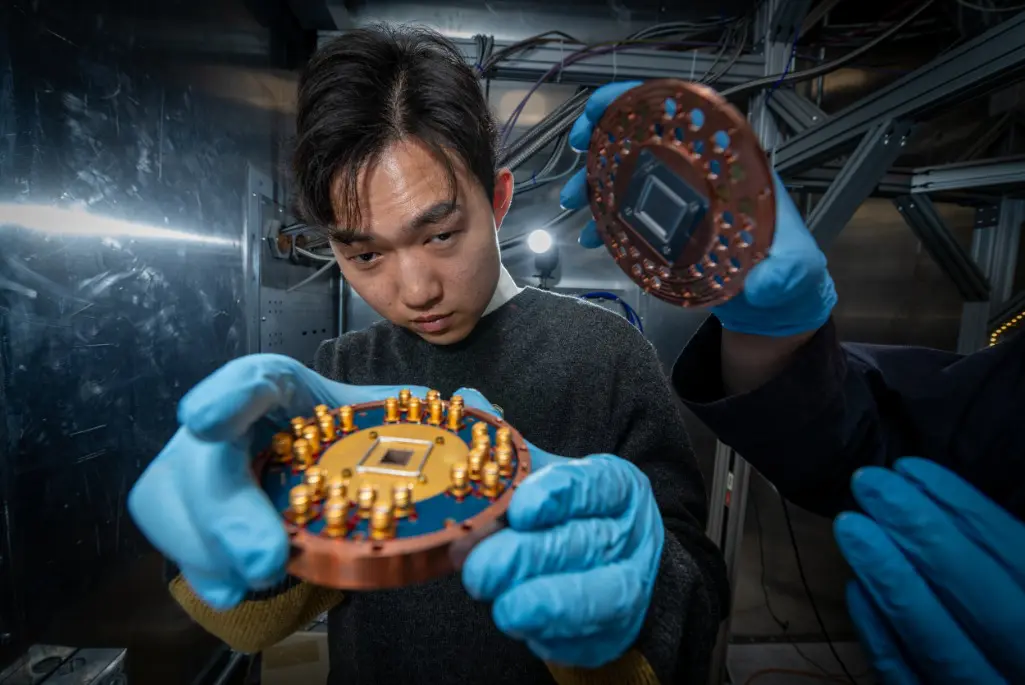
Researchers at Lawrence Berkeley National Laboratory and ESnet are constructing QUANT-NET, a three-node distributed quantum computing testbed that is the only DOE facility devoted to this emerging technology. The network will distribute quantum entanglement between Berkeley Lab and UC Berkeley using 5 kilometers of fiber, enabling collaboration with industry partners to test and deploy their components. This effort builds on significant progress toward scalable quantum networks, including custom-built ion-trap nodes and a modular software platform recently recognized with a best paper award at the IEEE Quantum Week conference. “Berkeley Lab’s expertise and capabilities are a vital component of the nation’s quantum ecosystem and help ensure that breakthroughs can move from experimental stages to practical applications,” said Bert de Jong, Quantum Systems Accelerator Director and Berkeley Lab scientist.
QUANT-NET Testbed Advances Distributed Quantum Computing
A five-kilometer fiber optic link is now distributing quantum entanglement between research facilities, marking a significant step toward practical quantum networking. This project is DOE’s only testbed specifically devoted to distributed quantum computing, highlighting its importance within the Department of Energy’s quantum portfolio. The QUANT-NET team collaborates with industry partners, offering access to their modular software for integration with other quantum networks and disseminating technological advancements to the broader research community. This collaborative approach is intended to accelerate the transition from experimental quantum technologies to practical applications. The testbed currently utilizes custom-built ion-trap quantum computing nodes, featuring 3-D printed micro-traps specifically optimized for quantum communications. A key innovation has been the deployment of quantum frequency conversion to telecom frequencies, a crucial step for long-distance quantum communication.
Beyond hardware, the team has developed an innovative modular quantum network software platform employing a two-level framework that automates quantum network operations. Co-PIs from the California Institute of Technology and the University of Innsbruck further contribute to the project’s international scope and expertise. The advancements made within QUANT-NET are shared with the research community, fostering broader innovation and collaboration in distributed quantum computing.
Quantum Systems Accelerator Develops Diverse Qubit Technologies
Beyond constructing the foundational hardware for quantum networks, the Quantum Systems Accelerator (QSA) at Lawrence Berkeley National Laboratory is actively diversifying the building blocks of quantum computation, the qubits themselves. Recognizing that no single qubit technology currently dominates, QSA pursues a multi-pronged approach, simultaneously developing trapped ions, superconducting systems, and neutral atoms, a strategy designed to maximize the potential for scalable, practical quantum devices. This commitment to technological diversity extends to collaborative efforts with industry partners, allowing for real-world testing and adoption of emerging breakthroughs. A key demonstration of this approach is the creation of a 256-atom quantum simulator, a significant step towards increasing the complexity and capability of quantum hardware for tackling problems beyond the reach of classical computers.
QSA has not limited its innovation to the physical qubits; the open-source QubiC control system, also utilized by NVIDIA’s NVQLink, provides a platform for scalable device benchmarking and algorithm development, fostering a broader ecosystem of quantum software tools. This focus on practical application is further evidenced by the commercial licensing of flex cable technologies and the deployment of hardware developed by companies like QuEra. QSA’s innovation ecosystem actively cultivates these industry partnerships through dedicated roundtables and access to resources like world-class quantum foundries and user facilities. The laboratory’s commitment extends to workforce development, currently training over 150 graduate students and 100 postdoctoral researchers annually, ensuring a continued pipeline of skilled talent for both academic and industrial quantum endeavors. These efforts, combined with initiatives like the Quantum Computing Mathematics and Physics Summer Camp (QCaMP), which has already reached over 500 educators and students, demonstrate a holistic approach to accelerating the entire quantum landscape.
Berkeley Lab’s expertise and capabilities are a vital component of the nation’s quantum ecosystem and help ensure that breakthroughs can move from experimental stages to practical applications.
Bert de Jong, Quantum Systems Accelerator Director and Berkeley Lab scientist
NERSC Accelerates Quantum Simulations with Supercomputing Resources
The National Energy Research Scientific Computing Center (NERSC) is rapidly becoming a crucial bridge between high-performance computing and the burgeoning field of quantum information science, enabling researchers to push the boundaries of what’s computationally possible. Since 2021, NERSC’s QIS @ Perlmutter program has awarded over half a million compute hours to more than 30 quantum information science project teams spanning national laboratories, industry, and academia, demonstrating a commitment to fostering collaborative exploration. This investment isn’t simply about providing processing power; it’s about accelerating the development of quantum simulations at a scale previously unattainable. NERSC’s efforts extend beyond compute time, with the Quantum Computing Access program offering select users direct access to quantum computers at both IBM and QuEra Computing for use in their research. This hybrid approach, combining the power of supercomputers with emerging quantum hardware, is proving particularly fruitful in areas like materials science and chemistry.
Collaborations with companies such as NVIDIA, QuEra, Xanadu, and Rigetti are focused on projects in quantum simulation, error mitigation, and condensed matter physics, indicating industry interest in leveraging NERSC’s resources. NERSC is actively integrating with other key initiatives at Lawrence Berkeley National Laboratory. The QUANT-NET project, constructing a three-node distributed quantum computing testbed connecting Berkeley Lab with UC Berkeley via 5 km of fiber, exemplifies this synergy. The team collaborates with industry partners to deploy components, shares software, and disseminates technological advancements. These combined efforts position NERSC as a central hub for advancing quantum simulations and fostering a robust quantum ecosystem.
Molecular Foundry & ALS Support Quantum Materials Discovery
The pursuit of practical quantum computing increasingly relies on materials science, and at Lawrence Berkeley National Laboratory, facilities like the Molecular Foundry and Advanced Light Source are proving essential to bridging the gap between theory and viable devices. Researchers are actively manipulating materials at the nanoscale to enhance coherence and scalability, critical hurdles in building stable and powerful quantum systems, and industry partners are directly benefiting from these advancements. The Foundry’s capabilities, described as providing access to “expertise, instrumentation, and tool development for research at the smallest scales,” are focused on fundamental understanding of quantum phenomena. A key resource is the Foundry’s QIS cluster tool, allowing researchers to rapidly prototype qubit components using diverse materials and methods within a single automated system. Complementing this is a forthcoming dilution refrigerator, designed for high-throughput qubit analysis, promising to accelerate the discovery of optimal materials.
Simultaneously, the Advanced Light Source is leveraging bright beams of X-rays and other light sources to visualize and control quantum states within novel materials, including superconductors and topological insulators. This capability is not merely academic; it’s intended to “help industry accelerate innovation in next-generation electronics and quantum devices.” The ALS enables precise probing of materials, underpinning technologies ranging from semiconductors to energy storage, and is directly supporting the development of quantum materials with tailored properties. Beyond instrumentation, Berkeley Lab is actively fostering collaboration, offering access to resources like the Foundry and ALS, alongside open-access software and rapid qubit design capabilities.
Source: https://newscenter.lbl.gov/2026/05/28/partnering-with-industry-to-accelerate-quantum-computing/



See today’s quantum computing news on Quantum Zeitgeist for the latest breakthroughs in qubits, hardware, algorithms, and industry deals.