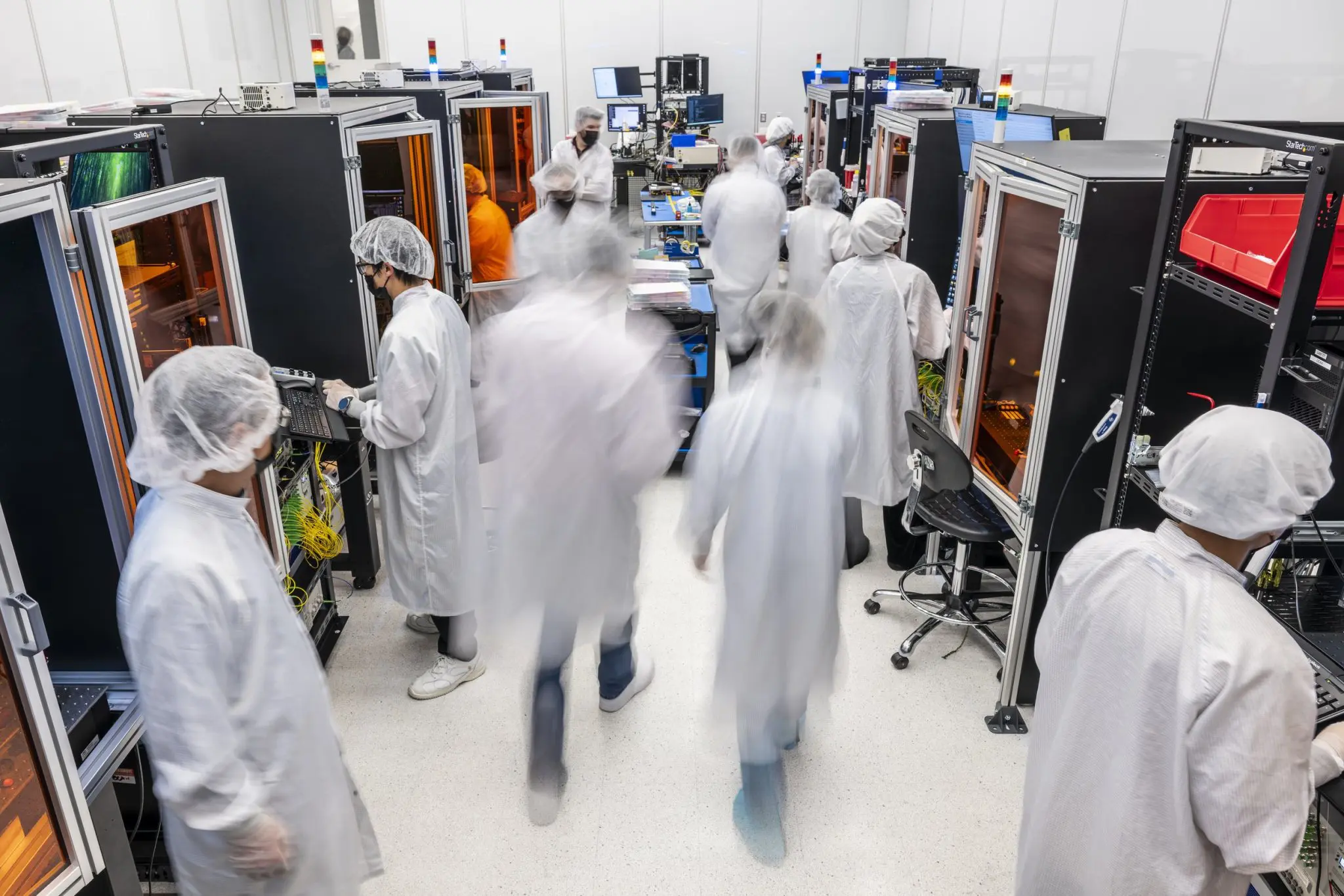
PsiQuantum has secured a $100 million Letter of Intent with the U. S. Department of Commerce, proposed under the CHIPS and Science Act, to bolster domestic quantum computing and semiconductor manufacturing. The funding will specifically accelerate the domestic production of key components like Barium Titanate (BTO), a material crucial for higher-performance optical switches within PsiQuantum’s quantum systems. Development will center at PsiFactory in Milpitas, California, where the company’s chip-to-fiber coupling technology is currently being refined. “Strong technology supply chains are essential for American security and prosperity,” said Victor Peng, Interim Chief Executive Officer of PsiQuantum. This partnership aims to advance quantum capabilities and strengthen the broader American semiconductor industry through scalable silicon photonics.
CHIPS Act Incentives Fuel Quantum Computing Advancement
The focus on BTO demonstrates a specific approach to strengthening the quantum supply chain, addressing a bottleneck in the development of more powerful quantum computers. PsiQuantum’s existing commitment to domestic sourcing is substantial, having already invested approximately $200 million with American suppliers across 38 states, a foundation the Department of Commerce incentives aim to build upon. This partnership extends beyond financial support, with the Department of Commerce recognizing implications for national defense, materials science, and financial modeling. Bill Frauenhofer, Executive Director of Semiconductor Investment and Innovation, stated that quantum computing has significant implications for national defense, advanced materials and biopharmaceutical discovery, financial modeling and energy systems. Dr. Pete Shadbolt, Co-Founder and Chief Scientific Officer of PsiQuantum, emphasized the relationship between the semiconductor industry and quantum computing, noting that the semiconductor industry helped make PsiQuantum’s path to fault-tolerant quantum computing possible, and PsiQuantum’s scalable breakthroughs in silicon photonics will create new possibilities for the future of computing.
PsiQuantum’s Silicon Photonics for Scalable Quantum Systems
PsiQuantum is pursuing a silicon photonics approach to quantum computing, differing from more common superconducting or trapped ion methodologies currently in early-stage development. This strategy centers on leveraging existing semiconductor manufacturing processes to accelerate scalability, a critical hurdle in realizing practical quantum computers; the company’s innovations focus on qubit creation and the infrastructure needed to connect and control them. A recently announced Letter of Intent with the U. S. This investment isn’t limited to materials science; funding will also support improvements in single-photon detectors, essential for reading out qubit states, and reducing the cost and complexity of cryogenic systems required to operate the quantum processor.
GlobalFoundries is excited to partner with PsiQuantum to accelerate photonic quantum computing.
Tim Breen, Chief Executive Officer of GlobalFoundries
Barium Titanate Manufacturing & Detector Technology Scaling
PsiQuantum is intensifying its focus on domestic materials science, specifically the manufacturing of barium titanate (BTO), as a crucial component in scaling quantum computing capabilities. The company’s commitment extends beyond theoretical advancements; it is actively building a supply chain anchored within the United States, with approximately $200 million already invested with American suppliers and vendors across 38 states. The focus on BTO isn’t arbitrary, as this material is integral to creating higher-performance optical switches, improving the overall functionality of quantum systems. PsiQuantum currently utilizes a Molecular Beam Epitaxy tool in Santa Clara, California, to develop 300mm wafers of BTO, and the Department of Commerce funding will directly support scaling this domestic manufacturing capacity. Beyond BTO, the company is also concentrating on high-temperature single-photon detectors, aiming to improve cost, complexity, energy requirements, and integration with support from the Commerce Department.
This location will serve as a key hub for accelerating these advancements. The company’s work with the Air Force Research Laboratory (AFRL) in Rome, New York, further exemplifies this commitment, integrating BTO electro-switch material into AFRL-designed optical circuits, demonstrating a collaborative effort to advance quantum technology for national defense applications.
The semiconductor industry helped make PsiQuantum’s path to fault-tolerant quantum computing possible, and now PsiQuantum’s scalable breakthroughs in silicon photonics will in turn create new possibilities for the future of computing.
Dr. Pete Shadbolt, Co-Founder and Chief Scientific Officer of PsiQuantum




See today’s quantum computing news on Quantum Zeitgeist for the latest breakthroughs in qubits, hardware, algorithms, and industry deals.