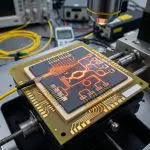
A photonic spiking reinforcement learning architecture, utilizing the Proximal Policy Optimization (PPO) algorithm, has demonstrated superior performance to the Dijkstra routing algorithm on a fat-tree software-defined network. Researchers have developed this new approach to address limitations in intelligent routing caused by high power consumption and latency, issues increasingly problematic for the expanding demands of cloud computing, big data, artificial intelligence, and the Internet of Things. The system integrates spiking neural networks, photonic computing chips, and a three-tier architecture to achieve real-time network perception and dynamic routing optimization. Leveraging Mach-Zehnder Interferometers and Distributed Feedback Semiconductor Amplifiers, the hardware-software framework achieves consistent accuracy in testing, with experimental results on 640 state-action pairs confirming the inference accuracy matches that of the pure software algorithm.
Photonic Spiking PPO Routing for SDN Implementation
A new approach to data routing, leveraging the energy efficiency of spiking photonics and the adaptability of reinforcement learning, has outperformed established algorithms in simulated network conditions. The team, led by Shuiying Xiang of Xidian University, proposes a different architecture for software-defined networks (SDN) that moves beyond the limitations of traditional, static routing methods. Conventional routing algorithms, the study notes, lack dynamic awareness and suffer from slow convergence, creating bottlenecks as data traffic surges. Evaluated on a fat-tree SDN, the photonic spiking PPO routing significantly outperforms the Dijkstra algorithm in four key metrics: throughput, packet loss rate, average latency, and load balance, particularly under heavy network load. This improvement stems from a three-tier architecture integrating data, control, and intelligent decision-making planes, with core routing computations handled by photonic computing hardware.
The hardware component relies on Mach-Zehnder Interferometers (MZI) functioning as photonic synapses and Distributed Feedback Semiconductor Amplifiers (DFB-SA) acting as photonic spiking neurons. Experimental results, conducted on 640 state-action pairs, show that the inference accuracy of the hardware-software collaborative framework is consistent with that of the pure software algorithm. Ling Zheng, an Associate Professor at Xi’an University of Posts and Telecommunications, and colleagues constructed a platform designed to maximize the speed and energy efficiency of photonic computing while maintaining training stability. This achievement represents the first full integration of photonic spiking reinforcement learning and SDN intelligent routing, establishing a new paradigm for routing optimization with low latency and high energy efficiency, and potentially applicable to large-scale data centers, satellite networks, and future 6G deployments.
MZI and DFB-SA Chips Enable Hardware-Software Framework
Researchers are now demonstrating functional hardware implementations of photonic spiking reinforcement learning for intelligent network routing, moving beyond software simulations. While deep reinforcement learning offers a promising path toward adaptive, real-time network control, traditional neural networks implemented on standard electronics face inherent bottlenecks in power consumption and processing speed. These photonic components are designed to accelerate core routing decision computations, enabling real-time network state perception and dynamic strategy optimization. By employing photonic computing hardware to perform core routing decision computations, the system achieves real-time perception of network states and dynamic optimization of routing strategies, successfully overcoming the limitations of static, traditional algorithms and power-hungry electronic alternatives. A three-tier architecture integrates the data plane, control plane, and intelligent decision-making plane, streamlining the flow of information and control signals.
Crucially, experimental results on 640 state-action pairs show that the inference accuracy of the hardware-software collaborative framework is consistent with that of the pure software algorithm. This hardware-software collaborative inference platform deploys the spiking Actor network on photonic hardware, maximizing speed and energy efficiency without compromising training stability. The system also exhibits strong robustness and fast re-convergence capability under topology changes such as link failures.
This achievement represents the first full integration of photonic spiking reinforcement learning and SDN intelligent routing, establishing a novel paradigm for routing optimization with ultra-low latency and ultra-high energy efficiency.
Researchers at Xidian University are developing a shift in data network routing, moving beyond the long-held reliance on the Dijkstra algorithm. This isn’t simply a theoretical exercise; the team has constructed a functional hardware-software framework, addressing critical limitations in existing intelligent routing systems. Experimental results on 640 state-action pairs show that the inference accuracy of the hardware-software collaborative framework is consistent with that of the pure software algorithm.
Real-Time Network Optimization for 6G and Data Centers
The escalating demands of modern digital infrastructure are driving innovation in network optimization, with a new approach leveraging the unique capabilities of photonics and spiking neural networks. This work, published by Opto-Electronic Sciences, proposes a system designed to overcome these challenges and support the bandwidth requirements of future 6G networks. Evaluation on a fat-tree software-defined network (SDN) revealed a significant performance advantage over the widely-used Dijkstra algorithm in key metrics including throughput, latency, packet loss, and load balance. Experimental results on 640 state-action pairs show that the inference accuracy of the hardware-software collaborative framework is consistent with that of the pure software algorithm, demonstrating a functional hardware implementation beyond purely simulated models. The potential applications extend beyond data centers, encompassing satellite networks and the future deployment of 6G technologies, offering a pathway towards space-air-ground integrated real-time network optimization.




See today’s quantum computing news on Quantum Zeitgeist for the latest breakthroughs in qubits, hardware, algorithms, and industry deals.