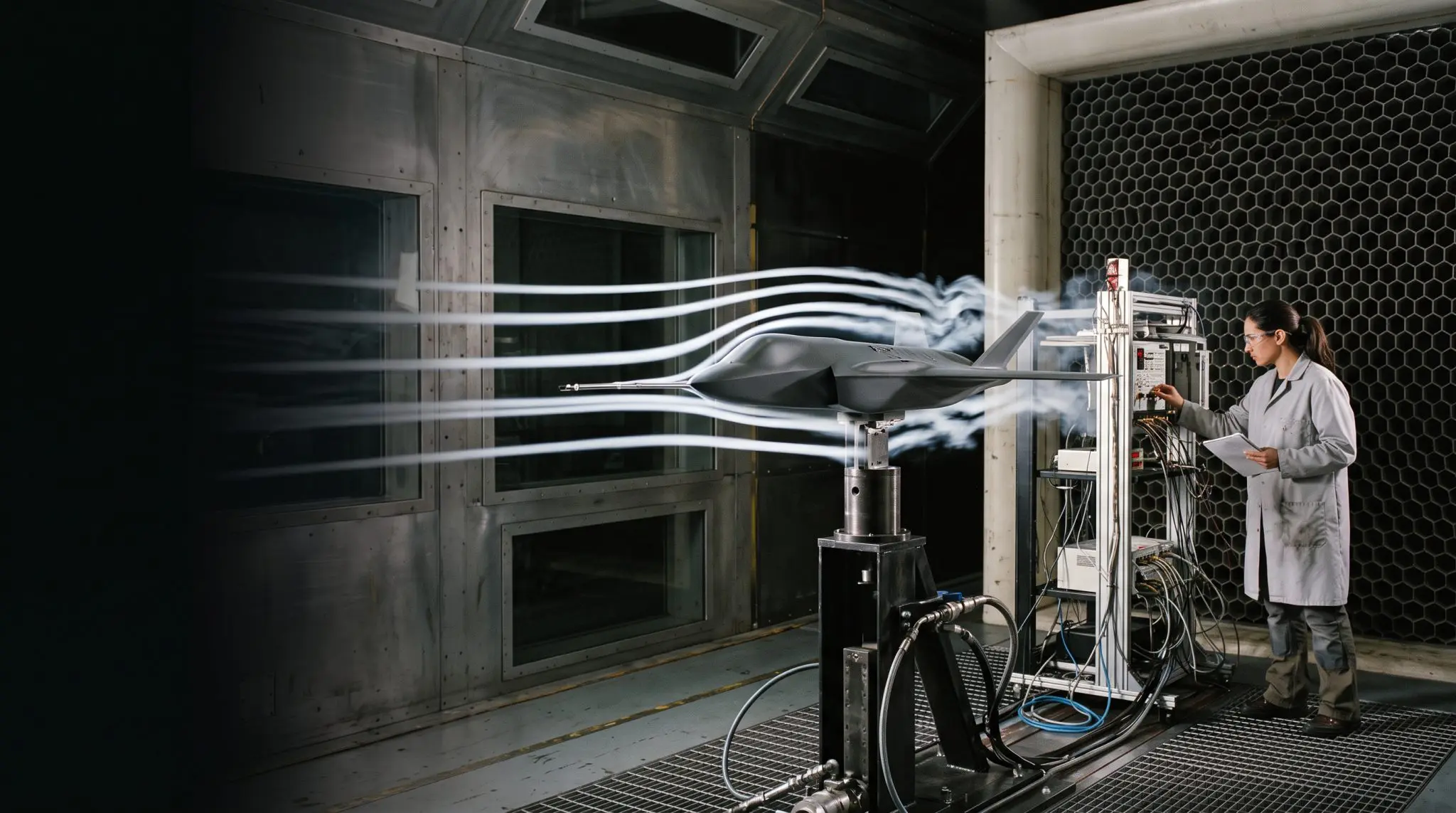
Oak Ridge National Laboratory researchers have developed a quantum algorithm that addresses a key bottleneck in fluid dynamics modeling, earning the innovation a 2026 R&D 100 Award as part of a record 22 awards for the lab. “We wanted to find a smarter approach to dealing with a major computational bottleneck in quantum modeling of fluid dynamics,” said Chao Lu, an ORNL postdoctoral researcher who led the study presented at the 2025 IEEE International Conference on Quantum Computing and Engineering. This work could accelerate simulations vital to fields ranging from aerodynamics to groundwater flow.
LuGo Algorithm Reduces Quantum Gates for Fluid Dynamics
LuGo, a quantum algorithm developed at Oak Ridge National Laboratory, reduced the number of quantum gates required for fluid dynamics simulations from 2 million to 91,000, a decrease exceeding 95 percent. This substantial reduction in computational demand was achieved through a novel approach to preprocessing data, shifting more calculations to classical computers before encoding information. The team validated the algorithm using classical simulations of the results, confirming its potential to accelerate complex modeling.
The core innovation behind LuGo lies in delaying quantum conversion; by performing extensive initial calculations on conventional hardware, the algorithm minimizes the burden on fragile qubits. Researchers have tested various solutions to address the relatively high error rate caused by the delicate nature of qubits, but the industry hasn’t settled on a standard protocol.
The final medium for encoding qubits also remains a developing area, with various systems employing neutral atoms, trapped ions, superconductors and other materials. The team’s work builds upon previous ORNL study examining potential quantum approaches to solve the Hele-Shaw flow equation using the Harrow-Hassidim-Lloyd (HHL) algorithm, extending its capabilities to more detailed simulations. Researchers used access to multiple quantum computing platforms, Quantinuum’s H-1, IBM’s Marrakesh and Sherbrooke, and IQM’s Garnet and Sirius, through the Quantum Computing User Program.
These machines, using both superconducting qubits and trapped ions, allowed for comprehensive evaluation of LuGo’s performance across different quantum hardware architectures. “With LuGo, we reduced the computational effort tremendously and observed better overall performance,” Lu confirmed, adding, “What LuGo does is extend the HHL solution’s capability to new levels of detail in much less time.” The team anticipates further acceleration of other applications as quantum computing technology matures.
“As quantum computing grows as a field and as we move toward a fault-tolerant generation of quantum computers, we expect we’ll find more of these kinds of approaches that allow us to leverage established classical solutions in new ways adapted for a quantum advantage.” The algorithm’s development was supported by the Oak Ridge Leadership Computing Facility’s Frontier supercomputer and Quantum Computing User Program (QCUP).
Frontier has a peak performance of 2 exaflops per second, meaning it can perform more than a billion-billion calculations per second, and is currently ranked No. 2 on the TOP500 list of the world’s most powerful supercomputers.
We wanted to find a smarter approach to dealing with a major computational bottleneck in quantum modeling of fluid dynamics.
Chao Lu, an ORNL postdoctoral researcher who led the study presented at the 2025 IEEE International
HHL Algorithm and Hele-Shaw Flow Enable Quantum Modeling
The record-breaking 22 R&D 100 Awards received by Oak Ridge National Laboratory this year emphasise the institution’s growing influence in quantum computing and broader scientific research, with a recent innovation focused on accelerating fluid dynamics modeling. Researchers refined the Harrow-Hassidim-Lloyd (HHL) algorithm, previously used to solve the Hele-Shaw flow equation, by developing a new approach called LuGo, an enhanced quantum phase estimation implementation.
This work addresses a critical limitation in quantum modeling: the escalating number of quantum gates required for complex calculations, which introduces error and instability in qubits. The team’s strategy centers on delaying quantum conversion, performing extensive initial calculations using classical computing resources before utilizing the power of quantum processors, and this approach significantly reduces computational demands.
This multi-platform testing confirmed improved overall performance and reduced computational effort. “Now we’re interested to see what kind of acceleration it can enable for other applications,” Lu stated, suggesting the potential for broader impact beyond fluid dynamics. The success of LuGo demonstrates a focused application of quantum computing to a defined problem, and positions the HHL algorithm as a more viable tool for tackling complex scientific simulations.
What LuGo does is extend the HHL solution’s capability to new levels of detail in much less time.
Kalyan Gottiparthi, an ORNL computational scientist and co-author of the study
Frontier Supercomputer Validates Quantum Fluid Simulation
“We needed 2 million gates to perform the necessary calculations,” explained a researcher, highlighting the computational burden that LuGo aims to alleviate. Access to multiple computing platforms, including the 113-petaflop Perlmutter system at the National Energy Research Scientific Computing Center, proved essential for refining the algorithm and validating its performance. The dynamic of quantum bits, or qubits, allows combinations of values to be encoded on a single bit, a capability that could open new avenues to solving complex problems.
We needed 2 million gates to perform the necessary calculations.
Murali Gopalakrishnan Meena, an ORNL computational scientist and co-author of the study


See today’s quantum computing news on Quantum Zeitgeist for the latest breakthroughs in qubits, hardware, algorithms, and industry deals.