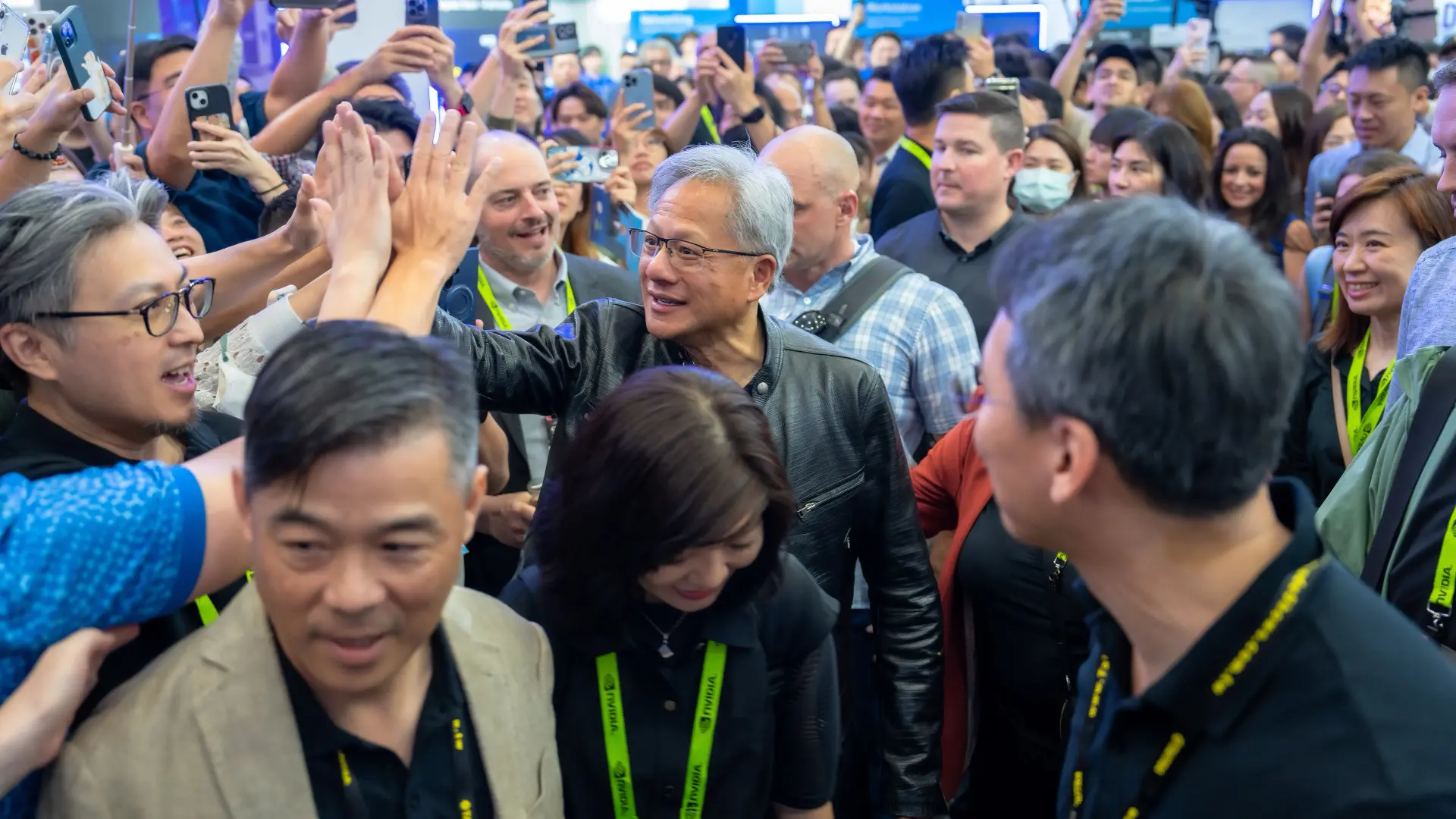
NVIDIA’s innovations in artificial intelligence have been recognized at the COMPUTEX Best Choice Awards, with the NVIDIA Vera Rubin NVL72 rack-scale AI supercomputer securing both a Golden Award and the Sustainable Tech Special Award, a distinction acknowledging both performance and eco-conscious design. The NVIDIA Jetson Thor platform also received a Golden Award, highlighting advancements in the expanding field of edge AI and robotics. The NVIDIA Alpamayo open platform was also honored in the Vehicle Technology and Smart Cockpit Category, demonstrating NVIDIA’s involvement in the development of autonomous vehicles. Entries were evaluated on functionality, innovation, and market potential, showcasing the company’s impact across multiple sectors.
NVIDIA Vera Rubin NVL72 Supercomputer: Scalability and Sustainable AI
The rack-scale system, unveiled at the conference, interconnects 36 NVIDIA Vera CPUs and 72 NVIDIA Rubin GPUs, unified by sixth-generation NVIDIA NVLink Switch technology for scalable performance. This architecture is further enhanced with ConnectX-9 SuperNICs and Spectrum-X Ethernet Photonics co-packaged optics switches, facilitating both scale-up and scale-across capabilities, alongside BlueField-4 DPUs to accelerate data processing for storage and security. According to NVIDIA, Vera Rubin NVL72 delivers up to 10 times higher inference performance per watt and reduces the cost per token by a factor of ten; when combined with NVIDIA Groq 3 LPX, the system achieves up to 35 times higher throughput per watt for trillion-parameter models. Designed specifically for agentic AI, reasoning, and long-context workloads, the supercomputer is intended to enable AI factories to scale intelligence both within a single rack and across entire data centers with secure, continuously available deployment.
The design prioritizes computational power and a reduced environmental footprint, establishing a standard for scalability, resiliency, and sustainable AI infrastructure. The Vera Rubin NVL72 boasts a cable-free, hose-free, and fanless modular tray design, dramatically reducing assembly time from two hours to just five minutes per compute tray. The system’s power shelves provide six times more onboard energy storage for intelligent power smoothing, protecting both the rack and the broader power grid from potentially disruptive load swings.
NVIDIA Jetson Thor Enables Edge AI and Robotics Applications
Artificial intelligence is increasingly extending beyond centralized data centers and into the physical world, demanding capable computing platforms at the edge, a trend NVIDIA is addressing with its Jetson Thor system. Current edge devices often struggle with the computational demands of advanced AI models, limiting their functionality to relatively simple tasks; however, the need for real-time processing and localized decision-making in applications like robotics and autonomous systems is driving demand for more powerful, efficient hardware. The award acknowledges Jetson Thor as the most powerful edge AI compute platform built for physical AI and autonomous robots, a claim substantiated by its current deployment across hundreds of applications. Unlike traditional systems reliant on constant cloud connectivity, Jetson Thor is designed to bring generative AI directly to devices like smart robots, industrial systems, and medical equipment, maximizing performance and memory optimization.
This localized processing capability is crucial for applications requiring low latency and reliable operation even in environments with limited or no network access. The platform’s capabilities extend beyond running existing AI models; NVIDIA is actively fostering innovation in areas like autonomous navigation and complex task execution. Already in production across hundreds of applications, Jetson Thor is enabling a new generation of intelligent machines capable of more sophisticated interactions with their surroundings. This focus on physical AI, where algorithms directly control physical systems, represents a significant shift from purely digital AI applications and opens up possibilities for automation and efficiency gains across numerous industries. The award-winning platform is expected to accelerate the development and deployment of robots and autonomous systems capable of operating with greater intelligence and adaptability.
NVIDIA Alpamayo Advances Reasoning-Based Autonomous Vehicle Development
NVIDIA is directly addressing the complexities of truly autonomous driving with its Alpamayo platform, moving beyond basic perception to focus on reasoning capabilities crucial for navigating unpredictable real-world scenarios. Unlike systems trained solely on common driving events, Alpamayo is engineered to handle rare, complex long-tail driving scenarios that challenge current autonomous vehicles, such as deciphering ambiguous pedestrian signals or resolving conflicting traffic cues. This focus on nuanced interpretation is central to NVIDIA’s approach, as the platform aims to equip vehicles with the ability to make informed decisions in situations outside typical training data. The Alpamayo open platform includes Alpamayo 1.5 and Alpamayo 1, 10-billion-parameter chain-of-thought reasoning vision language action models specifically for autonomous vehicle research.
Complementing these models is AlpaSim, an open-source simulation framework designed for high-fidelity AV development, and the NVIDIA Physical AI Open Datasets, comprising over 1,700 hours of driving data gathered across diverse geographies and conditions. This comprehensive suite of tools allows developers to rigorously test and refine AV systems in simulated and real-world environments, accelerating the path toward safer and more reliable autonomous transportation. This award underscores NVIDIA’s commitment to providing the underlying AI infrastructure and actively contributing to the advancement of autonomous vehicle technology itself. The platform’s emphasis on reasoning-based development represents a significant shift in the field, acknowledging that true autonomy requires more than just object recognition; it demands the ability to understand context, anticipate potential hazards, and make sound judgments in complex situations, ultimately striving for a level of driving intelligence comparable to a human driver.


See today’s quantum computing news on Quantum Zeitgeist for the latest breakthroughs in qubits, hardware, algorithms, and industry deals.