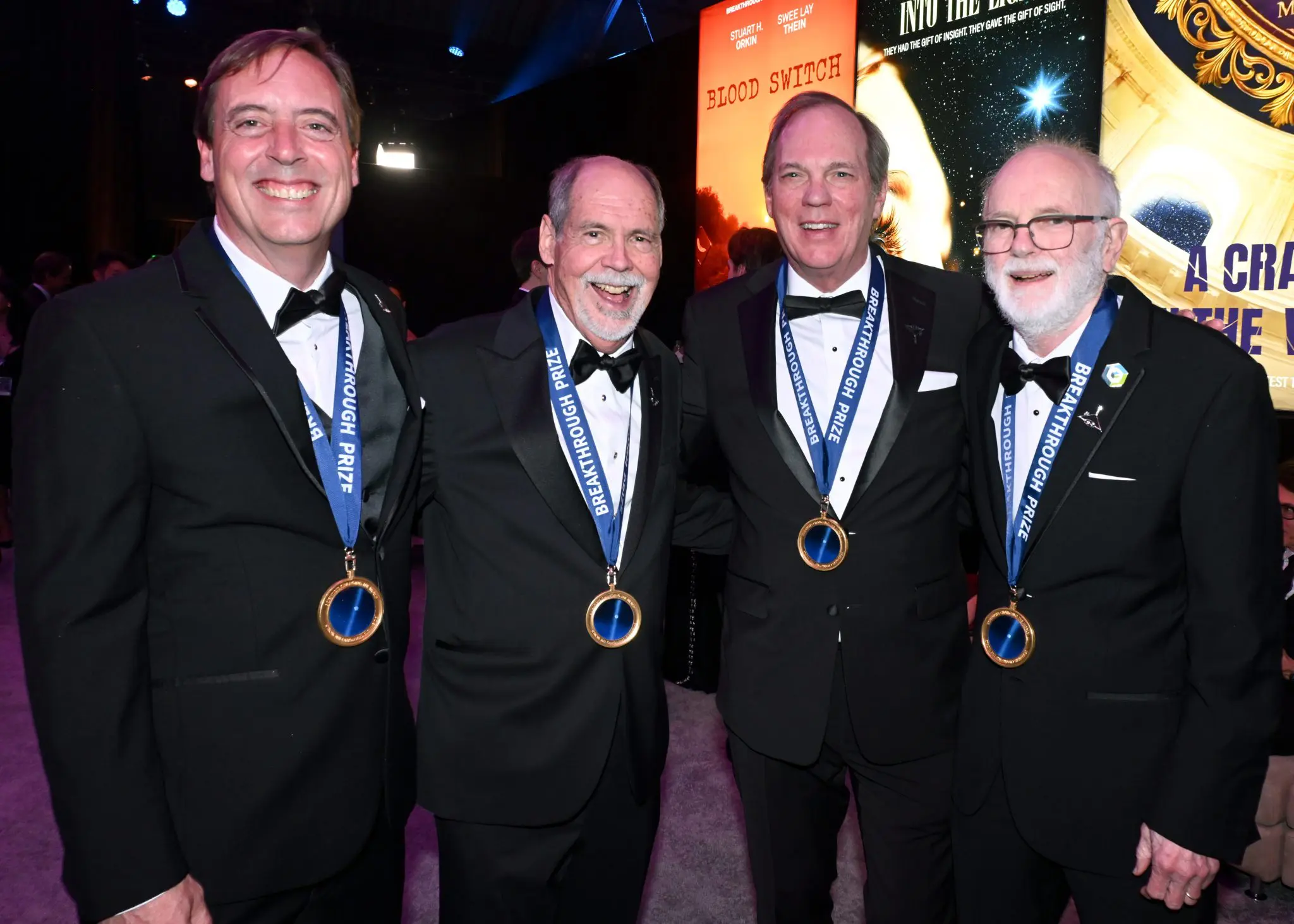
Fermilab scientist Chris Polly joined Hollywood stars in Los Angeles this weekend to accept a $3 million Breakthrough Prize in Fundamental Physics on behalf of an international collaboration studying the muon, a fundamental subatomic particle. The award, often called the “Oscars of Science,” recognizes “multi-decade contributions to the measurement of the muon’s anomalous magnetic moment, pushing the boundaries of experimental precision and igniting a new era in the quest for physics beyond the Standard Model of Physics.” This prize acknowledges a sustained, multi-generational effort; the experiment originated at CERN in the 1970s, moved to Brookhaven National Laboratory, and culminated in final results published from Fermilab in 2025. “I’m proud of the role Fermilab played in the Muon g-2 experiment, which is set to be the most accurate measurement of the muon for years to come,” said Fermilab Director Norbert Holtkamp.
Muon g-2 Experiment Measures Anomalous Magnetic Moment
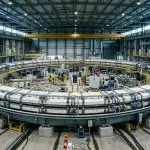
The collaboration’s success stems from increasingly precise measurements of the muon, a fundamental subatomic particle, and its magnetic moment, a property that reveals subtle interactions with quantum fields. The experiment’s design involved transporting a 50-foot-diameter superconducting magnetic storage ring 3,200 miles from Brookhaven to Fermilab in 2013, a logistical undertaking that demonstrates the scale of the research. Chris Polly, a Fermilab scientist and prize recipient, was among those who accepted the award at the ceremony in Santa Monica, California, marking a high point for the international team and their pursuit of fundamental truths.
Multi-Institutional Collaboration Spans Decades of Research
The culmination of a sustained, international effort in particle physics was formally recognized with a $3 million Breakthrough Prize awarded to the Muon g-2 collaboration; the award highlights decades of increasingly precise measurements of the muon’s properties, rather than a singular discovery. Chris Polly, a Fermilab scientist and one of the prize recipients, attended the 12th Breakthrough Prize ceremony in Los Angeles alongside Bradley Lee Roberts of Boston University, William M. Morse of Brookhaven National Laboratory, and David Hertzog of the University of Washington. The experiment’s design aimed to measure the muon’s magnetic moment with ever-increasing precision, searching for deviations that could reveal new physics beyond our current understanding.
I’m proud of the role Fermilab played in the Muon g-2 experiment, which is set to stand as the most accurate measurement of the muon for years to come.
Fermilab’s 2025 Results Confirm Brookhaven’s Findings
The culmination of experiments spanning multiple institutions, CERN, Brookhaven National Laboratory, and Fermilab, the Muon g-2 experiment’s 2025 results didn’t just refine existing measurements, they solidified a growing discrepancy with predictions made by the Standard Model. The 2025 data, in agreement with earlier results from Brookhaven in 2021, suggests the possibility of undiscovered particles and forces, a tantalizing hint that the current understanding of particle physics is incomplete. This substantial financial recognition underscores the value placed on basic research probing the universe’s deepest mysteries and highlights the significant investment required for such precision measurements.
The three generations of Muon g-2 experiments were designed to measure the magnetic moment of the muon with ever-increasing precision, exploring the quantum realm where particles briefly appear and vanish-and where even tiny deviations could point to entirely new laws of nature outside of the current Standard Model of Particle Physics.
Source: https://breakthroughprize.org/

See today’s quantum computing news on Quantum Zeitgeist for the latest breakthroughs in qubits, hardware, algorithms, and industry deals.