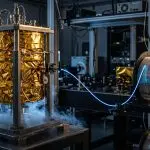
Researchers have demonstrated programmable quantum operations using a 20-meter multimode fiber, a distance previously limiting for maintaining quantum coherence. The work overcomes challenges posed by modal dispersion by harnessing ultra-long coherence from a warm 87Rb atomic ensemble to generate heralded single photons.
Atomic 87Rb Source Enables Long-Coherence Photon Generation
The experimental setup relies on three key stages, beginning with the generation of heralded single photons via spontaneous four-wave mixing (SFWM) within the 87Rb atomic vapor cell, a process where pump and coupling lasers excite atoms to produce correlated photon pairs. These photons are then spatially filtered and coupled into single-mode fibers, forming the foundation for quantum information processing.
The coincidence peak width, a measure of the photons’ temporal correlation, remains stable even after traveling through the 20-meter fiber, indicating minimal broadening and confirming the preservation of temporal coherence. This observation directly addresses a major obstacle in long-distance quantum communication: maintaining the delicate quantum state of photons over significant distances.
Digital optical phase conjugation (DOPC) plays a complementary role, compensating for the spatial phase scrambling caused by modal mixing within the fiber and enabling reconfigurable control over the output spatial state. However, the researchers emphasize that DOPC alone cannot eliminate intermodal group-delay spread for broadband photons. The extended operation within the 20-meter fiber is primarily enabled by the long-coherence atomic photon source, while deterministic spatial-mode programmability is enabled by DOPC.
The combination of these technologies allows for the preparation and reconfiguration of arbitrary spatial-mode quantum states, effectively creating qudits, quantum bits with dimensions greater than two, within the fiber. The team demonstrated the ability to prepare a single photon in programmable high-dimensional quantum states, initializing it in a fundamental Gaussian spatial mode before applying phase patterns via a spatial light modulator (SLM).
These patterns act as linear operators, transforming the initial state into a specific input spatial mode of the multimode fiber, with each of the ‘d’ dimensions corresponding to a unique output spatial mode. The relationship between the phase pattern and the resulting output mode is defined by the fiber’s T-matrix, a characteristic that describes how the fiber alters the spatial profile of light. Process fidelities exceeding 92.5(4)% were achieved for dimensions up to d = 7, demonstrating a high level of accuracy in manipulating these complex quantum states.
This level of fidelity is particularly noteworthy because exceeding 92.5% is a key benchmark for practical quantum information processing. The researchers verified these results through quantum process tomography (QPT), using mutually unbiased bases (MUBs) formed by combinations of defined input states.
The overall transmission and detection efficiency of the signal photon was approximately 6%, a figure calculated from the point of photon generation to final detection, accounting for losses within the optical system, the fiber and the single-photon detector. The narrowband characteristics of the atomic photons are not merely a technical detail. They directly address a fundamental limitation of multimode fiber operation.
The researchers explain that the long coherence length of the photons allows the system to tolerate the modal dispersion inherent in the fiber, a critical requirement for stable wavefront shaping and high-fidelity unitary transformations. This tolerance is demonstrated by the unchanged coincidence peak width after transmission, a clear indication that the temporal coherence, and therefore the quantum information encoded within the photons, is preserved.
Multimode Fiber Limits Addressed by Digital Phase Conjugation
Digital optical phase conjugation enabled the reliable synthesis of complex quantum states within a 20-meter multimode fiber, a length previously considered prohibitive due to signal degradation. The technique overcomes limitations imposed by modal dispersion, allowing for the deterministic creation of spatial modes structured by target unitary operations, including quantum Fourier transforms and generalized Pauli operators. This achievement moves beyond earlier demonstrations confined to 2-meter fiber lengths, demonstrating a significant preservation of fidelity over an extended propagation distance.
The core of this advancement lies in the exploitation of time-reversal symmetry, achieved through digital optical phase conjugation, which bypasses the need for extensive and repeated measurements of the fiber’s transmission matrix. Traditional T-matrix measurements, while capable of characterizing the fiber’s scattering properties, are time-consuming and susceptible to environmental fluctuations. Instead, this approach requires only a single complex-wavefront measurement per target mode, streamlining the process and enhancing stability.
The experimental setup incorporates several key components, including spatial light modulators (SLMs) for precise phase modulation and electron-multiplying CCD cameras for real-time visualization of the generated quantum states. A 4-f system configuration maintains a well-defined planar wavefront at the SLM surface, ensuring accurate phase control. The probe beam, manipulated by the first SLM, is coupled into the multimode fiber and undergoes backward propagation, allowing for the retrieval of the complex wavefront at the input port via digital holography. This technique effectively transforms the fiber into a programmable interferometric device capable of coherent spatial-mode superposition.
The researchers quantified the impact of increased fiber length by comparing temporal correlation width, spatial-mode contrast and transformation fidelity between the 2-meter and 20-meter multimode fibers. The results confirmed the robustness of the digital optical phase conjugation approach, demonstrating that high-fidelity programmable state synthesis can be reliably maintained over extended distances.
The use of graded-index fibers, for example, might offer a pathway to minimize modal dispersion and enhance signal propagation over longer distances. The idler photons, generated alongside the signal photons, are detected by a single-photon detector to herald the presence of the signal, an important step in ensuring the purity of the quantum state.
High-Dimensional Qudit Synthesis via 20-m Multimode Fiber
The fidelity of quantum operations remained consistently high even after photons traversed the 20-meter multimode fiber. This preservation of signal quality over an extended distance demonstrates the effectiveness of combining digital optical phase conjugation (DOPC) with a novel photon source. The team’s approach relies on manipulating wavefronts to counteract distortions introduced by the fiber itself, a technique proving robust even with increased modal dispersion.
The key to this extended coherence lies in the narrowband, long-coherence single photons generated from a warm 87Rb atomic ensemble. These photons exhibit coherence times reaching the nanosecond regime, three to four orders of magnitude longer than those produced by conventional sources like spontaneous parametric down-conversion. This intrinsic property allowed the researchers to maintain coherent multimode interference, a critical requirement for high-dimensional quantum state synthesis, despite the challenges posed by the longer fiber length.
The experimental setup involved constructing reconfigured input basis states using a spatial light modulator, enabling programmable high-dimensional transformations, including Hadamard and quantum Fourier transforms, with precise control over amplitude and phase. By adjusting these parameters through DOPC, the researchers synthesized states defined by a target unitary transformation within the qudit space. Quantum process tomography (QPT) was then used to quantitatively characterize the performance of these programmed logical mappings.
The results confirmed that the implemented transformations remained robust despite the inherent environmental sensitivity of longer multimode fibers. The researchers also explored the potential for even greater distances, noting that the intrinsically narrowband characteristics of the photons, in principle, could support substantially longer fiber propagation.
The study highlights the importance of wavefront control, specifically DOPC, in mitigating the effects of fiber-induced distortions. “DOPC thus offers enhanced robustness, speed, and reconfigurability, making it ideally suited for programmable high-dimensional spatial-mode state synthesis in MMFs,” they explain. The ability to reliably synthesize and manipulate complex quantum states within a fiber-based system represents a step towards scalable quantum information processing.
The researchers emphasize that their approach is not limited to the specific transformations demonstrated, Hadamard, quantum Fourier and Pauli-X, but can be extended to a wider range of unitary operations. The use of a warm 87Rb atomic ensemble is also noteworthy, as many coherence experiments require extremely cold temperatures, simplifying the experimental setup and potentially reducing costs.
The combination of long-coherence atomic photons and precise wavefront control offers a promising pathway towards building more complex and scalable quantum networks.
Quantum State Synthesis Validated by Tomography & MUBs
Quantum process tomography, employing mutually unbiased bases, confirmed high-fidelity target operations within the 20-meter multimode fiber, demonstrating a level of precision previously limited to much shorter distances. This fidelity was assessed through the reconstruction of output states, providing detailed information on programmed amplitudes and relative phases, and quantified by a process-matrix representation comparing programmed input-output relations to target unitaries. The analysis focused on calibrated subspaces, utilizing input states spanning complete sets of mutually unbiased bases prepared using standard quantum tomography protocols.
The experimental setup used digital optical phase conjugation to achieve high-dimensional state synthesis, a method that simplifies optical reconfiguration compared to bulk or integrated photonic architectures. These transformations were implemented by precisely controlling the amplitudes and relative phases of each spatially separated mode, effectively synthesizing states specified by a target unitary transformation in the qudit space.
Despite a reduction in the peak brightness ratio to 230, quantitative characterization of synthesized states, generalized Hadamard, quantum Fourier transform and Pauli-X targets, revealed process fidelities of 95.5% and 93.5% for four-dimensional operations, comparable to those obtained with a 2-meter multimode fiber. The team assessed scalability by extending implementation to Hilbert-space dimensions of 2, 3, 5, and 7, selecting dimensions based on mode separability and interference stability.
The choice of odd-dimensional mutually unbiased bases, which are more readily constructed, influenced the specific dimensions tested, demonstrating a practical consideration for implementation. The intrinsically narrowband, long-coherence atomic single photons used in the experiment offer the potential for even longer fiber propagation, provided that modal dispersion and long-term drift are adequately managed. While the achievable distance beyond the tested 20 meters was not determined in this study, the results suggest a pathway toward scalable quantum systems.




See today’s quantum computing news on Quantum Zeitgeist for the latest breakthroughs in qubits, hardware, algorithms, and industry deals.