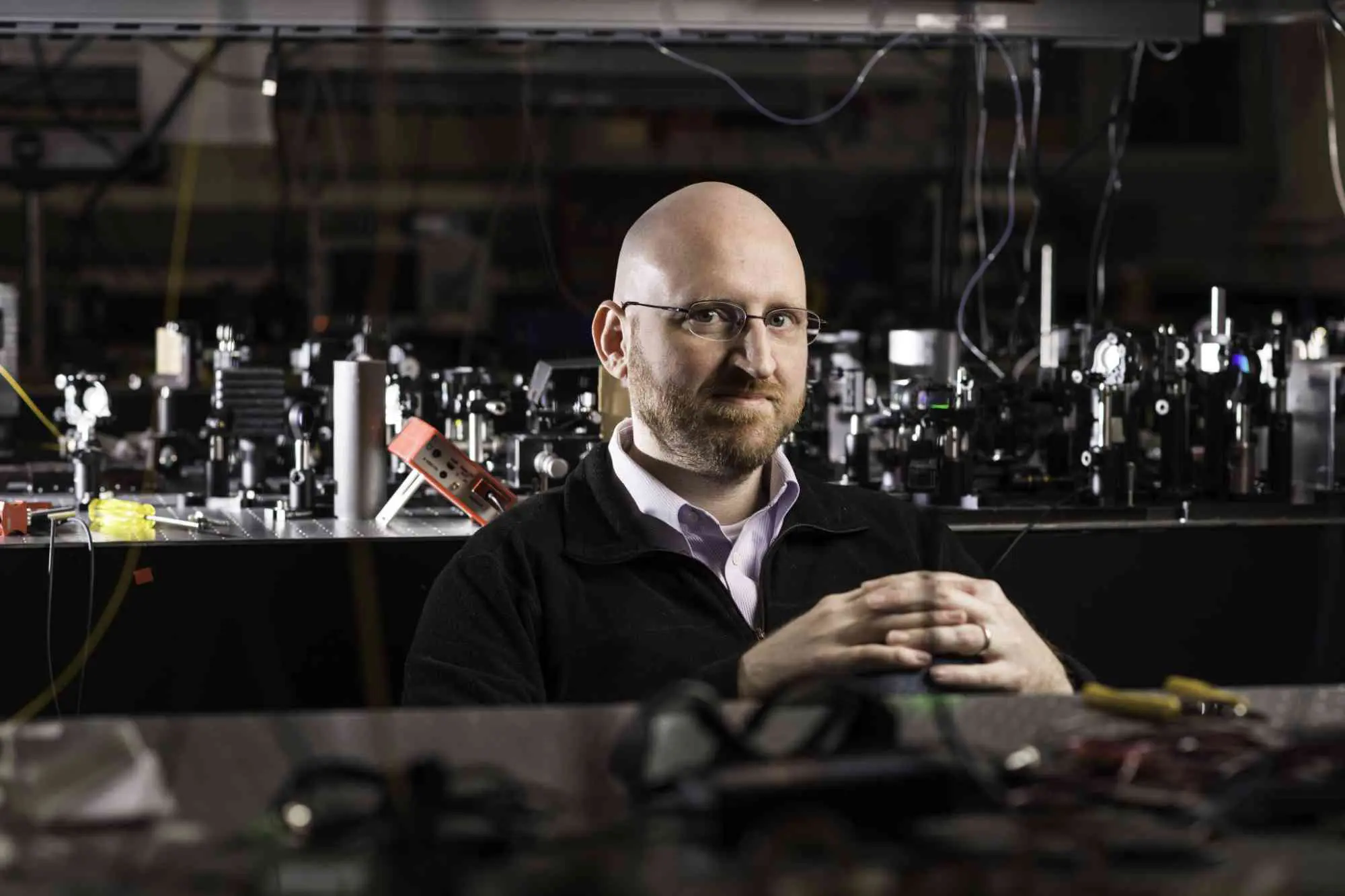
University of Rochester associate professor William Renninger is one of 21 new investigators selected by the Gordon and Betty Moore Foundation’s Experimental Physics Investigators Initiative, receiving $1.35 million over five years to explore the intersection of light and sound. Renninger’s research focuses on coupling photons, ideal for long-distance communication, with phonons, which excel at information storage and bridging quantum systems.
He intends to build more precise communication and sensing tools to study matter, from crystal defects to the boundaries of quantum physics. “My lab aims to broaden how researchers use light to control and measure motion in systems that are currently hard to reach,” says Renninger.
Renninger’s Light-Phonon Coupling for Quantum Technologies
William Renninger will receive $1.35 million. This funding places Renninger among a highly selective cohort of only 21 new investigators chosen for the initiative, signaling recognition of his work’s potential to advance the field. His project will uniquely integrate device engineering, precision measurement and fundamental physics to explore the intersection of optical and acoustic phenomena. Photons and phonons possess complementary strengths. Photons excel at long-distance communication, while phonons are adept at storing information and acting as interfaces to other quantum systems.
Renninger’s research specifically focuses on harnessing these distinct properties to create more precise tools for both communication and sensing, extending capabilities to study material behavior at unprecedented scales. This includes investigating defects within crystals used in semiconductors and probing the boundaries of quantum physics itself. The work aims to create light-driven sound devices and measurement techniques applicable across various platforms, from microchips to bulk crystals.
The potential outcomes of this research extend beyond improved communication and sensing; the project could also yield new methods for generating strong, narrow-band sound responses for signal processing and enhance sensitivity to extremely weak signals. Researchers theorize these signals may originate from ultralight dark matter, opening a novel avenue for its detection.
“We hope to produce better tools for optical signal processing, new ways to map hidden defects and energy loss inside materials, and experimental platforms for testing how large mechanical systems behave near the limits of quantum physics,” said Renninger. He added, “I’m extremely grateful to the Moore Foundation for this support to our research program.” The initiative also supports collaboration among its investigators, providing a platform for idea exchange and professional development, further amplifying the impact of this research.
My lab aims to broaden how researchers use light to control and measure motion in systems that are currently hard to reach.
William Renninger, Associate Professor at the University of Rochester’s Institute of Optics


See today’s quantum computing news on Quantum Zeitgeist for the latest breakthroughs in qubits, hardware, algorithms, and industry deals.