Caltech researchers have bypassed a critical 3,000 Kelvin (2726.85°C) melting point barrier, successfully creating thin films of materials previously considered impossible to deposit using conventional methods. The team, led by Professor Austin Minnich of mechanical engineering and applied physics, achieved this with a novel laser technique that eliminates the need for an extremely heat-resistant container. “If you think of your coffee cup with vapor coming off, it’s the same idea except, let’s say, you’re doing it with tungsten. Now your coffee would be at something like 3,600 Kelvin,” explains Minnich. This advance, enabled by funding from a Caltech De Logi Science and Technology Grant, has immediate implications for superconducting electronics and the development of quantum computers; the team demonstrated success using niobium as a test material.
Laser Thermal Evaporation Enables Ultra-Refractory Thin Films
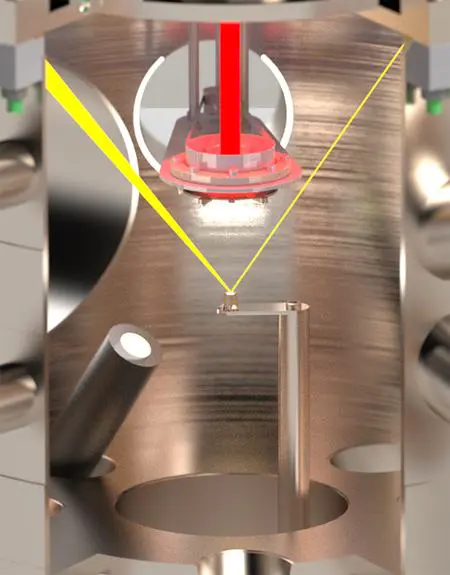
The conventional approach to thin film deposition involves heating a source material until it vaporizes and then condenses onto a surface, but ultra-refractory materials presented a significant challenge. Instead of attempting to contain the molten material, the Caltech team focused a high-power laser directly onto a pellet of the desired substance, melting only the center while the surrounding solid pellet acted as its own containment vessel. This laser thermal evaporation (TLE) process was initially demonstrated with nickel, using a 1-kilowatt fiber laser in a vacuum chamber to vaporize the material near its 1728 Kelvin (1454.85°C) melting point. Electrical conductivity measurements confirmed the resulting film’s quality was comparable to, or even better than, those created using conventional methods. Minnich said this work highlights how technological developments in apparently unrelated industries like metal cutting can have a large impact in other fields, emphasizing the potential of TLE for quantum technology, particularly with materials like niobium, tantalum, and their alloys.
Caltech Instrument Achieves First U.S. Laser Deposition
The creation of thin films, essential for applications ranging from microchip coatings to pharmaceutical finishes, has long been constrained by the properties of the materials themselves; specifically, those with exceptionally high melting points presented a significant hurdle for conventional deposition techniques. Materials deemed “ultra-refractory,” requiring temperatures exceeding 3,000 Kelvin (2726.85°C) to vaporize, previously demanded containment vessels that could not withstand such intense heat. Researchers at Caltech have circumvented this limitation with a newly developed laser-based deposition system, marking the first such instrument operational in the United States. This localized vaporization allows for the creation of thin films without the need for extremely heat-resistant materials. The team demonstrated the process successfully with niobium, a material critical for superconducting electronics and the advancement of quantum computing. Initial experiments, detailed in Applied Physics Letters, utilized a 1-kilowatt fiber laser to vaporize nickel, achieving film quality comparable to, or exceeding, that of traditionally deposited films.
TLE has a lot of interesting implications for quantum technology because many superconducting quantum computers use ultra-refractory materials such as niobium, tantalum, and their alloys.
Nickel Film Quality Matches Existing Deposition Methods
Researchers at Caltech are demonstrating similar performance between a novel laser deposition technique and established methods for creating thin films, specifically with nickel, a material vital for numerous applications. The new process circumvents the need for extremely high-temperature containment by focusing the laser directly on the target material, effectively creating its own localized vaporization source. Measurements of the electrical conductivity of the resulting nickel film revealed a quality equal to, or even surpassing, films produced through existing deposition techniques. This success with nickel, alongside previous work with niobium, suggests broad applicability for the laser-based approach.
If you think of your coffee cup with vapor coming off, it’s the same idea except, let’s say, you’re doing it with tungsten. Now your coffee would be at something like 3,600 Kelvin.



See today’s quantum computing news on Quantum Zeitgeist for the latest breakthroughs in qubits, hardware, algorithms, and industry deals.