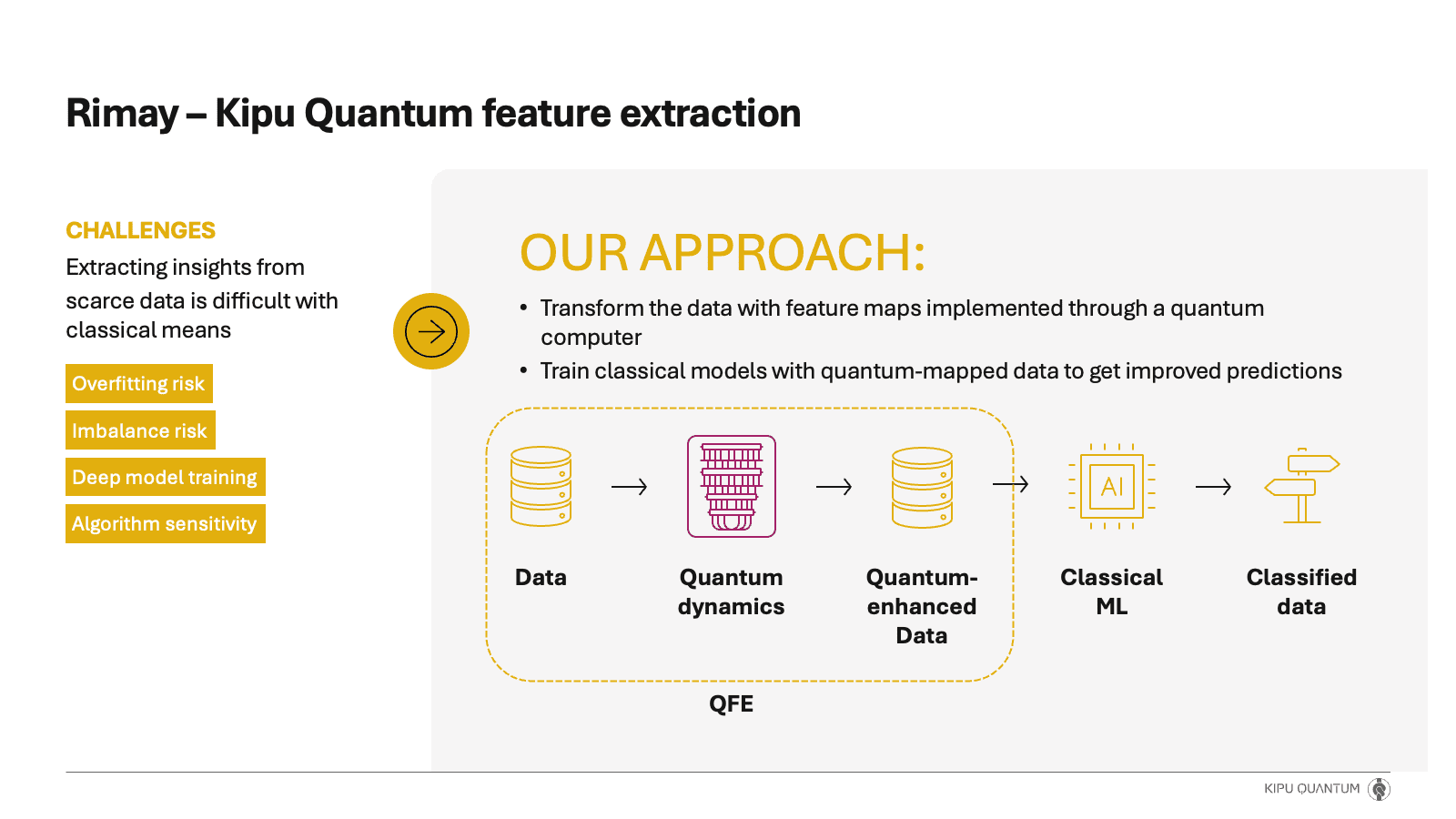
Kipu Quantum announced today the general availability of Rimay, a new service delivering quantum-enhanced machine learning results to customers. Rimay utilizes quantum feature extraction to boost the predictive power of existing machine learning models, offering improvements across diverse data types like tabular datasets, time series, and images. Early adopters including Komatsu Mining Corp. Perú, NTT DATA Europe & Latam, and KPMG have already leveraged Kipu solutions for applications ranging from predictive maintenance to environmental intelligence. “We deliver today measurable value to industry with quantum computers,” says Enrique Solano, CEO of Kipu Quantum. “Our customers…outperform their classical baselines using quantum-enhanced features. This is industrial quantum usefulness.”
Rimay Quantum Feature Extraction Enhances Existing ML Pipelines
Rimay, a new service from Kipu Quantum, promises to significantly boost machine learning performance by leveraging quantum feature extraction, achieving what the company terms “quantum-advantage level” accuracy. Unlike requiring a complete overhaul of existing systems, Rimay is designed for seamless integration into current machine learning workflows, working with tabular datasets, time series, and images through a unified API. This approach addresses a common bottleneck in ML, where subtle data correlations are missed or require extensive feature engineering for even incremental improvements.
Early applications demonstrate substantial gains across diverse industries; KPMG, for example, utilized Rimay to improve the classification of tree species from satellite imagery, yielding “clearer quantum-enhanced environmental intelligence.” Validated results reveal a +5% improvement in credit risk assessment versus classical models, and a remarkable +20% accuracy boost in semiconductor fault detection. Scott Crowder, VP IBM Quantum Adoption, added, “IBM offers a global fleet of quantum computers today over the cloud…We look forward to working with Kipu Quantum.”
Kipu Quantum Validates 4-20% Gains Across Diverse Industries
Quantum computing is rapidly moving beyond theoretical potential and into practical applications, with Kipu Quantum demonstrating measurable improvements across several key industries. Their new service, Rimay Quantum Feature Extraction, enhances machine learning models by uncovering subtle data correlations often missed by classical algorithms. Validated results show gains ranging from 4 to 20 percent in areas like credit risk assessment, where models saw a +5% improvement, and semiconductor fault detection, achieving a significant +20% accuracy boost. Kipu Quantum is integrating these advances into a commercial quantum processor ecosystem, offering a reusable service accessible today. Beyond finance, the technology is impacting environmental monitoring and critical infrastructure.
Source: https://lnkd.in/dcHDRCgH




See today’s quantum computing news on Quantum Zeitgeist for the latest breakthroughs in qubits, hardware, algorithms, and industry deals.