Researchers at the Karlsruhe Institute of Technology (KIT) have demonstrated an advance in flux qubit stability, achieving T1 = 25 µs, a key metric suggesting improved potential for complex quantum operations. The team reports a frequency tunability range of approximately 20 GHz at the flux-insensitive sweet spot, allowing for precise qubit control across a broader spectrum than previously possible with tunable qubits. This enhanced control was further showcased by successfully detecting two-level tunneling defects within a frequency range spanning one octave, indicating a practical application of the qubit beyond computational tasks. “Superconducting micro-circuits have become a testbed to explore quantum coherence in electrically controlled solid-state systems,” highlighting the importance of this work in advancing the field of superconducting quantum circuits.
A relaxation time of 25 µs, achieved in a newly designed flux qubit, signals a substantial leap toward more stable and complex quantum computations, overcoming limitations inherent in tunable qubit designs. The team’s design builds upon earlier work, notably that of Yan et al., who demonstrated coherence times of T1 ≈ 50 µs using larger square-plate shunt-capacitors. The qubit’s gradiometric configuration allows independent manipulation of both the potential asymmetry and the tunnel barrier, crucial for fine-tuning performance. Measurements reveal a quality factor, calculated as 2πfq⋅T1, reaching approximately 500k, demonstrating a significant improvement over previous iterations. Earlier gap-tunable designs exhibited T1 times of 1.4 ns and 1.5 µs, often limited by thermal noise and dielectric loss. This advancement positions their design as a powerful tool for both quantum computation and fundamental materials research, offering a platform to investigate decoherence sources with unprecedented precision and control.
Gradiometric C-Shunted Flux Qubit Design
The pursuit of stable and versatile qubits continues to drive innovation in superconducting circuit design, with flux qubits emerging as a promising, though historically challenging, platform. While not as widely used as transmon qubits in current large-scale architectures, flux qubits offer inherent advantages in anharmonicity, the property that defines distinct energy levels crucial for qubit control. Recent advances from a team at the Karlsruhe Institute of Technology are addressing long-standing limitations in coherence and tunability, presenting a new gradiometric C-shunted flux qubit design that significantly extends operational parameters. Researchers, with B. Berlitz as the corresponding author, have demonstrated a relaxation time (T1) of 25 µs, a substantial leap forward compared to earlier gap-tunable designs. This improvement is particularly noteworthy given previous constraints imposed by thermal noise and dielectric loss, factors that have historically limited qubit stability. The team reports a frequency tunability range of approximately 20 GHz.
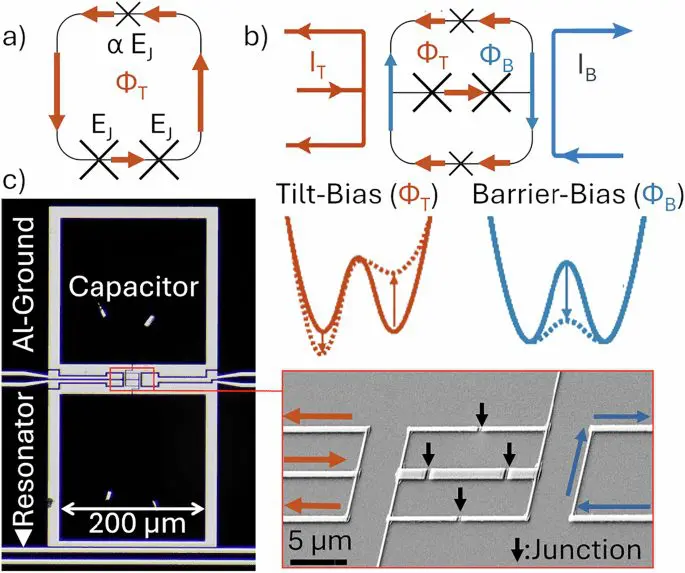
Measurements reveal a quality factor, calculated as 2πfq⋅T1, reaching approximately 500k. Early gap-tunable designs exhibited T1 times of 1.4 ns and 1.5 µs, and this new iteration represents a substantial advancement. This wide range is enabled by the qubit’s ability to replace the small junction with a DC-SQUID. This isn’t simply about enhancing computational power; it’s about utilizing the qubit as a sensitive probe of material quality.
This advancement, detailed in a recent publication, addresses a longstanding challenge in the field: balancing broad qubit tunability with extended coherence. Researchers, led by B. Berlitz as the corresponding author, have engineered a capacitively shunted flux qubit with independent control over both potential asymmetry and tunnel barrier height, utilizing fluxes ΦT and ΦB respectively. This gradiometric configuration, as illustrated in their published diagrams, allows for precise manipulation of the qubit’s energy landscape. This wide range is enabled by replacing the small junction with a DC-SQUID. Beyond simply enhancing qubit performance, the researchers demonstrate a practical application of their tunable qubit: the detection of two-level tunneling defects. Utilizing a frequency range spanning one octave, they’ve shown the device can act as a sensitive probe for material imperfections. The achieved stability, they report, is a significant step towards realizing more complex and robust quantum operations.
Achieved Coherence Times and Q-Factor
The pursuit of stable quantum states is rapidly advancing, with implications extending beyond computation into material science and defect detection. This improvement, detailed in recent findings, positions these qubits as potentially powerful tools for analyzing material imperfections at a microscopic level. The team’s design focuses on a capacitively shunted flux qubit, building upon earlier work that identified larger shunt capacitors as key to reducing dielectric loss. This isn’t simply about extending the duration of quantum calculations; the ability to maintain coherence for longer periods unlocks new avenues for qubit-based sensing. Researchers at the Karlsruhe Institute of Technology (KIT) have demonstrated a relaxation time of 25 microseconds, achieving a relaxation time of 25 µs, a key metric suggesting improved potential for complex quantum operations.
While earlier gap-tunable designs struggled with coherence times ranging from 1.4 nanoseconds to 1.5 µs, this new iteration represents a substantial advancement. The demonstrated stability, they report, is a key factor in enabling these extended coherence times and the subsequent material analysis capabilities.
The pursuit of quantum coherence often focuses on perfecting the qubit itself, yet a crucial, often overlooked aspect lies in the materials hosting these delicate states. This approach, detailed in their recent publication, moves beyond simply improving qubit performance to actively characterizing the environment influencing that performance. This enhanced stability is key to the spectroscopy application, allowing for precise measurements of subtle energy shifts caused by two-level tunneling defects, imperfections in the material that can disrupt quantum coherence. These traps can absorb and re-emit energy, creating noise that degrades qubit coherence. This wide range is enabled by the qubit’s ability to adjust the effective junction area ratio, α, in-situ via the control flux ΦB. The implications extend beyond superconducting qubits; understanding and mitigating these material defects is crucial for a wide range of quantum technologies.



See today’s quantum computing news on Quantum Zeitgeist for the latest breakthroughs in qubits, hardware, algorithms, and industry deals.