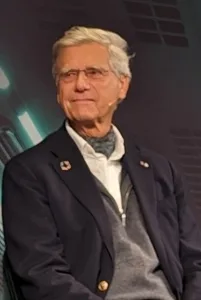
Hermann Hauser, a leading figure in the tech industry, has significantly influenced modern computing. Born in Austria, Hauser co-founded Acorn Computers in the United Kingdom, revolutionizing personal computing. The company’s most notable achievement was the development of the first ARM (Advanced RISC Machine) microprocessors, a technology that underpins most mobile devices today. Hauser’s career extends beyond Acorn and ARM, with numerous ventures and collaborations contributing to his reputation as a visionary in technology and innovation.
However, Hauser’s influence extends beyond his work with Acorn and ARM. His career is peppered with numerous ventures and collaborations, each contributing to his reputation as a visionary and pioneer. This article will explore these associations, shedding light on the people and projects instrumental in Hauser’s journey.
From his early days at Acorn to his current role as co-founder and venture partner at Amadeus Capital Partners, Hauser’s career is a testament to his relentless pursuit of innovation. His story is not just about technological advancement but also about the power of collaboration, the importance of risk-taking, and the potential of a single idea to change the world.
Whether you are a tech enthusiast, an aspiring entrepreneur, or simply someone curious about the forces shaping our digital world, this exploration of Hermann Hauser’s life and work offers a fascinating insight into the mind of a tech titan. It is a journey through the history of computing, seen through the eyes of one of its most influential figures. So, sit back and prepare to be inspired by the story of a man whose innovations continue to shape our digital lives.
Early Life and Education of Hermann Hauser
Hermann Hauser, a renowned physicist and entrepreneur, was born in Vienna, Austria, on 23 October 1948, and grew up in a small village near Wörgl in Tyrol. His father was not an academic but an entrepreneur who built up a wine wholesale business, and Hauser has credited the dinner-table talk about that business with his own appetite for risk. His love of physics came from an uncle who had studied physics and mathematics at university but worked as the local jeweller and watch repairer, and who explained atomic reactions to him on mountain walks.
Hauser attended the village primary school at Bruckhäusl and then spent eight years at the Gymnasium in Kufstein. By his own account he scraped into the Gymnasium only after private tuition, because the primary school had not prepared him for the entrance exam. When his father sought advice on whether he should read physics, an assistant lecturer at Vienna University said his results were good enough but warned him he would never get rich.
Hauser first came to England in 1964, aged fifteen, for a summer English course at the Studio School in Cambridge, and he returned most summers afterwards. After compulsory Austrian military service he took his first degree in physics at the University of Vienna, where he specialised in gravitational theory and was taught by Roman Sexl and Walter Thirring. During those Vienna years he spent his summers as a research assistant at the Cavendish Laboratory in Cambridge.
Upon completing his undergraduate degree, Hauser continued his studies at Cambridge. He was accepted into the Cavendish Laboratory, the University’s Department of Physics, for his doctoral studies. Hauser took his doctorate at the Cavendish Laboratory, working in the physics and chemistry of solids group. His research contributed significantly to understanding these materials, which are now widely used in the electronics industry.
Hauser took his Cambridge PhD in the 1970s with a thesis on mechanically activated chemical reactions, and the work produced what became known as the “Hauser Method” for extracting three reaction parameters from a single experiment. He believes he was among the first people in Cambridge to bind computer output directly into a thesis. After the PhD he stayed on at Cambridge as a research fellow.
In addition to his academic pursuits, Hauser demonstrated an interest in entrepreneurship at Cambridge. He co-founded Acorn Computers in 1978, a company that played a significant role in the early days of the personal computer revolution. This marked the beginning of Hauser’s successful career as a technology entrepreneur, which he has balanced with his ongoing contributions to the field of physics.
Influences and Inspirations of Hermann Hauser
One of the most notable influences on Hauser’s work is quantum physics. Hauser’s interest in quantum physics began at the University of Cambridge, where he studied physics and computer science. His fascination with the quantum world has driven his work, leading him to co-found Acorn Computers ARM Holdings and Amadeus Capital Partners. These have made significant contributions to computer science (Hodges, 2011).
Hauser knew Maurice Wilkes, the designer of EDSAC whose work on microprogramming underpins the microprocessors still made today, but Wilkes was a colleague rather than a doctoral mentor. The two came together properly later, when Hauser had become vice-president of research at Olivetti and was able to offer Wilkes a position at the Olivetti Research Laboratory in Cambridge, which Andy Hopper headed. Hauser’s own doctoral supervisor at the Cavendish was John Field.
Hauser’s work has also been inspired by his passion for education and belief in fostering the next generation of scientists and entrepreneurs. He has strongly advocated science education, particularly in computer science.
In addition to his work in physics and computer science, Hauser has been influenced by his interest in policy and his belief in the importance of science and technology in shaping society. He was appointed to the UK Government’s Council for Science and Technology in 2004, and he has served on the advisory board of the European Innovation Council, the EU’s deep tech funding arm, where he has argued for a European sovereign technology fund. These roles have given him a direct line into research funding policy on both sides of the Channel.
The Founding of Acorn Computers: Hermann Hauser’s First Major Venture
Acorn Computers, a British company, was founded in 1978 by Hermann Hauser and Chris Curry. Hauser, a physicist by training, had previously worked at the Cavendish Laboratory at the University of Cambridge, where he developed a keen interest in the burgeoning field of computer technology. On the other hand, Curry had a background in electronics and had previously worked for Clive Sinclair, a pioneer in the British computing industry. Together, they set out to create a company that would bring the power of computing to the masses.
The company’s first product, the Acorn Microcomputer (later renamed the Acorn System 1), was a microcomputer kit based on the 6502 microprocessor. This was a significant choice, as the 6502 was a relatively new and powerful chip that offered superior performance compared to other microprocessors available at the time. The Acorn System 1 was well-received and helped establish Acorn Computers as a serious player in the nascent personal computer market.
In 1981, Acorn Computers released the BBC Micro. This microcomputer was designed in response to a British Broadcasting Corporation (BBC) tender for a computer to be used in a nationwide computer literacy project. The BBC Micro was a huge success, selling over 1.5 million units and becoming a staple in British schools and homes. This success cemented Acorn Computers’ reputation as a leading innovator in the personal computer industry.
Despite BBC Micro’s success, Acorn Computers faced financial difficulties in the mid-1980s due to a combination of factors, including a slowdown in the British economy and increased competition in the personal computer market. In 1985, Olivetti, the Italian typewriter and computer manufacturer, took a controlling stake in the company, and Hauser went on to serve as Olivetti’s vice-president for research, overseeing laboratories in Europe and the United States. Despite this setback, Acorn Computers continued to innovate, developing the ARM microprocessor, which has since become the world’s most widely used microprocessor architecture.
How ARM Was Created At Acorn
The ARM architecture, which stands for Advanced RISC Machine, is a type of processor architecture based on a reduced instruction set computing (RISC) approach. This approach simplifies the processor by eliminating unnecessary instructions and focusing on a small set of simple and general instructions. Acorn turned to its own design after Intel refused to license it the 80286, and the resulting chip was the work of two Acorn engineers, Sophie Wilson, who wrote the instruction set, and Steve Furber, who designed the silicon. Hauser’s contribution was to authorise and protect the project rather than to draw the architecture himself. The design was a departure from the prevailing trend towards increasingly complex processors with large instruction sets, and its low power draw was as much a consequence of Acorn’s cheap plastic packaging constraint as of a grand plan.
The bet paid off, and the ARM architecture has become the dominant processor architecture for mobile devices. The ARM architecture’s power efficiency is ideal for battery-powered devices like smartphones and tablets. In addition, the cost-effectiveness of the ARM architecture has made it a popular choice for embedded systems, such as those found in consumer electronics and vehicles.
The RISC architecture, which uses a small, highly optimized set of instructions, allows for faster instruction execution and more efficient memory use. This starkly contrasted to the CISC architecture, which uses a large set of complex instructions, resulting in slower execution and less efficient memory use. Acorn’s decision to build its own RISC processor proved decisive for the semiconductor industry, and it led to ARM’s dominance in the mobile computing market.
Instead of manufacturing chips themselves, ARM licensed its designs to other companies. That intellectual property licensing model, which is distinct from the fabless model in which a company still designs and sells chips of its own, allowed ARM to focus on design while its licensees carried the cost and risk of manufacturing. The approach was unusual at the time and it now underpins much of the semiconductor industry.
Hauser did not run ARM. Advanced RISC Machines was spun out of Acorn in November 1990 as a joint venture with Apple and VLSI Technology, and Robin Saxby joined the following year as its first chairman and chief executive. Hauser’s role lay in backing the architecture at Acorn and in helping engineer the spin-out, not in directing ARM’s research programme.
Today, ARM processors are found in billions of devices worldwide, from smartphones to supercomputers. The ARM architecture has also been licensed to other companies, allowing them to create ARM-based processors. This has led to a proliferation of ARM-based devices and has cemented ARM’s position as a leading player in the semiconductor industry.
Hermann Hauser’s Contributions to the Tech Industry
Hauser’s contributions to the tech industry extend beyond the founding of influential companies. He has also played a key role in shaping the UK’s tech ecosystem through his work as a venture capitalist. As a co-founder of Amadeus Capital Partners, Hauser has invested in and supported a wide range of tech startups. These investments have helped to foster innovation, create jobs, and drive economic growth in the UK.
Furthermore, Hauser has strongly advocated for government support of technological innovation. He was instrumental in establishing the Catapult Centres, a network of technology and innovation centers in the UK. These centers give businesses access to advanced technologies and expertise, helping them develop and commercialize innovative products and services.
Hauser’s contributions to the tech industry have been recognized with numerous awards and honors. He was awarded the IET Mountbatten Medal in 2000 and made an honorary CBE in 2001. He was elected an International Fellow of the Royal Academy of Engineering and a Fellow of the Institute of Physics in 2002, a Fellow of the Royal Society in 2012, and he received an honorary knighthood, KBE, for services to engineering and industry.
In summary, Hermann Hauser’s contributions to the tech industry have been multifaceted and far-reaching. His work as a company founder, venture capitalist, and advocate for technological innovation has profoundly impacted the UK tech industry and beyond.
Legacy and Future Prospects of Hermann Hauser’s Work
Hauser’s work will continue to be relevant in the future. His emphasis on the importance of innovation and entrepreneurship in the technology sector provides a roadmap for future developments. His belief in the power of technology to solve complex problems and improve lives continues to inspire researchers and entrepreneurs alike.
Moreover, the principles that guided the development of the ARM microprocessor – efficiency, low power consumption, and high performance – are increasingly relevant in today’s world, where there is a growing emphasis on sustainability and energy efficiency. As such, Hauser’s work continues to provide valuable insights for developing future technologies.
In conclusion, Hermann Hauser’s work has left a lasting legacy in physics and technology. His contributions to personal computing, microprocessor development, and the growth of the UK technology sector have had a profound impact. Looking to the future, his work provides valuable insights and inspiration for developing new technologies.




See today’s quantum computing news on Quantum Zeitgeist for the latest breakthroughs in qubits, hardware, algorithms, and industry deals.