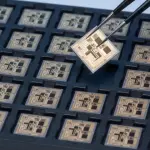
This approach tackles a fundamental bottleneck in scaling quantum computing, the exponential growth of wiring required to manage each qubit. This work originates from the Hefei National Research Center for Physical Sciences at the Microscale.
University of Science and Technology Research Team
Researchers from China detailed a method to significantly reduce the physical infrastructure needed to control large quantum processors, a critical step toward scaling beyond current limitations. The work, recently published, focuses on a “Control Line Multiplexing Framework” that minimizes the number of physical connections required within a dilution refrigerator, the specialized cooling system necessary for superconducting qubits. Extending the current “dedicated-control-line paradigm” to the millions of qubits anticipated for fault-tolerant quantum computing would quickly overwhelm the available wiring density and cooling capacity.
The researchers report that their framework circumvents this issue by intelligently sharing control signals, effectively reducing the hardware burden. This is particularly important as universal fault-tolerant superconducting quantum computers require millions of physical qubits to function effectively. The team’s innovation isn’t simply about reducing wire count; it’s about maintaining the fidelity of quantum operations while doing so.
The source material states that exceeding the wiring density and cooling-power budget of dilution refrigerators is a major challenge, and this framework offers a potential solution. The researchers successfully implemented this multiplexing scheme, demonstrating its feasibility and clearing the way for denser, more manageable quantum chips. The framework’s design allows for the potential to control over 1000 qubits with a significantly reduced number of control lines, a substantial improvement over existing architectures.
This reduction in physical connections also simplifies the manufacturing process and lowers the overall cost of building large-scale quantum computers. The research team’s affiliations span multiple institutions, including the Hefei National Laboratory, highlighting a collaborative effort to overcome these scaling challenges.
Control Line Multiplexing Framework Overview
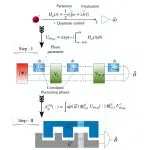
The University of Science and Technology of China team devised a method to combine multiple gate pulses into a single polychromatic microwave waveform, enabling spectral routing to individual qubits or couplers. This approach uses frequency as an addressable control dimension, effectively transforming a physical control line into a frequency-resolved control bus. By sharing this resource, the framework minimizes the number of physical connections needed to operate a quantum processor.
This spectral routing relies on band-pass filters, which isolate and direct specific frequencies within the combined waveform to the intended quantum elements. This allows for the efficient allocation of control signals, circumventing the limitations imposed by traditional wiring schemes. This scalability is a key advantage, as it directly addresses the exponential growth in wiring complexity that has historically hindered the development of larger quantum processors.
The implementation of this framework is not merely theoretical. The researchers successfully demonstrated its feasibility through practical implementation. This validation is essential, as it confirms the potential for real-world application and provides a foundation for further optimization and refinement. The work represents a step toward overcoming a fundamental obstacle in quantum computing.
Scalable Quantum Computing Architecture Design
The demonstrated architecture coordinates frequency and time-based resource sharing, moving beyond simply reducing wiring density. This coordination allows for a complete, scalable multiplexed-control system essential for universal fault-tolerant quantum computing, a system previously lacking a key component. The team’s approach integrates frequency-division multiplexing (FDM) with existing temporal division multiplexing (TDM) and on-chip DC sources, creating a control framework that combines these elements. Analysis of the multiplexed phase-controlled-Z (MP-CZ) gate revealed the frequency-allocation constraints and potential error mechanisms inherent in parallel operation, guiding the experimental design.
Demonstrations of 1:4 FDM for both single-qubit gates and MP-CZ gates showed no statistically significant multiplexing-induced degradation after waveform pre-distortion, a critical validation of the approach. These results indicate that frequency sharing can be implemented at the gate level without compromising fidelity, establishing a foundational element for an all-microwave quantum control architecture.
The success of this method hinges on waveform pre-distortion, which mitigates errors introduced by the multiplexing layer; with this correction, gate performance matched dedicated-channel baselines. “These results establish the gate-level feasibility of the architecture and support its periodic extrapolation toward scalable fault-tolerant quantum control,” the researchers write, highlighting the potential for expansion.
This framework is not limited to the current demonstration; its compatibility with TDM and on-chip DC sources suggests a versatile platform for future quantum processor designs, potentially enabling the control of processors with the hundreds of thousands of physical qubits needed for complex calculations like factoring a 2048-bit RSA integer.
Multiplexing Method Reduces Control Line Demand
Spectral routing, combining multiple gate pulses into a microwave waveform and directing them to specific qubits or couplers using band-pass filters, underpins the architecture of this new control scheme. Compatibility with both time-division multiplexing and on-chip DC sources further expands the system’s versatility. Extrapolating these results, the team projected resource requirements for a system of 381,000 physical qubits.
A traditional dedicated-line approach would require 1,143,000 control lines, assuming three lines per qubit. However, the multiplexed system requires only 23,814 lines, calculated based on a 32-qubit/64-coupler unit, with the first term accounting for qubit lines and the second for coupler-branch lines.
Framework Implementation for Quantum Chip Control
This architecture allows for the simultaneous activation of multiple couplers, assigning them to the same control pattern during parallel gate layers, a common structure in error-correction cycles and many quantum algorithms. This error suppression is critical for maintaining high-fidelity gate operations within the multiplexed system. Projections indicate that this line-reduction strategy significantly lowers conductive load, remaining within the representative 5-30 μW MXC cooling range, though this estimate excludes parasitic loads from filters, switches, splitters, packaging and on-chip sources.
The team derived a 1:48 line-reduction factor from an idealized frequency plan, demonstrating the potential for substantial hardware simplification. All source data supporting these findings are available from the corresponding author upon reasonable request, and custom code used for simulations and data analysis is also available. “Our results establish FDM gate control as a viable route to reducing the control-line overhead of superconducting quantum processors,” the researchers report.
Addressing Limitations of Current Control Schemes
Frequency-selective control of microwave-based two-qubit gates circumvents limitations present in earlier multiplexing schemes, enabling a pathway toward significantly reduced wiring complexity. Unlike unipolar flux-pulse gates, these gates use a carrier-frequency degree of freedom naturally suited to frequency division multiplexing. The team demonstrated that, after calibration, the implemented frequency multiplexing control chain introduces no measurable additional gate error.
This finding demonstrates that the introduced multiplexing does not significantly degrade gate performance, an important aspect of practical implementation. The ability to maintain high fidelity while reducing control lines represents an advancement in addressing the scalability challenges facing quantum computing.
Potential for Increased Quantum Chip Size
The demonstrated control architecture projects a reduction in required control lines to one-twelfth of current unmultiplexed baselines, and to one-forty-eighth under idealized conditions, offering a pathway toward significantly larger quantum processors. These estimates, detailed in the supplementary materials, are based on the observed gate parameters and suggest a substantial decrease in hardware complexity as qubit counts increase. This line-reduction factor is critical, as the exponential growth of wiring has long been a primary obstacle to scaling superconducting quantum systems beyond a few dozen qubits.
This approach shifts the bottleneck from physical wiring to the bandwidth of control electronics and processor size, challenges that are more readily addressed with advancements in conventional microfabrication and signal processing. The team demonstrated a 1:4 FDM configuration, achieving average errors of (10. 6 ± 0. This finding is particularly important, as maintaining high fidelity while reducing control lines is essential for practical quantum computation.
The research team’s work extends beyond theoretical design, demonstrating a functional 1:4 multiplexing configuration. This broad participation highlights the complexity of the engineering challenges involved in scaling quantum systems. The authors state in their published work.
👉 More information
🗞 A Control Line Multiplexing Framework for Scalable Quantum Computing
✍️ Dayu Li et al.
🧠 ArXiv: https://arxiv.org/abs/2610.35227



See today’s quantum computing news on Quantum Zeitgeist for the latest breakthroughs in qubits, hardware, algorithms, and industry deals.