Established methods used to measure distant stars, originally conceived using radio waves and later adapted for visible light, now encompass matter beyond photons, including atoms. The investigations explore two-particle interference phenomena demonstrated through Hanbury Brown Twiss and Hong Ou Mandel experiments; revealing a key connection between these approaches in quantum optics. These studies build upon earlier techniques, offering new avenues for exploring particle behaviour and furthering our understanding of quantum systems.
Links exist between two key quantum optics experiments, Hanbury Brown Twiss and Hong Ou Mandel, which examine how individual particles interfere; both have been demonstrated using atoms and photons. The team showed these seemingly different setups share underlying principles governing two-particle interference, revealing a fundamental similarity in particle behaviour. By unifying concepts across various types of matter, investigations like these deepen understanding within quantum optics and may inspire novel approaches to studying quantum systems.
Two cornerstone quantum experiments, Hanbury Brown Twiss and Hong Ou Mandel, are now unified beyond light to encompass matter waves created using atoms. These studies reveal that despite appearing distinct, both setups share fundamental principles governing how pairs of particles interfere, demonstrating a surprising similarity in particle behaviour regardless of whether photons or atoms are used. Imagine shining two flashlights on a wall; Hanbury Brown Twiss looks for subtle patterns created by correlated fluctuations in their brightness.
Similarly, splitting a single water droplet into two paths before recombining it illustrates how individual “particles” can behave like waves, sometimes interfering destructively as if avoiding each other. This work builds upon decades of research into quantum optics and raises an intriguing question: what new insights will emerge from applying these unified concepts to explore the intricacies of complex quantum systems.
Correlated Particle Detection Measures Intensity Fluctuations for Angular Size Determination
The technique at the heart of these investigations carefully measured correlations between arriving particles, initially photons, then later atoms. Stellar interferometry concepts first proposed in 1868 provided its foundation; rather than directly imaging distant stars through telescopes, fluctuations in light intensity were measured by paired receivers connected to an electronic circuit that multiplied their signals over time. Like overlapping ripples on a pond, multiple tiny objects acting as waves can exhibit stronger or weaker combined effects depending on how their “waves” align, this correlation revealed information about the source’s angular size without requiring high-resolution optics.
Dating back to 1868, stellar interferometry principles underpinned these experiments and signal fluctuations were measured via an electronic circuit multiplying signals over time. The characteristic distance of signal decay indicated measurement of a source’s angular size. Two receivers converted incoming radiation into electrical currents; however, specific parameters remained undisclosed within these tests.
Atomic interference replicates photon correlations revealing universal quantum behaviour
Stellar interferometry has evolved since its initial suggestion in 1868, with atomic interference experiments now achieving correlation measurements using atoms where photons previously dominated. This breakthrough enables investigations into matter-wave analogues of light phenomena, something impossible before due to limitations controlling and detecting atom pairs with sufficient precision. Hanbury Brown Twiss (HBT) and Hong Ou Mandel setups reveal fundamental similarities whether they utilise photons or atoms as interfering particles.
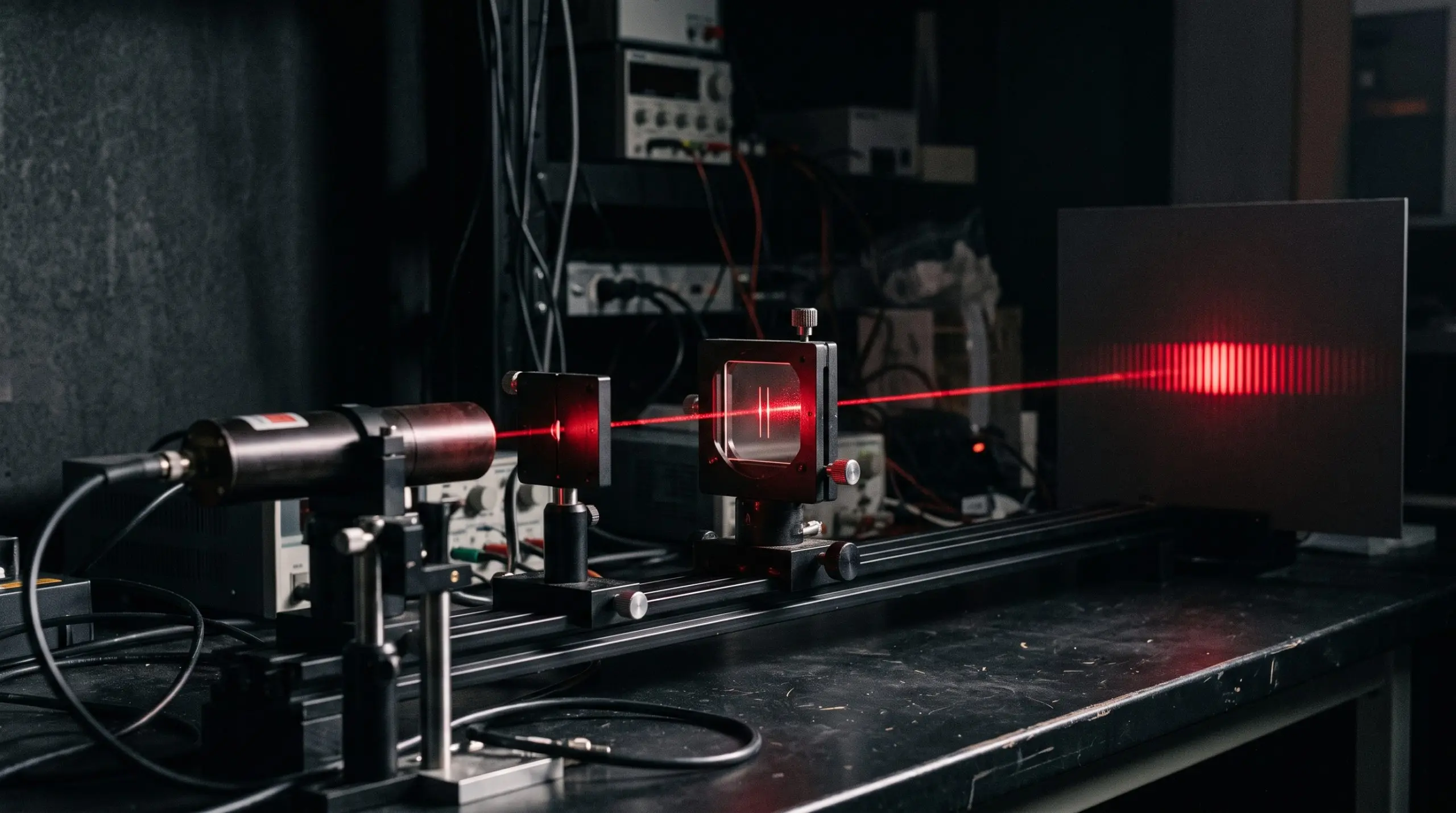
Unifying these approaches deepened understanding within quantum optics and opened new avenues for exploring particle behaviour beyond traditional photonic systems. Experiments replicated key features observed in photon-based Hong Ou Mandel (HOM) setups; specifically, indistinguishability between two atomic matter waves was achieved, their paths intertwined so that they behaved like a single entity, demonstrating interference patterns analogous to those seen with light.
In particular, these atom interferometers operated using rubidium-87 atoms cooled to just nanokelvins above absolute zero and accelerated to around ten metres per second for optimal wave behaviour. Coincidence counts were measured, recording simultaneous detection of both atoms, and similar dips in correlation strength as predicted by quantum theory for photons undergoing HOM interference appeared, even though the atoms had no direct interaction beyond this initial beam splitting.
Pedagogical Value Versus Scalability Challenges In Quantum Interference Studies
Extending two-particle interference experiments beyond photons to include atoms confirms fundamental principles across matter types; however, its primary value is pedagogical, consolidating existing knowledge rather than presenting novel data or theoretical breakthroughs. This focus raises an intriguing question about future directions: can such unified concepts truly unlock more complex quantum systems. Or will limitations controlling larger numbers of particles and maintaining their delicate coherence ultimately prove insurmountable for practical applications like advanced sensing technologies?
Despite acknowledging the consolidation of current understanding, considerable value remains in teaching and outreach purposes. Demonstrating two-particle interference with diverse matter reinforces core principles accessibly. This strength is vital as the field seeks wider public engagement alongside technological advancement, building foundational knowledge will be crucial when tackling more complex systems needed for improved sensors or computing technologies.
Next steps likely involve scaling up these systems, a challenge that could unlock new quantum optics experiments. The phenomenon’s demonstration using both light and atoms unifies concepts within quantum optics; similar results appear when utilising matter instead of photons as interfering particles.
This research demonstrated two-particle interference using seven atoms cooled to nanokelvins, confirming this quantum behavior extends beyond photons to include matter waves. Observing dips in correlation strength between the accelerated atoms, traveling at around ten metres per second, validates existing theory about how multiple particles interact through wave properties. This work primarily serves a pedagogical purpose by unifying core concepts across different types of particles used in quantum optics experiments. The authors suggest scaling up these systems represents a logical next step for exploring more complex quantum phenomena.
👉 More information
🗞 Two particle interference: The Hanbury Brown Twiss and Hong Ou Mandel experiments
✍️ Christoph I Westbrook
🧠 ArXiv: https://arxiv.org/abs/2610.30002

See today’s quantum computing news on Quantum Zeitgeist for the latest breakthroughs in qubits, hardware, algorithms, and industry deals.