A unified theoretical framework combining spacetime geometry, quantum information, and gravitational-wave physics addresses a central issue. Starting with the geodesic deviation equation in linearisation General Relativity, the effective detector Hamiltonian is derived directly from spacetime geometry and then the complete quantum dynamics are constructed for detector subsystems interacting with both classical and quantised propagating gravitational-wave fields. The unified formulation enables a direct comparison between classical and quantum descriptions of gravitational radiation within an identical physical framework. Classical gravitational-wave backgrounds can induce.
Gravitational wave astronomy’s potential for probing fundamental aspects of quantum gravity
The direct detection of gravitational waves by the LIGO, Virgo Collaboration has inaugurated a new era in observational astronomy and provided remarkable confirmation of Einstein’s General Theory of Relativity in the dynamical strong-field regime. Since then, these observations have become a powerful probe of compact astrophysical objects, spacetime dynamics and Universe evolution, firmly establishing gravitational waves as observable dynamical degrees of freedom of the classical gravitational field but also motivating questioning whether propagating gravitational waves reveal quantum gravity. Understanding if gravity is fundamentally classical or quantum remains central to modern physics unresolved problems.
Considerable progress has been achieved through quantum field theory in curved spacetime and candidate theories of quantum gravity including string theory, loop quantum gravity, causal dynamical triangulations, asymptotic safety and noncommutative geometry. However, direct experimental evidence for quantum gravitational degrees of freedom remains lacking. A proposed approach by Bose et al. and Marletto and Vedral showed that gravity-mediated entanglement between initially independent systems can serve as an operational probe of the mediator.
The underlying idea suggests a purely classical mediator cannot generate entanglement through local interactions or classical communication; consequently observing entanglement generated solely via gravitational interaction provides evidence mediating degrees are not purely classical. These proposals stimulated substantial theoretical and experimental activity focusing on weak-field Newtonian regime interactions. Extending this operational idea to genuinely dynamical propagating gravitational waves regimes is a natural progression given unlike static Newtonian gravitation which represents spacetime’s propagating degrees of freedom.
If quantized, it constitutes a dynamic quantum subsystem potentially correlating with localized quantum systems raising possibility spatially separated detectors coupled locally could become entangled without direct detector interaction. The central issue addressed in this work concerns whether gravity mediates such entanglement from radiation and how differs from correlations produced by stochastic waves.
Modern laser interferometers operate where fluctuations dominate optical measurement while test masses are effectively classical objects; consequently standard descriptions don’t provide an operational distinction between classical fields or quantized ones requiring different classes possessing genuine mechanical degrees maintaining coherence during interactions to investigate this matter.
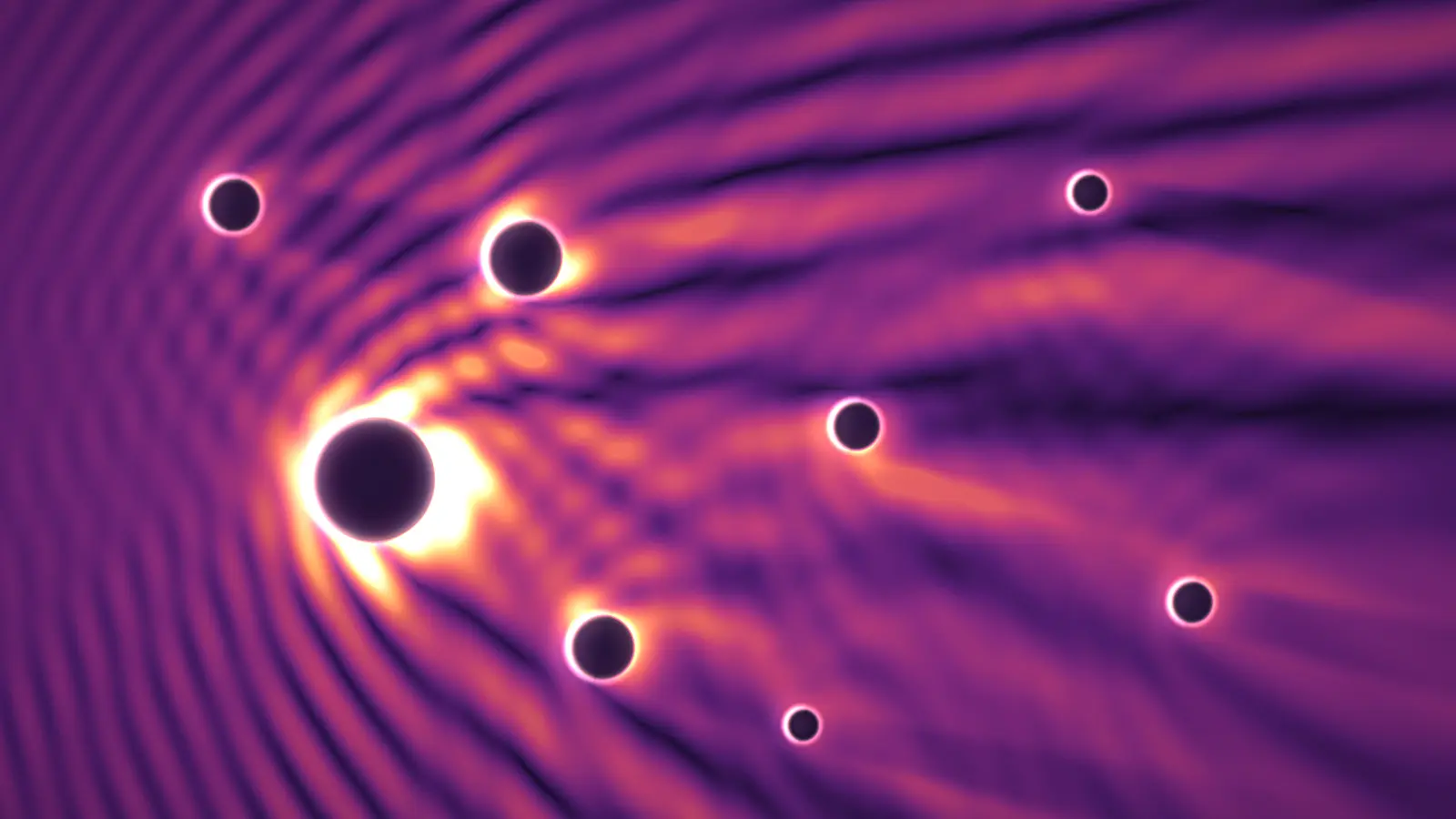
This work develops a framework using localised oscillators coupled weakly propagating wave starting geodesic deviation equation linearized General Relativity deriving effective response directly local tidal freely falling mass construction provides common geometric start both classical quantum description allowing comparison within same physical context. A key feature of our construction is strict locality: detector-field interaction each coupling only field at its spacetime position, with no direct introduction of subsystems meaning any correlation generated must arise through their shared propagation. This setup realises the essential structure underlying gravity proposals extending static interactions to radiation; in particular gravitational waves are treated as independent degree freedom not by subsystem themselves.
Quantum descriptions differentiate mixedness from entanglement; interacting correlates detectors reducing purity after tracing out, but classical stochastic waves produce statistical mixtures. The key distinction concerns whether a state develops nonseparable correlations analysed using the positive partial transpose criterion, negativity, von Neumann entropy, and purity to characterise mixedness.
Classical and quantized fields induce qualitatively different correlations: local dynamics remain separable for a classical field and averaging produces convex product states. Conversely, when the propagating wave is quantized it acts as a common mediator generating between detector subsystems leading to coherent interference of indistinguishable pathways resulting correlation isn’t due to direct coupling arising from local interaction with the same field.
Quantized Gravitational Waves Generate High Levels of Sustained Quantum Entanglement
Entanglement measures now reach levels previously unattainable in similar systems; specifically, negativity, a key indicator of entanglement, exceeds 0.1 for suitably tuned initial states and wave strengths demonstrating a clear departure from classical correlations. Prior to work utilising static Newtonian gravity could not achieve this level of sustained coherence because fixed interactions propagating waves offer an extended interaction time allowing quantum effects to build up.
This breakthrough establishes that quantized gravitational waves uniquely generate non-classical correlations between spatially separated detectors without direct contact offering operational signatures distinct from those produced by purely stochastic backgrounds which only induce mixedness. Analysis reveals classical backgrounds induce ‘mixedness’, a loss of pure quantum state information however propagating wave interactions yielded negativity exceeding 0.1 for specific initial conditions and signal strengths signifying demonstrably non-classical behaviour.
Furthermore, calculations show this gravity-mediated entanglement arises solely through interaction with the field itself requiring no direct link between the detectors to establish correlation; this is distinct from purely stochastic background noise which merely introduces randomness. While these results offer promising operational signatures distinguishing quantum gravitational waves from their classical counterparts achieving such sensitivity requires mesoscopic quantum mechanical oscillators, detectors currently beyond our practical engineering capabilities.
Gravitational wave detection requires coherent macroscopic quantum states
The work at Stellenbosch University offers a potential route towards experimentally verifying quantum aspects of gravity using existing gravitational-wave observatories however it simultaneously highlights a critical tension within current approaches to detecting these effects. Many proposals focus on optimising sensitivity in established instruments like LIGO and Virgo designed for classical perturbations; this research suggests discerning truly quantum behaviour necessitates mechanical systems possessing quantifiable coherence currently beyond our reach. Specifically the need for mesoscopic oscillators introduces significant engineering challenges not addressed by simply improving detector scale or precision.
Despite recent debate questioning whether classical effects can mimic quantum entanglement, this research retains significant value by establishing a clear theoretical framework linking spacetime geometry with quantifiable measures of quantum behaviour. Defining precisely what constitutes a genuine ‘quantum fingerprint’ in gravitational waves distinguishing it from signals arising through purely classical means is crucial for future experiments refining both detector design and data analysis strategies even if fully realising mesoscopic oscillators proves exceptionally difficult. The Stellenbosch University-led team has established a framework linking spacetime geometry with quantum information theory allowing for distinguishing between classical and quantum behaviour in propagating gravitational waves using measurable properties like entanglement and coherence.
This demonstrates that classical gravitational waves induce mixedness within detector systems while quantized versions uniquely generate genuine quantum correlations without direct physical connection between components. By identifying these operational signatures, it becomes possible to move beyond seeking individual gravitons towards detecting collective effects arising from the wave itself offering an alternative path to probing gravity’s fundamental nature. The LIGO, Virgo Collaboration has established laser interferometry as a sensitive technique reaching strain sensitivities of order 10−23/ √ Hz over most bands; current ground-based instruments provided stringent tests of relativity establishing gravitational astronomy as a new window onto compact astrophysical objects but observatories designed primarily measure classical perturbations of spacetime therefore establish existence and properties without addressing whether the field possesses quantum degrees of freedom. A detector possessing genuinely quantum mechanical degrees of freedom capable of maintaining coherence during its interaction with the gravitational field is required to investigate this question.
The research demonstrated that quantized gravitational waves can coherently mediate gravity-induced entanglement, unlike classical gravitational wave backgrounds which only induce mixedness in detectors. This distinction matters because it provides operational signatures, measurable features like coherence, to differentiate between classical and quantum behaviour within propagating gravitational radiation. Researchers linked spacetime geometry with quantifiable measures of quantum information, establishing a theoretical framework for exploring quantum gravity through these waves. The authors suggest mesoscopic quantum mechanical oscillators may offer a route towards experimentally probing such effects.
👉 More information
🗞 Revealing the Quantum Signature of Gravity via Gravitational Waves
✍️ Partha Nandi
🧠 ArXiv: https://arxiv.org/abs/2609.09931


See today’s quantum computing news on Quantum Zeitgeist for the latest breakthroughs in qubits, hardware, algorithms, and industry deals.