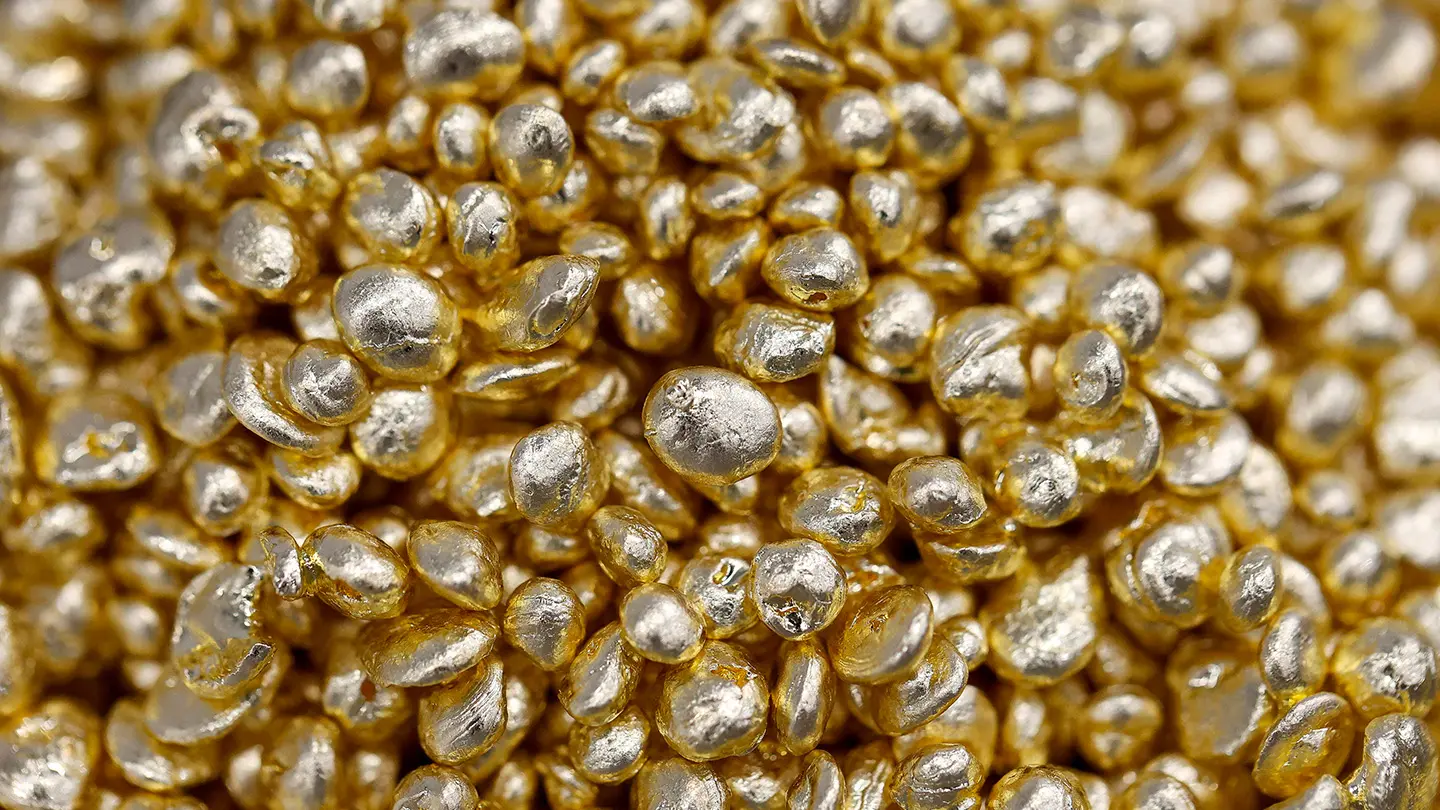
Without a rapid rearrangement of its surface atoms, gold would begin to oxidize in seconds, challenging the long-held perception of the metal’s inertness. Researchers have discovered that gold’s resistance to tarnish stems from how its atoms reconstruct from a square arrangement into hexagons, a process that actively hinders reactions with oxygen. The team calculated how well different gold surfaces could split oxygen molecules, the first step in oxidation, finding the square arrangement was significantly more effective at the task than the hexagonal form. “Just how much more reticent the reconstructed gold was to oxidize was definitely a surprise,” says Matthew Montemore, a chemical engineer at Tulane University in New Orleans. These findings, reported May 21 in Physical Review Letters, could also inform the design of more effective catalysts.
Surface Reconstruction Hinders Oxygen Splitting in Gold
A subtle atomic shift is responsible for gold’s famed resistance to corrosion, preventing oxidation that would otherwise occur within seconds. Researchers discovered that the inertness isn’t simply a lack of reactivity, but an active process of surface rearrangement that dramatically slows the initial step of oxidation: splitting oxygen molecules. The team’s calculations, published May 21 in Physical Review Letters, reveal that the geometry of gold’s surface plays a critical role in this protection, challenging the long-held assumption of its inherent stability. For oxidation to begin, diatomic oxygen in the air must first be broken down into individual oxygen atoms capable of bonding with the metal; the research focused specifically on how well gold’s surface could accomplish this initial split. When freshly exposed, gold atoms don’t remain in their standard lattice arrangement but instead undergo reconstruction, shifting from a square pattern to hexagons.
Surprisingly, the researchers found the square arrangement is significantly more effective at splitting oxygen, a detail that highlights the importance of surface structure. The hexagonal structure, while stable, requires a distortion back to the square arrangement before it can effectively split oxygen molecules, creating an energetic barrier to oxidation.
Quantum Calculations Reveal Hexagonal Structure’s Resistance
The longstanding puzzle of gold’s resistance to tarnish has yielded a new insight, moving beyond simple inertness to reveal a dynamic surface mechanism at play. This process isn’t a passive barrier, but an active defense against the initial step in corrosion: splitting diatomic oxygen molecules. Researchers focused on calculating how effectively different gold surface arrangements could accomplish this molecular division, investigating both hexagonal and square atomic configurations. Although any oxide layer forming on gold would likely be thin and unstable, understanding this initial resistance is crucial for designing more effective catalysts, and the findings could help scientists engineer materials that control chemical reactions with greater precision.
Just how much more reticent the reconstructed gold was to oxidize was “definitely a surprise,”
Researchers at Tulane University, led by chemical engineer Matthew Montemore, are refining the understanding of gold’s remarkable resistance to corrosion through detailed analysis of its surface atomic structure; this work extends beyond simply acknowledging gold’s inertness to pinpointing the mechanism behind it. This detailed understanding of gold’s surface chemistry could therefore contribute to advancements in a range of fields reliant on controlled chemical processes.




See today’s quantum computing news on Quantum Zeitgeist for the latest breakthroughs in qubits, hardware, algorithms, and industry deals.