Quantum computing, artificial intelligence and space flight keep running into one another, and few people sit closer to all three than Elon Musk. His companies cover rockets, cars, brain implants and AI. He ties the lot back to a single stated aim, which is keeping the human race alive and comfortable for the long run. That is the frame he brings to quantum computing.
Musk made his name and his first fortune at PayPal, and since then he has picked his ventures by the size of the threat each one answers. He runs SpaceX, Tesla, Neuralink, xAI, The Boring Company and X, and the list is less scattered than it looks. Every one of them is aimed at something that could go badly wrong for the species, from a wrecked climate at one end to an artificial intelligence that slips the leash at the other.
SpaceX is the clearest case. Its rockets come back and fly again, and its Mars plans exist so that one bad day on Earth does not end the story. Tesla works the other side of the same problem, selling electric cars and clean power in place of oil and gas.
How Elon Musk Came Round To Quantum
Musk has moved from watching the field at a distance to arguing about where its machines ought to be built. He read physics at the University of Pennsylvania, and he has said that quantum mechanics was among the hardest things he studied there. The struggle seems to have stuck with him rather than put him off, because he keeps coming back to questions about what reality is made of.
The change shows up in what he posts. In December 2024, Box CEO Aaron Levie wrote about progress in the field, and Musk replied: “I’ve heard from a few people now that quantum computing is showing real promise.” For a man who had treated the whole subject as a curiosity, that was a shift.
By February 2025 he was following it closely. Satya Nadella announced Microsoft‘s Majorana 1 processor. Musk observed: “More and more breakthroughs with quantum computing …” The reply was four words long. It landed on a topological qubit, a design that stores information in the shape of a system rather than in one fragile particle, and the industry had spent years calling that a long shot.
The October 2025 reply was the telling one. Sundar Pichai posted that Google‘s Willow chip had reached quantum advantage on a molecular problem whose answer could be checked independently, and Musk congratulated the team: “Congrats. Looks like quantum computing is becoming relevant.” He rarely hands a rival a compliment, so the tone said as much as the words.
The enthusiasm comes with a worry attached. In August 2025, after IBM published its quantum roadmap, he put a question to Grok in public: “estimate the probability of quantum computing cracking SHA-256.” SHA-256 is the hash function that sits under Bitcoin and much of the rest of the crypto world. That is the part he keeps returning to.
Quantum Computers On The Moon
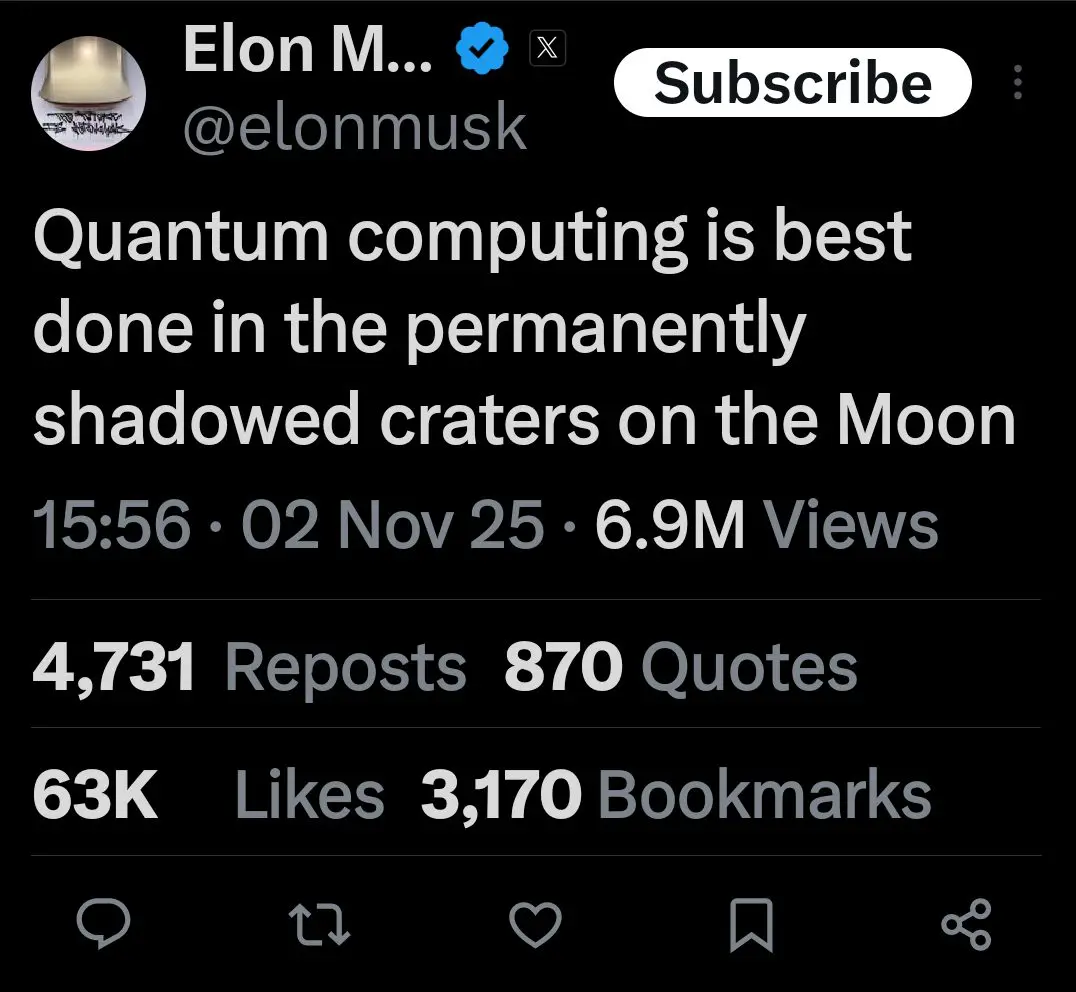
His boldest quantum idea so far arrived in November 2025, when he posted: “Quantum computing is best done in the permanently shadowed craters on the Moon.” It reads like a throwaway line. There is real physics behind it.
He set the case out on the All-In Podcast. A crater floor that never sees the Sun sits below -200°C, so some of the cooling a quantum machine needs comes free. The permanent dark keeps stray energy out, the near-vacuum keeps stray noise out, and the crater walls block the solar radiation that knocks qubits off their values. He pointed to Google’s own figures, which show quantum errors climbing when the Sun is active, and argued that a machine on the Moon would simply hold steadier.
The idea also fits the lunar plans SpaceX already has, which is presumably part of its appeal. On the podcast he called the wider scheme “Gigahard” infrastructure in space, a phrase that tells you he is not picturing another data centre on Earth.
Will Musk Enter the Quantum Computing Arena?
Elon Musk has a habit of walking into industries that look slow and stuck, so the obvious question is whether quantum computing is next. He went from a cautious note in December 2024 to a specific November 2025 proposal about where the machines belong, and that is a long way past idle interest.
A few things point that way. He tends to start companies at the moment a technology stops being a lab curiosity and starts being a product, and quantum computing is somewhere near that line now. The fit with what he already owns is easy to see. Tesla would put it to work on materials and battery chemistry, SpaceX on trajectories and communication links, and xAI on the artificial intelligence it is chasing.
If he does come in, he is unlikely to do it the usual way. Going head to head with IBM, Google or IonQ on general-purpose machines would mean fighting on their ground. A “SpaceQ” outfit that put quantum hardware on top of SpaceX launches would play to what he already has. It would build for orbit or for the Moon, and sell the time to businesses and to scientists alike.
There is a second way in, through the AI side. On a September 2025 podcast about AI and Bitcoin security he covered both halves of the same coin. One half is the speed a quantum machine might add to AI training, the other is the damage it might do to the codes that keep money safe. He called fault-tolerant machines, the kind that correct their own errors well enough to run a long calculation, “decades away.” What he would not rule out is the two fields arriving together at the moment machines outrun us, which he expects and dreads in roughly equal measure.
The clock suits him too. Eleven months separate “real promise” from a plan for craters on the Moon, and that is a fast run for a man with a great many other things on. The compliment to Google says something as well, because he does not usually hand those out.
What Elon Musk Is Worried About
Every time he talks the field up, he adds a caveat about security. The SHA-256 question in August 2025 was the short version of a longer worry he has aired on podcasts. Shor’s algorithm would break RSA, the encryption that guards most web traffic, by pulling large numbers apart into the primes that make them up. Grover’s algorithm does something milder to hash functions, cutting the work of an attack to roughly its square root, and both land on Bitcoin and on the wider blockchain world.
He does not think the danger has arrived. Machines good enough to break today’s encryption are still years off, he says, and in the meantime the thing that actually loses people their money is a person clicking the wrong link. If he ever does build in this field, that view suggests he would ship the defence alongside the machine. He would work on codes a quantum computer cannot break at the same time as the computer itself.
Simulation, And Why He Keeps Raising It
The other thread running through all of this is the simulation hypothesis, the idea that what we take for the universe is a computation running somewhere else. Wave function collapse is the way a quantum system stops being a spread of possibilities the moment anyone measures it. He has suggested that this looks like the sort of corner-cutting a simulation would do to save effort. On that reading a quantum computer is not only a tool. It is a way of poking at the machinery.
That is not a business case. It may weigh on him more than one. If the world really does run on something like computation, then a quantum computer is the closest instrument anyone has built to the thing being measured. The question of whether we live inside a simulation would stop being an argument and start being an experiment.
What To Watch For
Through 2025 his public remarks stopped being asides and started being proposals. That is usually the stage at which he does something. It might be a new company, it might be a quantum team inside one of the firms he already runs, or it might be a partnership with somebody who owns the hardware.
The pieces line up too neatly to ignore. Space gives him the cold, dark, quiet places the machines want. AI gives him a reason to want the computing power, and the questions about reality give him a reason to care beyond the balance sheet. On the All-In Podcast he tied quantum computing to the same civilisational argument he makes about rockets, which is his way of saying he thinks it is necessary rather than merely interesting.
So the field may be about to acquire another large and disruptive participant in Elon Musk. The posts and the podcast appearances show more than curiosity now; they show a position forming. He started by noting what Microsoft had done, and he ended by saying where the machines belong.
An announcement could come in the next few months, or the capability could simply appear inside the companies he already runs without one. Either way he would arrive holding two things almost nobody else in quantum computing has, which are launch capacity and a large AI operation. He also brings a long record of taking on jobs that everyone competent had already written off.
The November 2025 post about the Moon made the point in a single line, which is that the best place to do a thing is not always on this planet. If Elon Musk does come in, he will not come in the way the incumbents expect. The interesting question then stops being whether he shapes quantum computing and becomes how far he bends it.

See today’s quantum computing news on Quantum Zeitgeist for the latest breakthroughs in qubits, hardware, algorithms, and industry deals.