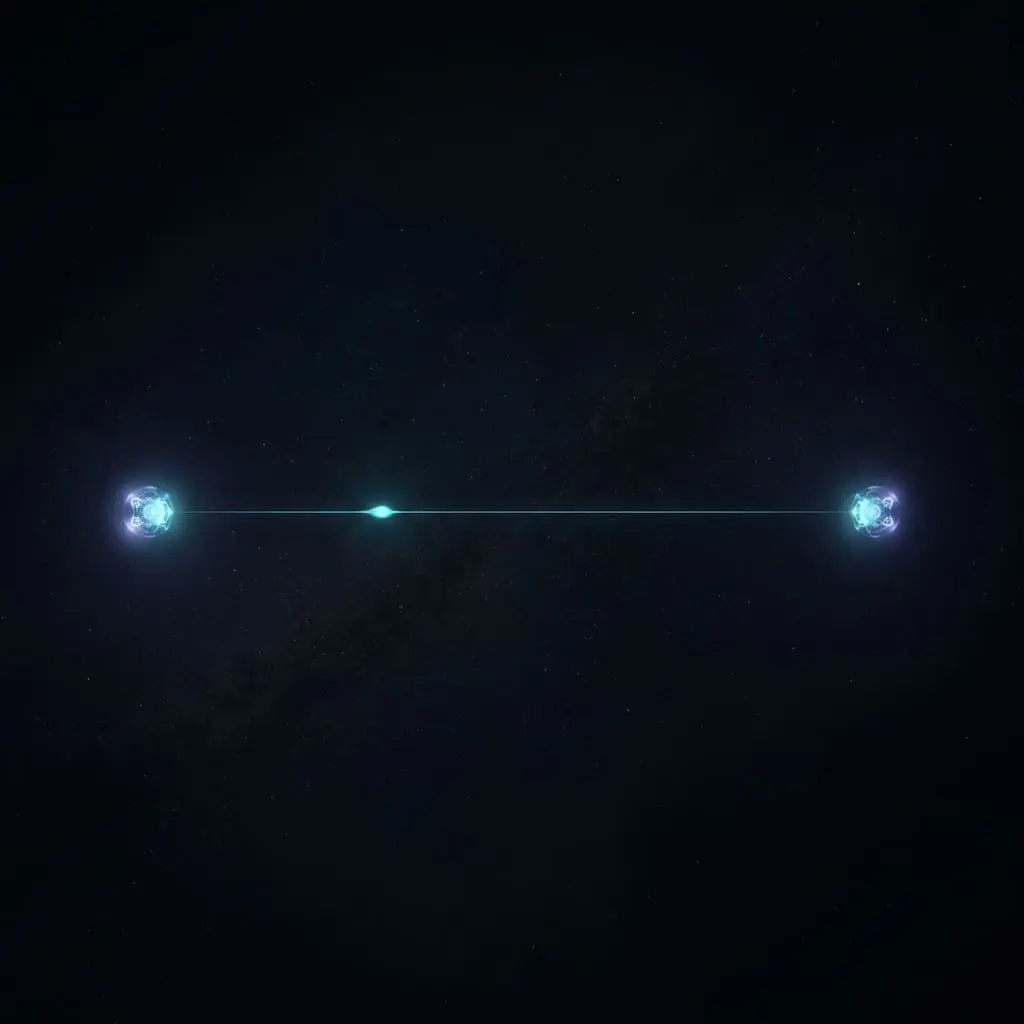
An advance in entanglement distribution has been experimentally demonstrated by efficiently generating Gaussian continuous-variable entangled states in parametrically driven systems, even over long distances. While most quantum applications require discrete-variable systems, researchers have overcome this mismatch by coupling qubits to a broadband reservoir of correlated photonic states, driving them into a pure and almost maximally entangled Bell state. This entangled state is stabilized remotely in a fully autonomous manner, without the need for synchronized pulses or other forms of active control. This fully autonomous entanglement stabilization, demonstrated for the first time experimentally after a proposal from Kraus and Cirac more than twenty years ago, offers a key feature for building scalable quantum computing platforms and networks.
Gaussian continuous-variable entangled states represent an advancement in quantum information processing because they can be efficiently generated in optical, microwave, mechanical, or electro-optic systems and distributed over long distances, a capability traditionally associated with discrete-variable systems. Unlike conventional distribution schemes relying on direct photon exchange, this new approach utilizes a nonlocal interference effect, harnessing preexisting quantum correlations within a distributed photonic state. This allows for entanglement stabilization between qubits even when they are spacelike separated and opens possibilities for multiplexing, enabling a single photon source to generate multiple entangled pairs in parallel, with the rate of generation limited only by the bandwidth of the source. Researchers presented the first experimental demonstration of this hybrid entanglement distribution scheme, driving two transmon qubits with the output of a nondegenerate Josephson parametric converter, achieving a concurrence of C = 0.10 ± 0.01, fully consistent with theoretical models.
Much quantum networking research focuses on discrete variable systems, but entanglement of stationary qubits is gaining traction as an alternative. These states, generated in systems like optical, microwave, or electro-optic setups, offer high throughput and the potential for long-distance distribution, a capability not always inherent in discrete-variable approaches. Researchers are now demonstrating how to bridge this gap between readily available continuous-variable entanglement and the requirements of practical qubit-based quantum processing. Importantly, the stabilization of this entanglement occurs without the need for precisely timed control pulses or other active interventions, a critical feature for building scalable quantum networks. The Josephson parametric converter produces a propagating two-mode squeezed state of microwave photons, which successively relaxes the qubits into an entangled steady state, separated by 50 centimeters of coaxial cable. A concurrence of C = 0.10 ± 0.01, aligns with theoretical predictions and suggests pathways for expanding the system to multiple qubits. The qubits can certify entanglement of the microwave state directly at cryogenic temperatures.
Bridging Discrete and Continuous Variables with Photonic Reservoirs
We implement a prototype dual-rail quantum network, where a Josephson parametric converter acts as an entanglement source that emits a broadband two-mode squeezed state of correlated microwave fields. In this work, we present the first experimental demonstration of this hybrid entanglement distribution scheme, which was originally proposed by Kraus and Cirac more than twenty years ago. We do so by driving two separated transmon qubits with the output of a nondegenerate Josephson parametric converter. The converter produces a propagating two-mode squeezed state of microwave photons, which successively relaxes the two frequency-detuned qubits, separated from the photon source by 50 centimeters of coaxial cable each, into an entangled steady state. This process occurs autonomously, mediated by the dissipation into the correlated photonic reservoirs.
We verify and quantify the predicted transfer of entanglement from a continuous-variable reservoir to a discrete-variable qubit state together with the underlying nonlocal interference mechanism. The observed buildup, stabilization, and squeezing-dependent concurrence of the reduced two-qubit state of up to C = 0.10 ± 0.01 is fully consistent with a theoretical model, and we identify clear pathways for further improvements and extensions to multiqubit settings. We further show that, by employing the qubits, we can certify entanglement of a weakly excited microwave state, directly at cryogenic temperatures and in a parameter regime where conventional linear detection schemes with noisy preamplifiers are inefficient and require calibrated noise subtraction.
Experimental Demonstration of Hybrid Entanglement Distribution
While quantum entanglement is often envisioned as a direct link between qubits, a hybrid entanglement distribution scheme originally proposed over two decades ago has been experimentally demonstrated to remotely stabilize entanglement by harnessing existing quantum correlations within a shared photonic state. This process bypasses the need for direct photon exchange between quantum nodes and occurs autonomously, mediated by the dissipation into the correlated photonic reservoirs, without requiring synchronized pulses or active control. The observed concurrence of the reduced two-qubit state is up to C = 0.10 ± 0.01, which is consistent with a theoretical model and suggests pathways for scaling to multiqubit systems.
Beyond simply generating entanglement and quantifying its transfer and fidelity, particularly in systems bridging the gap between continuous and discrete quantum variables, is a focus of current research. The observed concurrence of the reduced two-qubit state is C = 0.10 ± 0.01.
We implement a prototype dual-rail quantum network, where a Josephson parametric converter acts as an entanglement source that emits a broadband two-mode squeezed state of correlated microwave fields.
Certifying Microwave State Entanglement with Qubits
We implement a prototype dual-rail quantum network, where a Josephson parametric converter acts as an entanglement source that emits a broadband two-mode squeezed state of correlated microwave fields. In this work, we present the first experimental demonstration of this hybrid entanglement distribution scheme, which was originally proposed by Kraus and Cirac more than twenty years ago. We do so by driving two separated transmon qubits with the output of a nondegenerate Josephson parametric converter. The converter produces a propagating two-mode squeezed state of microwave photons, which successively relaxes the two frequency-detuned qubits, separated from the photon source by 50 centimeters of coaxial cable each, into an entangled steady state. This process occurs autonomously, mediated by the dissipation into the correlated photonic reservoirs.
We verify and quantify the predicted transfer of entanglement from a continuous-variable reservoir to a discrete-variable qubit state together with the underlying nonlocal interference mechanism. The observed buildup, stabilization, and squeezing-dependent concurrence of the reduced two-qubit state of up to C = 0.10 ± 0.01 is fully consistent with a theoretical model, and we identify clear pathways for further improvements and extensions to multiqubit settings. We further show that, by employing the qubits, we can certify entanglement of a weakly excited microwave state directly at cryogenic temperatures and in a parameter regime where conventional linear detection schemes with noisy preamplifiers are inefficient and require calibrated noise subtraction.
See today’s quantum computing news on Quantum Zeitgeist for the latest breakthroughs in qubits, hardware, algorithms, and industry deals.