Andrew Ng did more than almost anyone to turn deep learning from an academic speciality into an industrial tool, and then he taught it to millions of people. He built the team that made deep learning work at Google, co-founded the platform that put machine learning courses in front of a global audience, and has spent the years since arguing, loudly, against the hype that his own field attracts.
He works on artificial intelligence rather than quantum computing, and this guide does not pretend otherwise. The reason a quantum publication profiles him is that his engineering discipline, in particular his insistence on beating an honest baseline and his suspicion of glamour over results, is the exact lens quantum machine learning claims need. Quantum machine learning is trying to do for quantum what Ng did for classical, and it faces the test he spent a career applying.
Ng made deep learning usable, then taught it to millions. He led Google Brain, co-founded Coursera, and more than eight million people have taken a machine learning class from him.
His signature idea is data-centric AI. He argues that most real-world gains come from improving the data rather than the model, which reverses where the field spent years looking.
He is a prominent AI sceptic on his own terms. He calls the risk of AI causing human extinction implausible and accuses large firms of using fear to capture regulation.
He is an AI figure, not a quantum one. This profile makes no claim that he works on quantum computing, and the connection drawn here is purely methodological.
His baseline test is what quantum machine learning has to pass. Does it beat the best classical model, on real data, at a real task, rather than a weak baseline or an oracle query count.
Several quantum machine learning claims have failed that test. Dequantization removed supposed exponential advantages once someone wrote the better classical algorithm, which is Ng’s discipline enforced from the outside.
- Who Andrew Ng is
- The self-flying helicopter
- Google Brain and the cat
- Coursera and teaching at scale
- Baidu and building in industry
- DeepLearning.AI, AI Fund and Landing AI
- AI is the new electricity
- Data-centric AI, his real idea
- The agentic turn
- Education as the real mission
- The sceptic on his own field
- Where he stands on regulation
- On scale, and its limits
- Where his field meets quantum
- The quantum machine learning test
- When the quantum speedup vanished
- Where the sceptic can be questioned
- What he teaches about reading claims
- Frequently asked questions
Who Andrew Ng is
Andrew Ng was born in London in 1976 and educated at Carnegie Mellon, MIT and the University of California, Berkeley, where he took his doctorate. He joined Stanford in the early 2000s, led its artificial intelligence laboratory, and remains an adjunct professor there alongside a run of company-building that few academics attempt and fewer manage.
The shape of the career of Andrew Ng is unusually consistent. At each stop he builds a system that makes machine learning work on real data at real scale, and then he turns around and teaches what he learned to as large an audience as possible. The building and the teaching are not separate activities for him, and understanding that is the key to the rest.

The helicopter that flew itself upside down
Before deep learning, Ng was a roboticist, and his early Stanford work is worth knowing because it shows the same instinct in a different setting. His doctoral research and the projects that followed applied reinforcement learning, in which a system learns by trial and reward, to the control of autonomous helicopters.
The results were spectacular in a literal sense. His group built controllers that flew radio-controlled helicopters through aerobatic manoeuvres that expert human pilots find extremely difficult, including sustained inverted flight, by first learning a model of the aircraft’s dynamics and then learning a controller against it. His earliest doctoral students, Pieter Abbeel and Adam Coates, pushed the work until the group had run out of manoeuvres to attempt.
He also started a broader effort called STAIR, the Stanford Artificial Intelligence Robot, an attempt to build a single general-purpose robot that would force different areas of AI to work together. Its most lasting product was not the robot but a piece of software written to support it, the Robot Operating System, which became standard infrastructure across robotics. The pattern of building a system and then giving away the tool that made it possible was there from the start.
Google Brain and the cat
In 2011 Andrew Ng founded and led the Google Brain team, the effort that brought large-scale deep learning into one of the world’s biggest technology companies. Its most famous early result was almost comic in its simplicity and profound in its implication.
Given a vast quantity of unlabelled video frames and enough computing power, a neural network taught itself to recognise cats, without ever being told what a cat was. The point was not the cat. It was that scale, meaning more data and more computation applied to a fairly simple model, produced capabilities that careful hand-engineering had failed to reach.
That lesson, that scale beats cleverness more often than the field expected, became one of the defining ideas of the following decade, and it is the direct ancestor of the very large models that dominate artificial intelligence now. Ng was making the argument early and building the systems that proved it.
Coursera and teaching at scale
The same year, Ng put his Stanford machine learning course online for free, and the response was overwhelming, with enrolment in the hundreds of thousands. In 2012 he co-founded Coursera with his Stanford colleague Daphne Koller to build a platform for exactly that, high-quality courses delivered to anyone with an internet connection.
The machine learning course he taught there became one of the most-taken online courses in any subject, and it trained a generation of practitioners who went on to build the field. More than eight million people have now taken an artificial intelligence class from him across his various platforms.
This matters for how his influence works. Ng shaped the field twice over, once through the systems he built and once through the enormous number of people he taught to build their own, and the second effect compounds in a way that individual research results do not.
Baidu and building in industry
In 2014 Andrew Ng became vice president and chief scientist at Baidu, the Chinese search company, where he led an artificial intelligence group of well over a thousand people and was responsible for the company’s AI strategy. It was a move from research and teaching into large-scale industrial deployment, running AI as a core business function rather than a laboratory pursuit.
The Baidu years sharpened a view that runs through his later work. Making machine learning valuable in a real company is mostly not a matter of better algorithms, which are often freely available, but of data pipelines, engineering discipline and picking problems where the technology actually fits. That practical emphasis is the seed of his data-centric argument.
DeepLearning.AI, AI Fund and Landing AI
Since leaving Baidu, Ng has built a cluster of organisations that reflect his twin instincts. DeepLearning.AI, the venture Andrew Ng launched in 2017, produces the courses that have become the standard on-ramp into modern machine learning. AI Fund, started in 2018, is a venture studio that builds AI companies from scratch. Landing AI, which he chairs, focuses on bringing machine vision to manufacturing and other industries where the data is scarce and messy.
In 2024 he joined the board of directors of Amazon, a signal of how far his standing reaches into the largest technology companies. Across all of it the through line holds, which is a preoccupation with making the technology work in practice and getting it into the hands of people who will use it.
AI is the new electricity
The most-quoted line from Andrew Ng is that artificial intelligence is the new electricity. The comparison is deliberate and worth taking seriously rather than as a slogan. Electricity was not a single product but a general-purpose capability that, once available cheaply, transformed almost every industry over the decades that followed.
His claim is that AI has the same character, a broadly applicable tool rather than a single application, whose value comes from being applied patiently across countless specific problems. That framing is optimistic about the technology’s reach and notably unexcited about any single dramatic breakthrough, which is consistent with everything else in his thinking.
It is also a useful frame for quantum computing, and a cautionary one. Quantum is sometimes sold the same way, as a general-purpose accelerator that will touch every industry, when the honest picture is a narrow set of problems where it helps and a vast set where it does nothing. The electricity comparison flatters AI because AI genuinely is broad. It fits quantum computing far less well.
Data-centric AI, his real idea
If Ng has one original contribution to how machine learning is practised, rather than to its theory, it is the argument for data-centric AI. The idea is a deliberate inversion of the field’s default habit.

For years the standard way to improve a system was to hold the data fixed and improve the model, chasing benchmark scores with bigger or cleverer architectures. Ng argues that in most real applications this is looking in the wrong place, and that holding the model fixed while systematically improving the data, by fixing wrong labels, covering the edge cases and making everything consistent, produces the larger gain.
The argument is unglamorous, which is precisely his point. Better data is tedious work that does not produce a publishable architecture, so the incentives of research pushed the field away from it even as it remained the more effective lever in practice. Recognising that the glamorous place to look for improvement is often the wrong one is a lesson with reach well beyond artificial intelligence.
The agentic turn
The recent attention of Andrew Ng has moved to what he calls agentic workflows, and his position is characteristically practical. Most use of large language models, he points out, is zero-shot, meaning the model is asked to produce a final answer in one pass, like writing an essay with no editing allowed.
An agentic workflow instead lets the model iterate, plan, use tools and revise its own output across several steps, and Ng has argued that this pattern may drive more near-term progress than the next generation of larger foundation models. It is a notable claim from someone with every incentive to bet on scale, and it is consistent with his long-standing view that how you apply a system often matters more than how big it is.
The framing travels usefully into quantum computing. The quantum equivalent of the zero-shot-versus-workflow distinction is the growing recognition that a quantum processor will be one component in a larger classical workflow rather than a machine that answers a question in one shot, an orchestration problem as much as a physics one. Ng reaching the same conclusion in his own field is a sign that it is a general lesson about how specialised computation gets used.
Education as the real mission
It would be easy to treat the teaching as a side effect of the research, and Ng himself suggests the opposite. The through line of his career is arguably the education rather than the systems, with the systems serving partly to establish the credibility that makes the teaching land.
The scale is the point. A brilliant research result advances the field by one step, whereas teaching several million people to do machine learning competently advances it by however many steps those people collectively take. The multiplier is enormous and slow, and it does not show up in citation counts, which is exactly the kind of unglamorous high-value work his data-centric argument also celebrates.
There is a lesson here for quantum computing, which has a serious and often-noted talent shortage. The field spends heavily on hardware and comparatively little on the patient work of teaching enough people to use it, and Ng’s career is an argument that the second investment may matter as much as the first. A technology is only as useful as the number of people who can actually build with it.
The sceptic on his own field
For someone who has done so much to advance artificial intelligence, Ng is strikingly resistant to the fears that surround it. The personal site of Andrew Ng sets out his views at length, and he has been blunt about the claim that AI poses a meaningful risk of causing human extinction. In a written statement to a United States Senate AI Insight Forum he put it directly.
His scepticism is not complacency about all risks, since he acknowledges concrete near-term harms, but a specific rejection of the existential framing that has come to dominate some of the debate. He argues that treating speculative catastrophe as the central concern distracts from the practical work of deploying the technology responsibly, and misjudges what the systems actually are.
That instinct, to deflate a dramatic narrative and ask what the technology can actually do today, is exactly the instinct quantum computing coverage needs. The two fields share a tendency to be discussed in terms of a spectacular future rather than a measurable present, and Ng is a useful model for how a leading practitioner pushes back on his own field’s excesses.
Where he stands on regulation
Ng’s scepticism has a sharp political edge. He has argued publicly that some large AI companies are promoting fear of catastrophic risk as a way to justify regulation that would entrench their own position, a strategy he describes as regulatory capture.
His concern is that heavy licensing requirements, justified by speculative dangers, would fall hardest on open-source development and smaller competitors while suiting the incumbents who can absorb the compliance cost. It is a contested position and worth presenting as his argument rather than as settled fact, but it is a coherent one from someone who has spent his career widening access to the technology rather than restricting it.
The relevance to quantum computing is indirect but real. As quantum technology attracts national strategies, export controls and security regulation, the same question arises of who benefits from a given rule, and Ng’s habit of asking that question plainly is a useful one to carry across.
On scale, and its limits
Ng was an early and influential champion of scale, the idea that more data and more computation applied to simple models would keep producing better results, and the large-model era has largely vindicated him. He is not, however, a simple maximalist about it, and the nuance is worth capturing.
His data-centric argument is in part a corrective to naive scaling, since throwing more data at a model helps only if the data is good, and past a point the quality of the data matters more than its quantity. He has also been measured about the limits of current systems, noting that they remain narrow and that human-level general capability is not close, which distinguishes him from both the boosters and the doom-sayers.
The relevance to quantum computing is a caution about its own scaling story. Quantum progress is often narrated as a qubit count climbing toward a threshold, as if scale alone will deliver useful computation, when the honest picture also depends on error rates, connectivity and whether a useful algorithm exists for the problem at hand. Ng’s insistence that scale is necessary but not sufficient, and that quality and applicability decide the outcome, transfers directly.
Where his field meets quantum
The direct intersection between Ng’s work and quantum computing is quantum machine learning, the attempt to use quantum computers to do the kind of learning Ng does classically. It is worth being precise about what that field is and is not claiming.
The vocabulary is borrowed almost wholesale from Ng’s world, with quantum neural networks, quantum kernels, variational classifiers and quantum feature maps all naming quantum analogues of standard machine learning constructions. The hope is that a quantum computer might represent or process data in ways a classical one cannot, yielding faster training or better models for some class of problems.
That hope is legitimate as a research direction. The difficulty is that it is often stated as an achievement rather than an aspiration, and separating the two requires exactly the discipline Ng brings to classical machine learning claims.
The quantum machine learning test
Ng’s habitual question of any machine learning result is simple and unforgiving. Does it beat the best available classical method, on real data, at a real task? Not a toy problem, not a deliberately weak baseline, and not a count of queries to an abstract oracle.
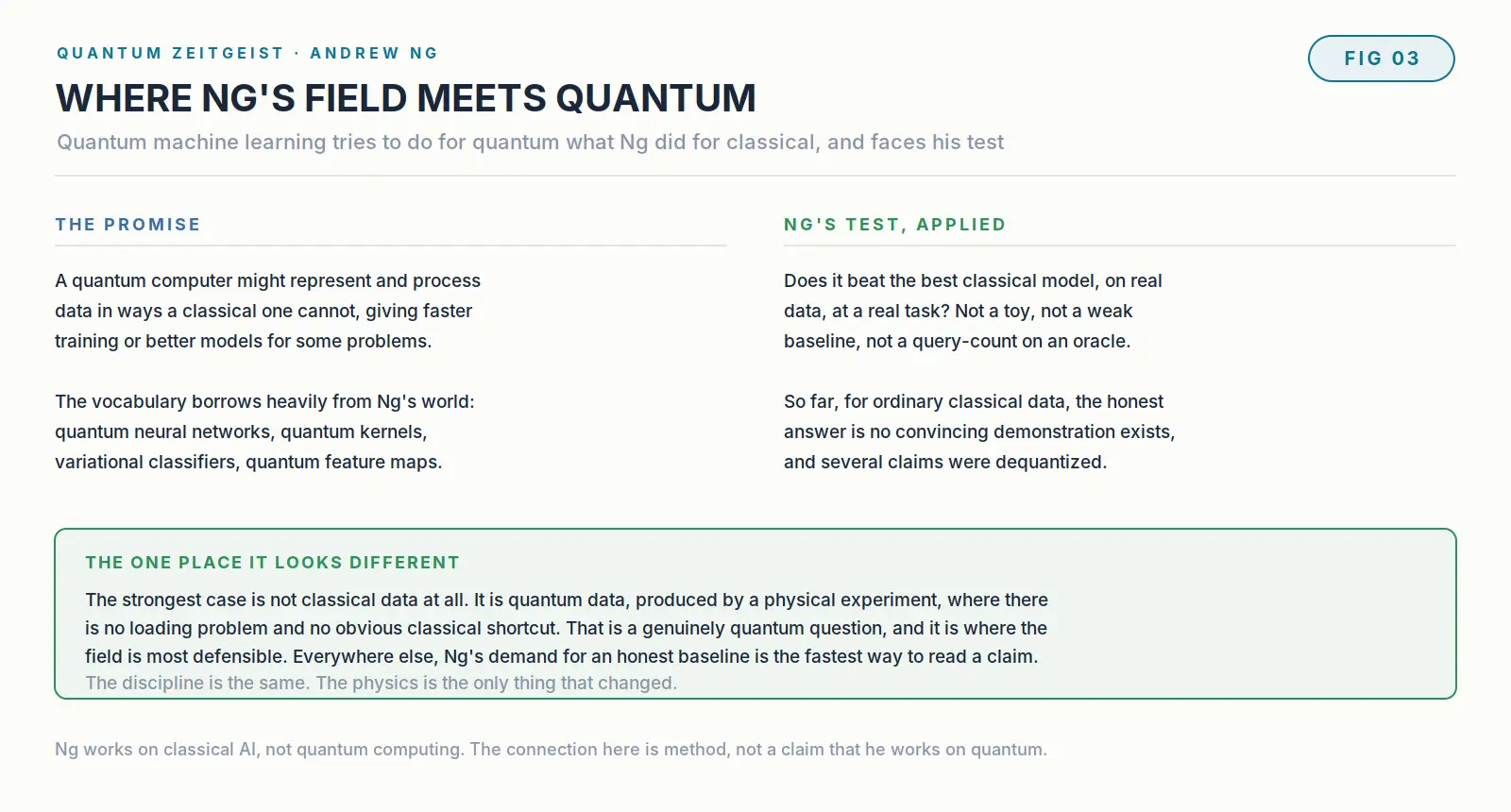
Applied to quantum machine learning, that question is clarifying. For ordinary classical data, the kind Ng works with, the honest answer is that no convincing demonstration of quantum advantage exists, and the strongest theoretical claims have not survived scrutiny. This is not a hostile verdict but the current state of an active field, stated in the terms a practitioner would use.
There is one genuine exception worth stating clearly. When the data is itself quantum, produced by a physical experiment rather than loaded from a classical dataset, there is no loading problem and no obvious classical shortcut, and provable learning advantages exist in that setting. That is a real quantum question, and it is where the field is most defensible. Everywhere else, Ng’s demand for an honest baseline is the fastest way to read a claim.
When the quantum speedup vanished
The clearest illustration of Ng’s discipline being enforced in the quantum world came from outside quantum computing entirely. In 2018 an undergraduate named Ewin Tang produced a classical algorithm that matched a celebrated quantum recommendation-system algorithm, showing that its claimed exponential speedup had never existed.
The quantum result had been compared against the wrong classical baseline, exactly the error Ng warns against, and once a good classical version was written the advantage disappeared. This process, now called dequantization, went on to remove claimed advantages from several other quantum machine learning proposals.
Dequantization is Ng’s baseline test applied from the classical side, and it is one of the healthiest things that has happened to quantum machine learning. A field that can have its overclaims corrected this way is a field with standards, and the correction makes the surviving results more trustworthy rather than less.
Where the sceptic can be questioned
Fairness requires noting that Ng’s positions are contested, and not only by people with an interest in hype. His dismissal of extinction risk is a genuine disagreement with serious researchers who hold that low-probability, high-consequence risks deserve attention precisely because they are hard to reason about, and his confidence that no plausible path exists is itself a strong claim.
His regulatory-capture argument, likewise, can be turned around. Some of the safety concerns he attributes to self-interest are held sincerely by people with no commercial stake, and treating all catastrophe talk as strategic risks dismissing legitimate caution along with the opportunistic kind. The honest position is that he may be right about the incentives and still wrong about particular cases.
None of this undermines the methodological point this profile rests on, which is narrower and more robust. Whatever one thinks of his views on existential risk or regulation, his demand that a claimed improvement beat an honest baseline on a real task is not a matter of opinion. It is simply what evaluating a technical claim requires, and it holds whether the claim is about artificial intelligence or quantum computing.
What he teaches about reading claims
The practical inheritance from Ng, for anyone assessing quantum computing rather than artificial intelligence, is a short set of habits. Ask what the baseline is and whether it is the best available or a convenient weak one. Ask whether the demonstration is on real data or a toy. Ask whether the improvement is measured on a real task or an abstract proxy such as an oracle query count.
Those questions are not quantum questions and they are not AI questions. They are the questions a serious engineer asks of any claimed improvement, and Ng has spent a career insisting on them in a field that, like quantum computing, is prone to excitement outrunning evidence. That is why he belongs in a quantum publication despite never having worked on quantum computing.
His example also carries a quieter lesson about optimism. Ng is genuinely bullish on artificial intelligence while being ruthless about its specific claims, and the two are not in tension. Believing a technology matters and demanding honest evidence for each particular result is the correct posture, and it is the one quantum computing most needs from the people who cover it.
Frequently asked questions
Who is Andrew Ng?
Andrew Ng is a British-born computer scientist, born in 1976, who is one of the most influential figures in modern artificial intelligence. He founded Google Brain, co-founded Coursera, founded DeepLearning.AI and Landing AI, was chief scientist at Baidu, and is an adjunct professor at Stanford.
Does Andrew Ng work on quantum computing?
No. Ng works on artificial intelligence and machine learning, not quantum computing. He appears in a quantum context because his engineering discipline, especially his insistence on beating an honest classical baseline, is directly relevant to assessing quantum machine learning claims.
What is data-centric AI?
It is Andrew Ng’s argument that in most real applications, the largest improvements come from systematically improving the data rather than the model. It reverses the field’s habit of holding data fixed and chasing better architectures, and holds the model fixed while fixing labels, covering edge cases and improving consistency.
What did Andrew Ng do at Google Brain?
He founded and led the team that brought large-scale deep learning into Google, demonstrating that scale, meaning more data and computation applied to relatively simple models, produced capabilities that hand-engineering had not reached. Its famous early result was a network that learned to recognise cats from unlabelled video.
What does Andrew Ng think about AI risk?
He rejects the idea that AI poses a meaningful risk of causing human extinction, saying he sees no plausible path to it, while acknowledging concrete near-term harms. He has also argued that some large companies promote catastrophe fears to justify regulation that would entrench their position.
How is Andrew Ng relevant to quantum machine learning?
Quantum machine learning borrows its vocabulary and goals from the classical machine learning Ng helped build, and it faces his central test, whether it beats the best classical method on real data. For ordinary classical data, no convincing quantum advantage has been demonstrated, and several claims were later matched by classical algorithms.
What is Andrew Ng’s most famous saying?
His best-known line is that artificial intelligence is the new electricity. He means that AI is a general-purpose capability that will transform many industries as it is applied patiently across countless specific problems, rather than arriving as a single dramatic breakthrough.
Is Andrew Ng on the Amazon board?
Yes. He joined the Amazon board of directors in 2024, one of several roles connecting him to the largest technology companies, alongside his own ventures DeepLearning.AI, AI Fund and Landing AI.


See today’s quantum computing news on Quantum Zeitgeist for the latest breakthroughs in qubits, hardware, algorithms, and industry deals.