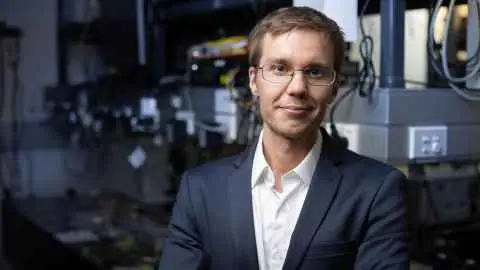
Researchers from the University of Auckland collaborating with the University of Maryland and the US National Institute of Standards and Technology have demonstrated a new chip-scale optical frequency comb. This achievement builds on work Professor Miro Erkintalo began predicting in 2021, culminating in a successful lab demonstration in 2024, and offers a path to shrink these essential components for atomic clocks and quantum computing instruments to portable devices. “This work is the culmination of several years of work, involving a fantastic international collaboration,” says Erkintalo, suggesting a new path for shrinking the technology for future navigation systems and precision sensors.
Chip-Scale Frequency Comb Generation via Doubled Laser Frequency
The team found that the new comb can be generated by two lasers an octave apart. To showcase the platform, the researchers used the chip-based system to perform the three core tasks associated with frequency combs: generating precise optical frequencies, producing low-noise millimetre-wave signals and integrated optical clock readout.
The research builds on a prediction made in 2021 by Professor Miro Erkintalo, envisioning a frequency comb generated by launching two laser beams into a chip-scale ring, and culminated in a successful laboratory demonstration in 2024. The resulting chip-scale frequency comb functions as creating millions of precisely spaced light frequencies to measure time, distance and chemical signals with extreme accuracy, mirroring the function of a traditional ruler with evenly spaced lines.
This work is the culmination of several years of work, involving a fantastic international collaboration that brings together the world-leading knowledge and innovation of New Zealand researchers with equally world-leading folks in the US.
Professor Miro Erkintalo, Head of the Department of Physics at the University and a researcher at the Dodd-Walls Centre for Photonic and Quantum Technologies
Demonstration of Comb Capabilities: Precision Measurement and Clock Readout
The newly demonstrated chip-scale frequency comb generates precise optical frequencies, low-noise millimetre-wave signals, and enables integrated optical clock readout, showing its immediate utility beyond a physics proof-of-concept. Researchers achieved these three core tasks using the miniaturised system, validating its functionality for practical applications. The team’s success hinges on generating the comb with two lasers separated by an octave, a doubling of frequency, unlocking a wider range of potential uses.
The ability to perform integrated optical clock readout is particularly significant for deployable atomic timekeeping, a demanding application previously hindered by the complexity of controlling chip-integrated frequency combs. “With this new approach, we finally see a viable path for their use in deployable atomic timekeeping, which is one of their most demanding and important applications.” Portable atomic clocks enabled by this technology could revolutionize navigation by providing an alternative to GPS, and facilitate detailed mapping of underground mineral deposits.
This advance represents more than just a technical feat. It exemplifies how curiosity-driven research can yield unexpected commercial benefits. “It also shows how new technological applications with commercial implications emerge from research that is originally driven by curiosity.” The team’s design flips the conventional approach to optical frequency combs, broadening its accessibility for applications ranging from precision sensors to communications networks. The research builds on the foundational work of John Hall and Theodor Hänsch, who pioneered laboratory-scale optical frequency combs and were awarded the 2005 Nobel Prize in Physics.
The research suggests a new path for shrinking ‘light ruler’ technology to chip size for future navigation systems, communications networks, precision sensors and portable atomic clocks.



See today’s quantum computing news on Quantum Zeitgeist for the latest breakthroughs in qubits, hardware, algorithms, and industry deals.