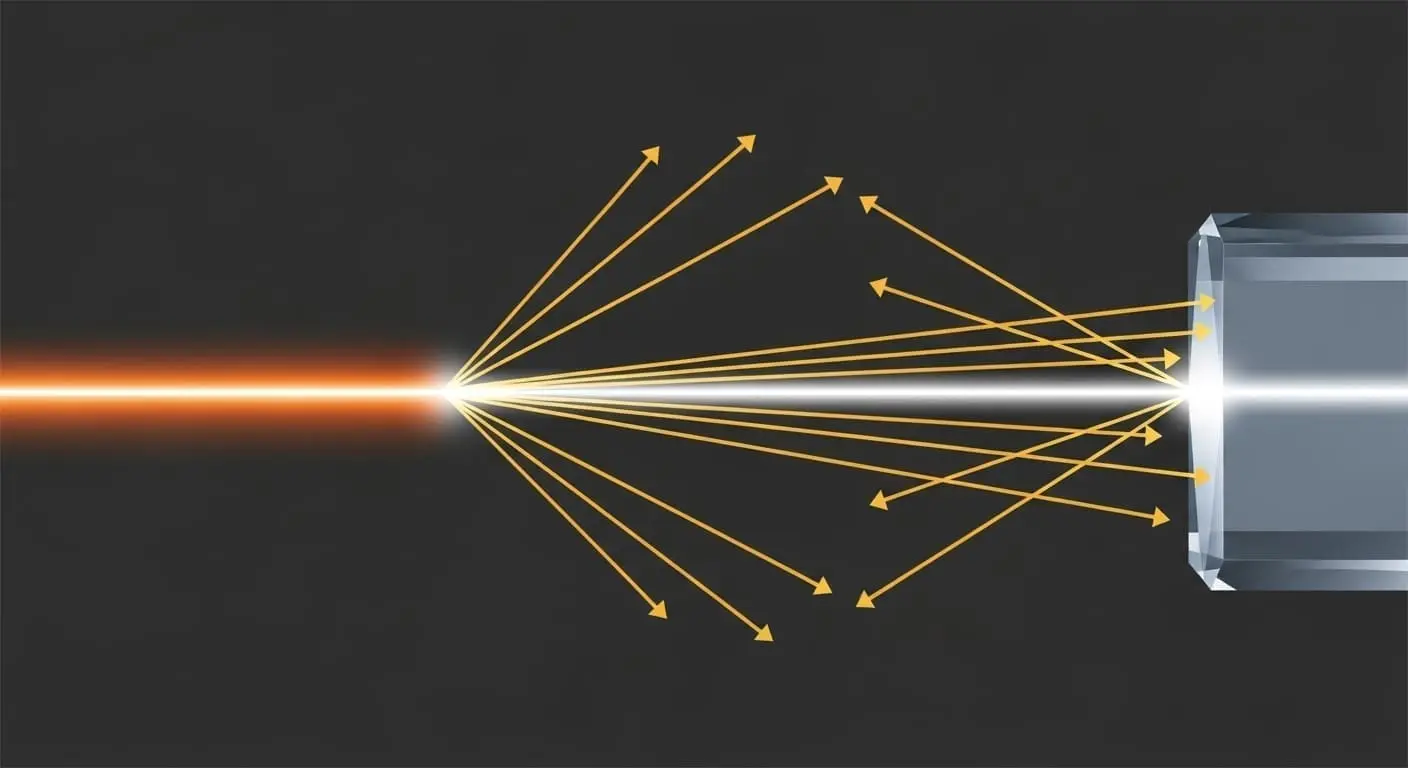
A new discrete-time framework using Markov-state modelling accurately models the behaviour of digitally controlled lasers, a growing area of technology found in photonic integrated circuits. Swarnav Banik of the University of Oxford and colleagues capture the stochastic effects of quantization, sampling and noise inherent in digital laser stabilisation using this approach. The framework enables direct calculation of key stability metrics, bypassing the need for lengthy simulations, and provides a physically transparent method for optimising laser performance in integrated photonic systems. The formulation accurately predicts laser behaviour under certain conditions, while also identifying the limits of its applicability when dealing with complex noise correlations.
Discrete-time Markov modelling enhances laser stabilisation and performance metrics
A new discrete-time Markov-state framework has improved actuator frequency stability by a factor of ten, enabling laser control previously unattainable in digitally stabilised systems. This method models digitally controlled lasers, bypassing computationally intensive simulations that previously limited optimisation efforts. The framework directly calculates key stability metrics from the unit-eigenvalue solution of a transition matrix, offering a physically transparent approach to analysing and improving laser performance in integrated photonic systems.
Validation involved generating white optical frequency noise and employing a frequency discriminator, a device measuring frequency changes, with a dynamic range spanning 212 quantisation steps. The resulting steady-state actuator distributions closely matched those from full time-domain simulations, confirming the model’s ability to replicate laser behaviour; mean values of both distributions were approximately equal. The framework accurately predicted suppression of slow drifts in laser frequency while preserving high-frequency fluctuations, a characteristic important for many applications. These results were obtained under ideal conditions of decorrelated sampling, but do not yet demonstrate performance when faced with the more complex challenge of correlated noise impacting the discriminator’s readings.
Markov Approximation Validity in Digitally Stabilised Lasers
The Markov formulation is exact under decorrelated sampling and update schemes, while correlated discriminator sampling introduces a predictable inflation of actuator variance without shifting the operating point. Long-range temporal correlations induce sampling-dependent deviations in both actuator mean and variance when coloured noise is present, defining the regime of validity of the memoryless Markov description. This provides a compact and physically transparent set of tools for analysing and optimising digitally stabilised lasers in integrated photonic systems.
Precise wavelength control is a critical requirement in modern optical and photonic systems, directly impacting system stability, capacity, and scalability. In applications such as Dense Wavelength Division Multiplexing (DWDM) networks, coherent optical links, and emerging Artificial Intelligence-driven data-centre interconnects, large numbers of closely spaced optical wavelengths must be stabilised simultaneously to maintain channel alignment, minimise crosstalk, and enable high spectral efficiency. Traditional analogue locking techniques, including Pound, Drever, Hall, optical beat-note locking, and modulation transfer spectroscopy, offer high control bandwidth and excellent noise performance, but many contemporary optical communication and sensing systems operate in regimes where ultra-high feedback bandwidth is unnecessary.
Digital control provides practical advantages in these systems, such as sharing hardware resources across channels and implementing diverse locking schemes in software, thereby scaling more efficiently than analogue electronics. Unlike analogue systems, digital feedback loops are discrete and stochastic, with sensing and actuation quantization, measurement noise, and sampling delay causing the laser frequency to evolve in discrete steps governed by probabilistic transitions. Quantization of sensor and actuator can prevent the lock from reaching the exact target frequency, while measurement noise can induce random walk-like fluctuations or occasional loss of lock.
Sampling delays introduce additional uncertainty by postponing corrective actions, potentially leading to drift or oscillations near the lock point. Consequently, stochastic state transitions and nonlinear behaviours arising from these effects, termed digital non-idealities, are not adequately captured by classical tools. The choice of control loop design parameters, such as the employed dither scheme and update logic, influences the system’s statistical behaviour, producing stability properties that cannot be predicted by classical loop-gain or Bode analysis.
Probabilistic state-transition methods have been adopted by related engineering fields to model certain digital control systems, but these approaches have not been adapted for laser frequency stabilisation. Semiconductor noise spectra, synchronous lock-in detection, and nonlinear optical discriminators produce state-dependent transition probabilities that differ from those in existing digital-control formulations. As a result, despite their growing prevalence, digital laser frequency stabilisation methods lack a unified theoretical framework for predicting their steady-state behaviour, limiting our understanding of how digital non-idealities and control-loop design parameters influence performance, thereby constraining systematic optimisation.
A model has been created of the quantized actuator setpoint as a discrete-state variable whose evolution is governed by probabilistic transitions determined by the laser frequency noise, the discriminator response, and the implemented digital control logic. When successive control updates depend only on the current actuator state and statistically independent noise realizations, the actuator dynamics satisfy the Markov property by construction. Under these conditions, the feedback loop can be represented by a transition matrix whose unit-eigenvalue eigenvector yields the exact steady-state actuator probability distribution.
This distribution provides immediate access to key statistical properties of the lock, including residual frequency offset, steady-state variance, and convergence behaviour, without requiring long time-domain simulations or extensive ensemble averaging. It offers a transparent and computationally efficient means to quantify how digital non-idealities shape steady-state performance, thereby allowing efficient exploration of design trade-offs. This framework has shown that, for white frequency noise, the Markov prediction reproduces time-domain steady-state statistics, provided that the frequency discriminator sampling and control loop update schemes do not introduce inter-update memory.
This establishes the Markov description as a computationally efficient substitute for time-domain simulations in the memoryless regime. Controlled deviations from this idealized case reveal how specific control loop design choices, such as finite-difference demodulation and update timing, introduce short-range temporal correlations that manifest as a systematic inflation of the actuator variance, even under white noise. Analysis extends to coloured noise, where long-range temporal correlations violate the memoryless assumption and lead to quantitatively predictable departures between Markov and transient dynamics.
The manuscript details the methodology, beginning with a representative digital laser frequency feedback loop and its formulation as a Markov process. Section II defines the free-running laser noise and introduces a universal frequency discriminator model that captures relevant hardware and control-loop design parameters. Section III establishes exact agreement between the Markov and time-domain descriptions under white-noise-limited operation. Section IV examines controlled sources of variance inflation arising from correlated discriminator sampling.
Section V analyzes the breakdown of the Markov description in the presence of flicker noise. Section VI summarizes the implications and outlines future extensions. The digital laser frequency lock is modelled as a discrete-time stochastic process evolving over a finite set of actuator states, reflecting the quantized nature of the digitally controlled tuning element and its periodic update. Stochastic transitions between discrete states arise from laser frequency noise and discriminator noise, which perturb the control decision at each update cycle, even though the actuator itself is deterministic.
A schematic illustrates the interaction between the laser, frequency discriminator, and the digital actuator. At time index n, the instantaneous frequency deviation from the discriminator reference is given by ∆ν[n] = νf[n] + νa[n], where νf[n] represents the stochastic free running laser optical frequency and νa[n] is the actuator-applied frequency correction. The actuator is modelled as a Na-bit Digital-to-Analogue Converter (DAC) whose output frequency correction is given by νa[n] = i∆νa, where i is the discrete actuator state index and ∆νa is the actuator frequency step size.
The state index I takes values from the finite set i ∈S ≡ {−Na−1 + 1, , 0, , Na−1}. To connect stochastic laser dynamics to discrete feedback updates, a frequency discriminator maps the laser frequency deviation, ∆ν, to a measurable error signal, eD. This mapping should be monotonic over the range of laser frequency excursions expected during operation, ensuring that each discriminator output uniquely corresponds to a single laser frequency to avoid ambiguity in the feedback loop. Upon sampling eD, the controller applies a deterministic decision rule to increment, decrement, or hold the actuator state at the next update. Noise-induced fluctuations in the sampled discriminator output introduce uncertainty when the signal lies near a decision threshold, although the control rule is deterministic.
Consequently, identical actuator states can yield different update outcomes at successive cycles, giving rise to probabilistic transitions between discrete actuator states. These transition probabilities depend on the intrinsic laser frequency noise, digital non-idealities, and control-loop design parameters. The actuator evolution satisfies the Markov property when the control decision at update cycle n depends only on the instantaneous frequency offset and the applied control rule, and not on prior actuator states, modulation dithers, or temporally correlated noise.
This condition is satisfied for white frequency noise when the discriminator sampling and update timing are chosen such that successive error signals are uncorrelated. For a system satisfying the Markov memoryless property, all state-to-state transition probabilities are collected into a transition matrix T, with entries Tij normalized so that P j’S Tij = 1 for each i ∈S. T advances the actuator state probability distribution, Pa, according to Pa[n + 1] = T Pa[n]. As a result, the steady state actuator distribution, Pa’m, is given by the eigenvector problem Pa’m = T Pa’m, where Pa’m represents the long-term probability of finding the actuator in each discrete state, directly quantifying the statistical properties of the control loop and the resulting lock stability. Unlike time-domain simulations, which require explicit stepwise propagation and long averaging to capture rare transitions, the Markov approach yields these distributions immediately.
The computational cost of the Markov method scales with the number of discrete actuator states rather than the simulation duration or noise correlation time. To evaluate and illustrate the Markov framework, representative models of the free-running laser and the frequency discriminator are considered. The free running laser frequency is modelled as the sum of a frequency offset, ν0, and a residual noise, δν, according to νf = ν0 + δν. A semiconductor laser representative of diode and PIC-based devices, which typically exhibit a free-running Lorentzian linewidth, ∆νlw, of 10 to 150kHz and pronounced flicker noise at low frequencies, is used.
Modelling laser dynamics with simplified assumptions for rapid system design
Although digital laser control offers compelling advantages for scaling optical systems, accurately predicting performance remains elusive. This new Markov-state framework provides a valuable tool for modelling these systems, but its reliance on a ‘memoryless’ process presents a fundamental limitation. The authors acknowledge that real-world noise often exhibits long-range correlations, meaning past behaviour does influence future states, and this violates the core assumption underpinning their model.
Acknowledging that this Markov model rests on a simplification does not diminish its immediate practical value. The framework offers engineers a computationally efficient method for predicting laser stability without demanding lengthy simulations; this is key for designing complex optical systems rapidly. Specifically, it provides a clear pathway to assess the impact of digital control choices on laser performance, informing optimisation strategies for photonic integrated circuits and beyond.
The research demonstrated a new discrete-time Markov-state framework for modelling digital laser frequency control. This approach calculates key stability metrics directly from the transition matrix, offering a computationally efficient alternative to time-consuming simulations. The model accurately predicts actuator and laser frequency distributions, even with white frequency noise, provided sampling is appropriately managed. The authors note the framework’s limitations with correlated noise, but highlight its value for rapid system design and optimisation of digital laser systems, such as those utilising photonic integrated circuits.
👉 More information
🗞 Steady-State Statistical Modeling of Digitally Stabilized Laser Frequency with Markov-State Feedback
🧠 ArXiv: https://arxiv.org/abs/2604.06676

See today’s quantum computing news on Quantum Zeitgeist for the latest breakthroughs in qubits, hardware, algorithms, and industry deals.