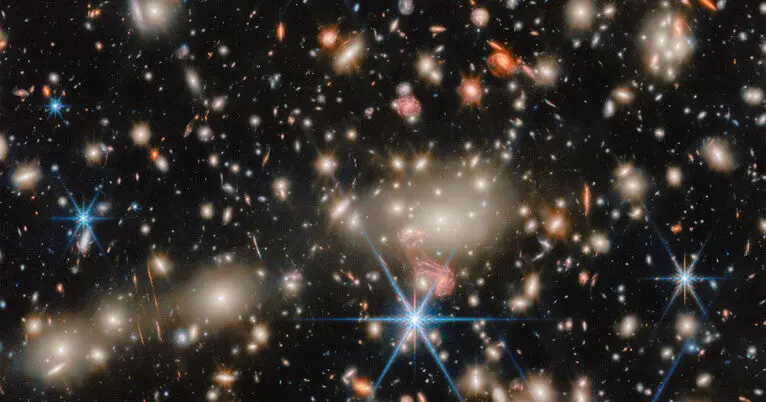
New observational data from gravitational lensing analysis of three galaxy clusters, MACS J0416, MACS J1206, and MACS J1149, is challenging the widely accepted Lambda CDM model of cosmology, according to a Yale study led by astrophysicist Priyamvada Natarajan. The research suggests scientists may need to reconsider fundamental assumptions about dark matter, the unseen substance thought to comprise the scaffolding of the universe. Natarajan, the Joseph S. Fruton Professor of Astronomy & Physics at Yale’s Faculty of Arts and Sciences, and her co-authors propose that either two distinct types of dark matter exist, or an entirely new particle is influencing the densest regions of galaxy clusters. “Both possibilities require an intellectual expansion,” Natarajan said, adding, “It’s a moment when we have to open our minds and change our notion of what works.”
Galaxy Cluster Lensing Reveals Anomalies in Dark Matter Distribution
Galaxy cluster lensing data from three separate systems challenges long-held assumptions about the distribution of dark matter within the universe’s largest structures. A new analysis, spearheaded by Yale astrophysicist Priyamvada Natarajan, reveals discrepancies between observations and predictions generated by the standard Lambda CDM cosmological model, prompting a re-evaluation of current dark matter simulations. Natarajan and her team, including Ph. D. students Barry T. Chiang and Isaque Dutra, employed gravitational lensing, a technique that maps matter distribution by measuring how gravity bends light, to scrutinize the sub-halos within these clusters. These sub-halos, remnants of smaller dark matter clumps drawn into the cluster’s gravity, are expected to host visible galaxies. The team examined four independent properties of these sub-halos, comparing their findings with simulations based on the standard model.
Natarajan explains that inside galaxy clusters, clumps of dark matter appear to behave differently in their outer regions than in their dense inner cores. The analysis revealed that the observed distribution of dark matter clumps in the inner regions of clusters deviates significantly from model predictions; the matter content is far more concentrated toward the centers than expected, and simulations underestimate the number of sub-halos present. Observations of galaxy-galaxy strong lensing, where individual galaxies act as smaller lenses within the larger cluster, show an excess of lensing events, “by nearly an order of magnitude,” according to Natarajan.
Gravitational Lensing Technique Maps Dark Matter & Visible Matter
Recent advances in astronomical observation are challenging established understandings of dark matter, prompting scientists to reconsider the fundamental assumptions underpinning cosmological models. This model, which describes the evolution of the universe, assumes the existence of cold dark matter, unseen particles interacting only through gravity. Priyamvada Natarajan, a leading theorist on black holes and dark matter at Yale, spearheaded the research, suggesting a need for expanded understanding of this elusive substance. Observed sub-halos exhibit a higher concentration of matter towards the cluster centers than simulations predict, and there are fewer sub-halos in the innermost region. Isaque Dutra emphasized that this excess lensing “may be revealing what dark matter is as its resolution requires self-interactions beyond gravity for the dark matter particle.”
This lensing excess is striking because it is not merely mapping where dark matter is – it may be revealing what dark matter is as its resolution requires self-interactions beyond gravity for the dark matter particle.
Isaque Dutra
Standard CDM Model Tested Against Sub-Halo Properties
Priyamvada Natarajan of Yale University is leading a challenge to the standard model of cosmology, scrutinizing the behavior of dark matter within galaxy clusters. Natarajan and her team, including Barry T. Chiang, focused on sub-halos, smaller clumps of dark matter residing within larger galaxy clusters, and their properties offer a unique window into the nature of dark matter itself. Natarajan explains that the technique maps all matter, both visible and dark, by measuring how gravity bends light. Their findings reveal a discrepancy between simulations and observations, particularly in the dense inner cores of galaxy clusters. Simulations underestimate the number of sub-halos in these innermost regions, and predict far fewer galaxy-scale lensing events than are actually observed. “To explain this excess lensing, the centers of the sub-halos must be much denser and more concentrated than ordinary simulations allow,” she adds. This suggests either the presence of two types of dark matter or the existence of an entirely new particle influencing dark matter behavior.
Self-Interacting Dark Matter as Explanation for Lensing Excess
Recent analysis of distant galaxy clusters is challenging established understandings of dark matter, potentially requiring a significant shift in cosmological models. The team’s findings suggest the current model may be incomplete, prompting consideration of alternative dark matter compositions or behaviors. Natarajan concludes, “Either we need to refine the current model and perhaps accommodate a second particle, one that self-interacts, or perhaps more excitingly we may just be seeing the first small hints that point the way to an entirely new kind of particle.”
It’s a moment when we have to open our minds and change our notion of what works. I personally find that very exciting.
Source: https://news.yale.edu/2026/05/14/it-time-expand-our-thinking-about-dark-matter-new-study-says-yes




See today’s quantum computing news on Quantum Zeitgeist for the latest breakthroughs in qubits, hardware, algorithms, and industry deals.