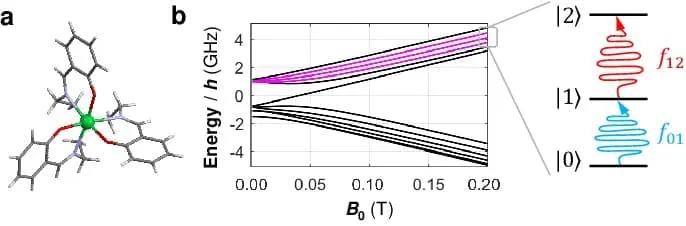
Researchers in Parma have successfully implemented the Quantum Fourier Transform (QFT) on a 173Yb(trensal) molecular qudit, a key step toward realizing the potential of this emerging platform for quantum technologies. The QFT, a core component of many quantum algorithms, was achieved by manipulating coherences between qudit states using radio frequency pulses generated by a 6 GS/s Active Technologies AWG-5062D. Achieving this level of control required pulse durations as short as 230 ps, enabling precise manipulation of the multi-level qudit states. The experimental setup combined the Active Technologies AWG with a HyReSpect spectrometer, demonstrating the complex instrumentation needed for coherent control and state tomography in molecular spin qudit research. The research originates from the Department of Mathematical, Physical and Computer Sciences at the University of Parma. The published paper states that the QFT provides an ideal benchmark for coherence manipulation and a challenge for molecular spin qudits.
Quantum Fourier Transform Implementation on 173Yb(trensal) Qudit
Storing quantum information within the phases of coherences, the team utilized a 173Yb(trensal) qudit to perform the QFT, an essential building block for many quantum algorithms and a demanding test of coherence control. This demonstration addresses a critical gap in the field, as experimental validations of molecular spin qudit capabilities have been limited. As stated in their published paper, the QFT provides an ideal benchmark for coherence manipulation and a challenge for molecular spin qudits. The combination of two pulse generators in the experimental setup highlights the complexity of achieving coherent control and performing complete state tomography on these molecular systems; the research originates from the Department of Mathematical, Physical and Computer Sciences in Parma led by Prof. Roberto De Renzi. This advancement allows for the exploration of more complex quantum algorithms on chemically tunable, multi-level qudit platforms.
AWG-5062D Arbitrary Waveform Generator Enables Coherent Control
The ability to generate pulses of any arbitrary shape provided maximum flexibility in experimental conditions, crucial for manipulating the multi-level qudit states and maintaining coherence throughout the QFT sequence. The research, recently published by NATURE, showcases the potential of molecular spin qubits for quantum technologies, combining chemical tunability with multi-level encoding, and the AWG-5062D’s role in unlocking these possibilities. The instrument’s capacity to create sub-nanosecond pulses was essential for storing quantum information in the phases of coherences within the qudit.
However, experimental demonstrations of their envisaged capabilities remain scarce, posing the difficulty of achieving precise control over coherences between qudit states in long pulse sequences.
Marcos Rubín-Osanz, Laura Bersani, Simone Chicco, Giuseppe Allodi, Roberto De Renzi, Athanasios Mavromagoulos, Michael D. Roy, Stergios Piligkos, Elena Garlatti & Stefano Carretta




See today’s quantum computing news on Quantum Zeitgeist for the latest breakthroughs in qubits, hardware, algorithms, and industry deals.