Google Quantum AI researchers report achieving a logical error rate of 7.72 × 10⁻⁴ using the surface code, a crucial step toward stable quantum computation. The team unified calibration with computation by repurposing quantum error detection events, typically used for correction, as a learning signal for a reinforcement learning agent. This allows the quantum computer to continuously adjust its control parameters during computation, improving the logical stability of the surface code 3.5-fold against injected drift with complementary decoder steering. Numerical simulations suggest this framework’s optimization speed remains consistent even as quantum codes scale to include over a thousand control parameters, potentially enabling larger, more powerful machines. The researchers state that this work “enables a new paradigm: a quantum computer that learns from its errors and never stops computing.”
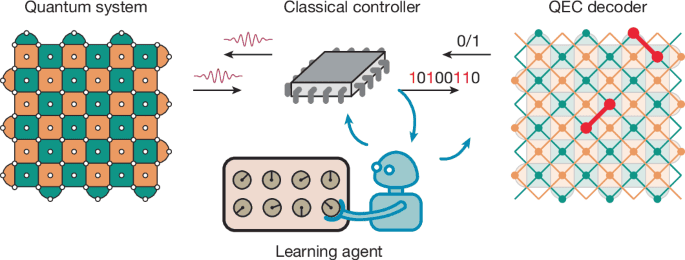
A logical error rate of 7.72 × 10⁻⁴ achieved with the surface code demonstrates a significant advance toward stable quantum computation. Researchers at Google Quantum AI and Google DeepMind unified the processes of calibration and computation to reach this milestone. The core innovation lies in giving the quantum error correction process a dual role: not only correcting the quantum state, but also teaching a reinforcement learning agent to stabilize the system. This framework was experimentally demonstrated on a Willow superconducting processor, improving the logical stability of the surface code 3.5-fold with complementary decoder steering. Beyond surface codes, the team also achieved an average logical error rate of 8.19 × 10⁻³ with the color code. The reinforcement learning agent manages over a thousand control parameters, which specify how an abstract quantum error correction circuit translates into analog waveforms controlling the quantum system. Numerical simulations reveal the optimization speed of this reinforcement learning framework is independent of system size, suggesting scalability to quantum codes with tens of thousands of control parameters, which is promising for future large-scale quantum computers.
Quantum computers, despite their potential, remain susceptible to environmental noise, a challenge addressed by quantum error correction. While quantum error correction effectively digitizes errors, transforming analog disturbances into discrete “error” or “no error” events, its success hinges on precise analog control of the underlying qubits, maintaining error rates below approximately 10−3 to 10−2. This agent then continuously steers the quantum system’s control parameters during computation, and improves the logical stability of the surface code 3.5-fold against injected drift with complementary decoder steering. The reinforcement learning agent manages over a thousand control parameters with this system.
The team reports demonstrating average logical error per cycle of 7.72 × 10⁻⁴ for the surface code and 8.19 × 10⁻³ for the color code, representing a substantial step toward stable quantum computation. Improving the logical stability of the surface code 3.5-fold against injected drift, with complementary decoder steering, is a critical measure of system stability. This achievement focuses on proactively preventing errors, rather than simply minimizing them after they occur. Numerical simulations further suggest the scalability of this approach, and the framework is applicable to any qubit modality and quantum error correction architecture.
The pursuit of stable quantum computation took a significant step forward as researchers demonstrated a reinforcement learning agent capable of actively counteracting environmental drift in a superconducting processor, paving the way for sustained, error-corrected calculations. Experiments conducted on a Willow superconducting processor achieved average logical error rates of 7.72 × 10⁻⁴ and 8.19 × 10⁻³. The system manages over a thousand control parameters, which dictate how abstract quantum error correction circuits translate into physical control waveforms. The agent’s ability to reach high performance even when initialized with randomized control parameters suggests a potential replacement for traditional calibration methods.
Instead of solely utilizing error detection for state correction, the team repurposed these events as a learning signal for a reinforcement learning agent, unifying calibration with computation. The reinforcement learning agent manages over a thousand control parameters, which specify how an abstract quantum error correction circuit translates into analog waveforms controlling the quantum system. This framework was experimentally demonstrated on a Willow superconducting processor, improving the logical stability of the surface code 3.5-fold against injected drift with complementary decoder steering, resulting in average logical error rates of 7.72 × 10⁻⁴ and 8.19 × 10⁻³ for the surface and color codes, respectively. This isn’t simply about reaching a low error rate, but sustaining it amidst the inherent analog instability of quantum systems.
This framework isn’t limited to current hardware; the researchers emphasize its general applicability, stating, “Although demonstrated here using a planar quantum error correction code implemented with superconducting circuits, it is directly applicable to any physical qubit modality and quantum error correction architecture.”
Maintaining the delicate analog control necessary for effective quantum error correction presents a significant hurdle, extending beyond simply achieving a threshold error rate; the system’s performance is vulnerable to drift over time. While traditional calibration techniques have proven capable of reaching the required precision, the inherent analog nature of qubit control demands continuous adaptation to maintain stability. The reinforcement learning agent manages over a thousand control parameters, improving the logical stability of the surface code 3.5-fold against injected drift with complementary decoder steering, and results in average logical error rates of 7.72 × 10⁻⁴ and 8.19 × 10⁻³ for the surface and color codes, respectively.
Google Quantum AI researchers are developing a new approach to maintaining stability in quantum computations, unifying calibration with computation. This agent dynamically adjusts the quantum computer’s control parameters during computation, as prior methods required recalibration pauses. Experiments conducted on a Willow superconducting processor demonstrated a significant result of 7.72 × 10⁻⁴ and 8.19 × 10⁻³. The reinforcement learning agent manages over a thousand control parameters, showcasing a level of automated control previously unattainable, and numerical simulations suggest this framework scales effectively.
See today’s quantum computing news on Quantum Zeitgeist for the latest breakthroughs in qubits, hardware, algorithms, and industry deals.