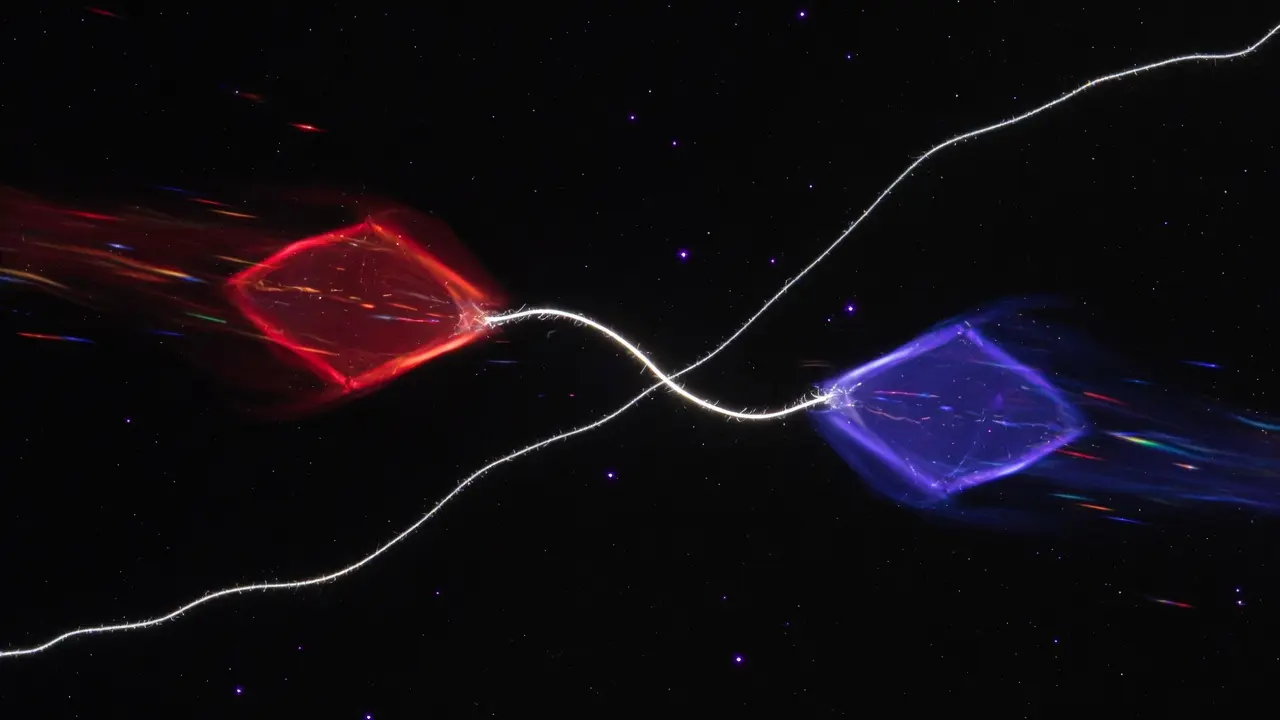
Researchers from the FZU – Institute of Physics of the Czech Academy of Sciences and Paderborn University report that qubits initially separate from their environment can suddenly become entangled, a counterintuitive finding that challenges the traditional understanding of decoherence.
The team’s complete study of qubit-environment entanglement relaxes previous restrictions by allowing for mixed initial qubit states, revealing that standard methods for detecting entanglement become less reliable and are reduced to a “witness status.” This work demonstrates that the evolution of these witnesses reflects entanglement features forbidden in pure-qubit cases, including a surprising initial separability before entanglement appears. The study also highlights a stark numerical advantage when using this witness approach to analyze entanglement in large environments.
Mixed Initial States Expand Qubit-Environment Entanglement Studies
Previously used criteria for determining separability, the absence of entanglement, now function only as entanglement witnesses, indicating the possibility of entanglement without absolute proof. This shift arises from studying qubit-environment interactions limited to pure dephasing, where the qubit loses its phase information but not its energy.
The research demonstrates that conditions previously sufficient to confirm a qubit and its environment were not entangled are no longer conclusive when the qubit begins in a mixed state. Instead, these conditions now serve as indicators. A violation of the criteria confirms entanglement, but adherence to them does not guarantee separability.
This is because mixed initial states allow for the possibility of bound entanglement, a less readily exploitable form of quantum correlation that cannot occur with pure initial states undergoing the same dephasing interactions. The study focused on identifying “resourceful free” entanglement, meaning entanglement that can be used for quantum information processing, rather than the bound variety. The computational demands of analyzing qubit-environment entanglement are already substantial, requiring either minimization over numerous parameters or diagonalization of large matrices.
However, the new findings suggest that traditional methods become even more challenging when dealing with qubits affected by decoherence. Researchers found that quantifying entanglement with the witness approach requires considerably less computing power than other methods, a benefit that could accelerate the development of more complex quantum systems.
The analysis also revealed a surprising dynamic: even when starting completely separate, qubits can suddenly become entangled with their environment. The evolution of these entanglement witnesses captures features impossible in pure-qubit scenarios, expanding the range of observable entanglement phenomena. The team explored this behavior by simulating a spin qubit interacting with a sparse spin environment to illustrate the peculiarities of the evolution of entanglement in this case, as well as to emphasize the level of reliability of the entanglement witness.
The researchers used the eigenbasis of the conditional density matrix of the environment to perform their analysis, a technique that allows for efficient calculation of entanglement measures. “If any of the conditions is broken, there is entanglement present, but the state can be entangled also when none of the conditions are violated,” the study concludes, highlighting the detailed nature of entanglement detection in mixed states.
This means that while the witness approach provides a reliable indicator of entanglement, confirming the absence of entanglement remains a more complex challenge. The work builds on previous criteria for qubit-environment entanglement, extending their applicability to a wider range of initial qubit states and interaction scenarios.
Pure Dephasing Hamiltonians Define Qubit-Environment Interaction
Pure dephasing Hamiltonians, interactions that cause a qubit to lose its quantum information without energy transfer, fundamentally alter how entanglement between a qubit and its environment is understood. The shift in analytical power stems from the complex evolution of entanglement in mixed initial states, where the interplay between the qubit and environment exhibits behaviors forbidden in purely quantum scenarios. The study highlights that the conditions for separability, when broken, reliably indicate entanglement, though confirming the complete absence of entanglement remains more ambiguous.
However, the use of entanglement witnesses offers a numerical advantage in these scenarios. This advantage is important as researchers strive to scale up quantum processors and maintain the delicate quantum states necessary for computation. The researchers found that the conditions which definitively prove separability for pure qubits now only serve as indicators of entanglement.
Separability Criteria Transition to Entanglement Witnesses
The shift means previously definitive tests for separability now function as ‘witnesses’, signaling entanglement’s presence, but cannot conclusively prove it, even when all criteria are met. This transition occurs specifically in systems where the qubit’s interaction with its environment causes pure dephasing, a common decoherence mechanism. This subtlety requires researchers to employ more sophisticated entanglement measures, as witnesses can fail to detect entanglement even when it is present.
Partial transposition, a technique used to analyze entanglement, may also need to be replaced with other positive but not completely positive maps to identify all instances of entanglement. Analysis of normalized entanglement witnesses for a nitrogen-vacancy (NV) center spin qubit interacting with sparse spin environments illustrates this altered behavior. Most notably, this includes sudden birth of entanglement as the initial phase of the evolution is typically separable. there is a numerical advantage to the study of entanglement for large environments when using the witness rather than the traditional measures available.
Sudden Birth of Entanglement in Mixed Qubit Evolution
Features impossible in pure qubit states now emerge when qubits begin in mixed states, a finding that redefines expectations for qubit-environment entanglement evolution. Initial phases of evolution, typically considered separate, can unexpectedly give rise to entanglement. This unexpected behavior stems from the study’s focus on mixed initial qubit states, exceeding the limitations of previous research restricted to pure states. Separability criteria previously used to definitively determine whether a qubit and its environment are entangled are now revealed to function as entanglement witnesses, indicators of entanglement rather than conclusive proof.
The level of reliability of the entanglement witness was emphasized through the study of this interaction. The evolution of the witnesses reflects the array of features that entanglement can exhibit in the mixed case but are forbidden in the pure-qubit case.
Sparse Spin Environment Models NV Center Entanglement
The study details a numerical benefit when analyzing entanglement in complex systems using an “entanglement witness” approach, rather than traditional entanglement measures. For large environments, the witness method offers a significant advantage, streamlining calculations and potentially accelerating the development of more robust quantum computing systems.
Analysis of the simulations revealed that the complexity of entanglement evolution increases with the number of environmental spins, yet the determination of whether entanglement is present, indicated by positive or negative curves on the entanglement witness, becomes simpler with more spins. For five environmental spins, the evolution of the witness became markedly clearer, despite the increased complexity of the system.
👉 More information
🗞 Qubit-environment entanglement in pure dephasing dynamics for mixed initial states
✍️ Małgorzata Strzałka and Katarzyna Roszak (FZU – Institute of Physics of the Czech Academy of Sciences, Na Slovance 2, 182 00 Prague, Czech Republic); Nico Peters, Laura Ares and Jan Sperling (Theoretical Quantum Science, Institute for Photonic Quantum Systems (PhoQS), Paderborn University, Warburger Straße 100, 33098 Paderborn, Germany)
🧠 ArXiv: https://arxiv.org/abs/2610.36936
See today’s quantum computing news on Quantum Zeitgeist for the latest breakthroughs in qubits, hardware, algorithms, and industry deals.