

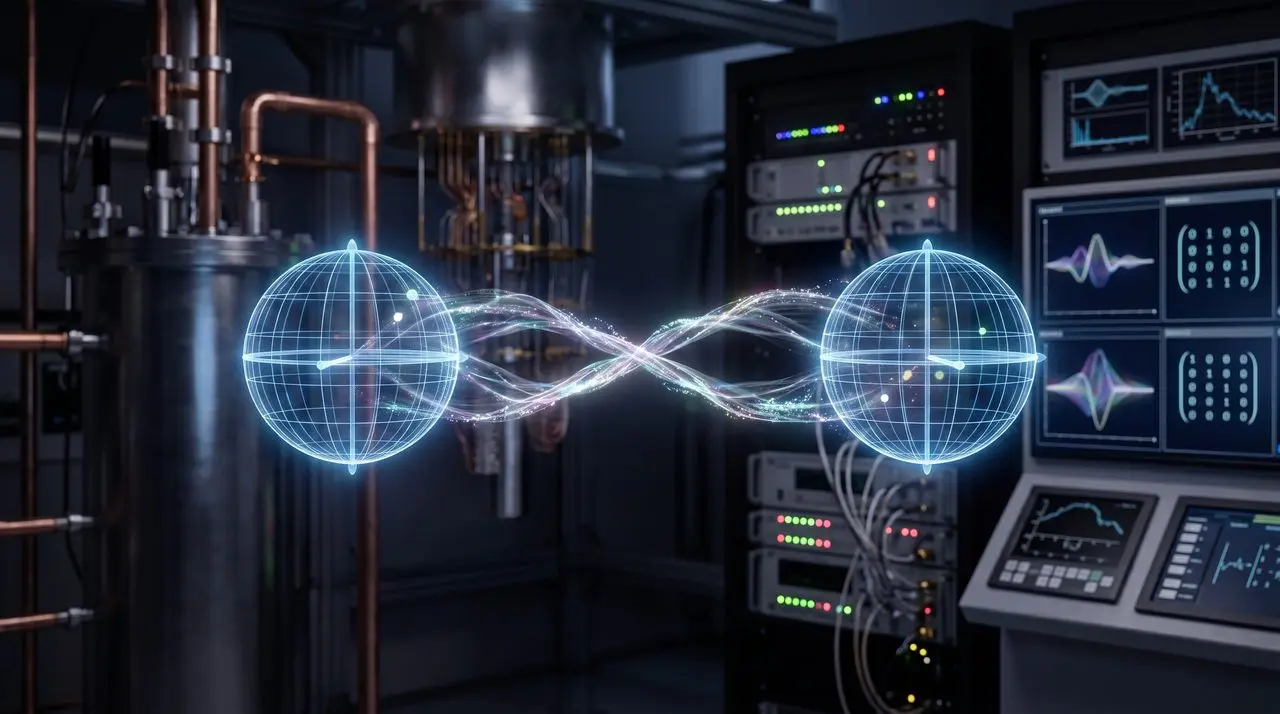
Challenges linked to the experimental characterisation and validation of accurately performed quantum computations are addressed. The focus lies upon a three-mode non-Gaussian trilinear Hamiltonian that researchers recently achieved using superconducting microwave platforms. A thorough theoretical analysis details the computational resources created by this system, together with experimentally accessible protocols intended to confirm their presence. Systematic investigation reveals the ability of this Hamiltonian to generate two key resources for quantum computation: multipartite entanglement and Wigner negativity. Researchers used Displaced-parity Bell tests to demonstrate the production of nonlocal states and associated characteristics.
Displaced parity measurements simplify certification of multipartite entanglement and Wigner negativity
Scientists at Università degli Studi di Milano and Chalmers University of Technology have achieved a substantial improvement in certifying multipartite entanglement. Previously, this required complete reconstruction of a state’s Wigner function, demanding significant computational power. Now, however, researchers attain certification via displaced-parity Bell tests measuring only four points within the phase space; this bypasses full Wigner function reconstruction allowing for more efficient validation of quantum systems and sharply reducing experimental overhead.
The trigemini Hamiltonian simultaneously generates both multipartite entanglement and Wigner negativity, important resources for advanced quantum computation. Violations of the Mermin, Klyshko inequality reached approximately 2.21 under specific conditions. Further quantification revealed that Wigner logarithmic negativity could be benchmarked against established non-Gaussian resource states demonstrating its utility as a measure of these quantum resources.
Efficient verification paves the way for scalable continuous-variable quantum technologies
Generating multipartite entanglement and Wigner negativity is an important step towards universal continuous-variable quantum computation but validating these non-Gaussian resources remains experimentally demanding. The team’s new protocols offer an efficient alternative to full state reconstruction which is often limited by both computational power and measurement precision. This advance highlights a broader tension within the field: current methods primarily focus on demonstrating resource generation rather than integrating them into functional algorithms or addressing practical concerns like noise durability.
Validating complex quantum resources isn’t merely an academic exercise, acknowledging concerns about prioritising demonstration over application is vital for genuine progress; it represents a necessary step toward building practical devices. Researchers devised streamlined protocols to validate these complex quantum resources, sidestepping computationally intensive full state reconstruction techniques which often limit experimental progress and moving beyond simply demonstrating resource generation towards enabling more practical verification protocols key for scaling up these technologies.
The research demonstrated the generation of multipartite entanglement and Wigner negativity using a three-mode non-Gaussian trilinear Hamiltonian in superconducting microwave platforms. This matters because creating and verifying such resources are essential components for achieving universality in continuous-variable quantum computation. Using displaced-parity Bell tests with violations reaching approximately 2.21, researchers provided an operational certification of this entanglement without requiring complete reconstruction of the system’s quantum state. The authors introduced measurement-efficient validation protocols that reduce experimental overhead, representing progress toward building scalable quantum technologies.
👉 More information
🗞 Quantum computational resources and validation protocols for a three-mode non-Gaussian trilinear Hamiltonian
✍️ Niccolò Laurora, Matteo Bina, Giulia Ferrini and Alessandro Ferraro
🧠 ArXiv: https://arxiv.org/abs/2609.10043




See today’s quantum computing news on Quantum Zeitgeist for the latest breakthroughs in qubits, hardware, algorithms, and industry deals.



