
A silicon nitride chip, fabricated at Honeywell Aerospace’s photonics foundry, now underpins a prototype that shrinks quantum sensors down to handheld size. Infleqtion, Honeywell Aerospace, and UC Santa Barbara collaborated to develop an integrated optical “cavity” that improves laser performance and precision within quantum systems, essential for reliable computing and sensing.
“Quantum technology has incredible potential, but realizing that potential means making these systems smaller, more stable, and manufacturable at scale,” said Pranav Gokhale, CTO of Infleqtion. The prototype’s manufacturing process uses techniques common in the semiconductor industry, enabling potential production at scale across existing commercial facilities.
Silicon Nitride Cavity Enables Chip-Scale Quantum System Miniaturization
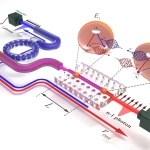
The prototype optical cavity, fabricated on a silicon nitride chip, reduces the footprint required for laser stabilization within quantum systems by an unspecified amount, enabling the development of more compact devices. This miniaturization relies on silicon nitride photonic integration processes refined by Honeywell Aerospace over the past decade, demonstrating a move toward practical quantum sensor designs.
The cavity’s performance directly impacts the precision of lasers used in quantum computers, clocks and sensors, critical components for reliable operation and data acquisition. Infleqtion’s engineering team collaborated with the OCAQπ Group at UC Santa Barbara to co-design the prototype, building on the group’s decade-long effort to transition cold-atom quantum experiments from optical tables to integrated chips.
This partnership facilitated the translation of academic research into a commercially viable fabrication process, using Honeywell Aerospace’s foundry for production. “This prototype is an important step toward that future and it’s a direct result of bringing together world-class academic research, cutting-edge fabrication capabilities, and deep quantum systems knowledge,” said Pranav Gokhale, CTO of Infleqtion. The team’s focus on manufacturability aims to overcome a key obstacle to widespread quantum technology adoption. This compatibility with current infrastructure lowers barriers to entry and accelerates the path to commercial deployment of quantum sensors.
UC Santa Barbara Chancellor Dennis Assanis emphasized the collaborative nature of the project, stating, “By working together, UC Santa Barbara, Infleqtion, and Honeywell Aerospace have combined their individual strengths to create a product that is expected to make a rapid impact on key industries across the globe.” The development of this cavity, according to researchers, expands access to quantum technology by simplifying its implementation and reducing its physical size.
The fact that it’s manufacturable at commercial foundries means this technology has a genuine path to widespread deployment, not just in quantum computers, but in clocks, sensors and other devices that could benefit people in everyday life.
Daniel J. Blumenthal, UCSB Distinguished Professor of Electrical and Computer Engineering
UCSB, Infleqtion, and Honeywell Advance Quantum Hardware Manufacturability
This reduction in footprint allows for the potential creation of quantum sensors small enough to be handheld, expanding their use beyond laboratory settings. Infleqtion, using technology initially developed by SiNoptiq, a photonic technology startup acquired in 2024, integrated its expertise with the fabrication capabilities of Honeywell Aerospace. “The development of this new optical cavity opens the door to a world where quantum technology is more accessible than ever before,” said Dennis Assanis, Chancellor of UC Santa Barbara.
The technology underpinning this advancement has already spurred intellectual property development, with over a dozen patent applications filed for the photonic technology. Infleqtion’s systems are currently deployed with organizations including the U.S. Department of Defense, indicating a growing demand for practical quantum solutions.
The development of this new optical cavity opens the door to a world where quantum technology is more accessible than ever before.
Dennis Assanis, Chancellor of UC Santa Barbara


See today’s quantum computing news on Quantum Zeitgeist for the latest breakthroughs in qubits, hardware, algorithms, and industry deals.