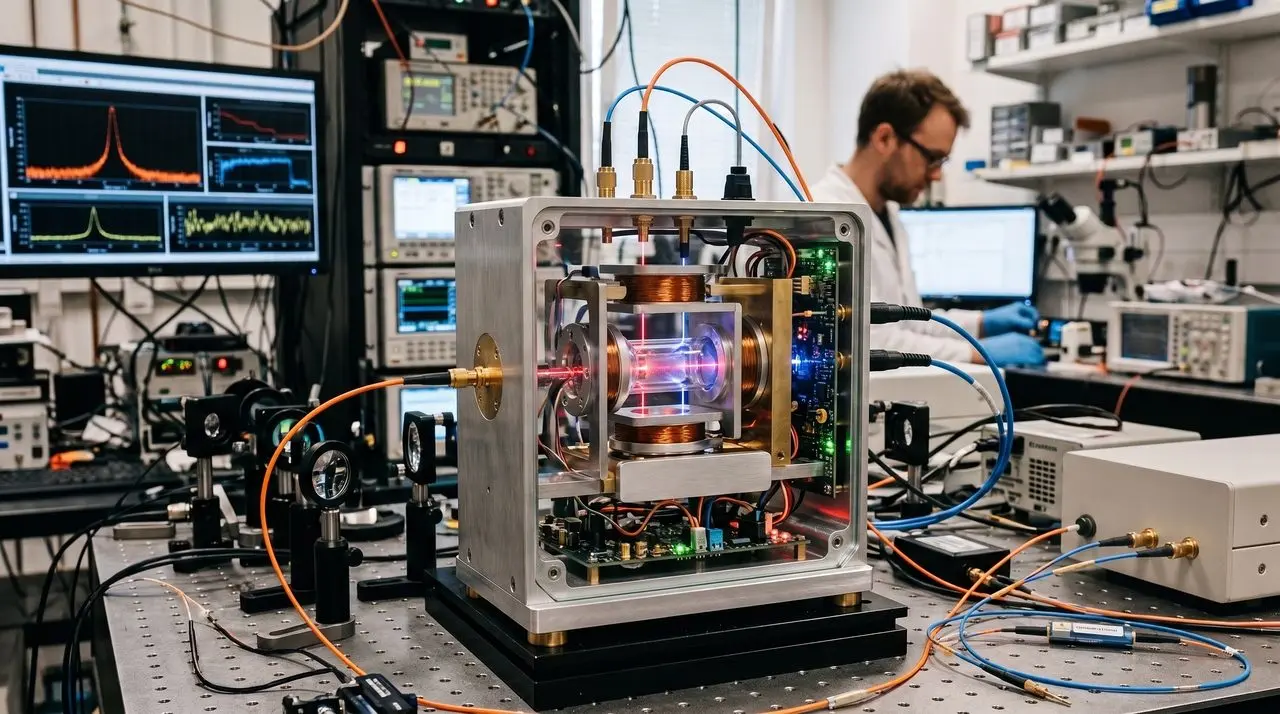
A breakthrough at Monash University has expanded the bandwidth of magnetic quantum sensors using diamonds containing nitrogen vacancy centres. Limitations in sensing bandwidth previously restricted their use; however, a single resonance bandwidth of forty-eight MHz was achieved, over ten times greater than before. This result came from strong driving with multiple modulated microwave fields under a magnetic gradient, alongside sensitivity down to five hundred and forty-eight picoteslas per root Hertz.
The ability for diamond-based quantum sensors to detect changing signals dramatically increased, moving from megahertz speeds to forty-eight MHz. These sensors utilise diamonds containing nitrogen vacancy centres, defects within the crystal structure, to measure magnetic fields with high precision. The expanded bandwidth allows detection of rapidly fluctuating information, potentially enabling use as components in advanced communication systems beyond simple signal identification. Researchers employed a technique called heterodyne mixing, similar to tuning two radio frequencies together to create new ones easier to analyse, alongside strong microwave driving under a magnetic gradient.
Heterodyne Mixing Enables Ultra-Wideband Magnetic Sensing ins
Single resonance bandwidth expanded from MHz scale to forty-eight MHz, over ten times greater sensing capability than previously possible. This leap crossed a threshold where rapid detection was unattainable due to narrow linewidth limitations. Employing heterodyne mixing, akin to tuning radio frequencies for clearer analysis, the team combined this technique with strong microwave driving under a magnetic gradient applied across diamonds containing nitrogen vacancy centres.
Both instantaneous bandwidth at the MHz level and sensitivity of $548 pT/sqrt(Hz), alongside peak sensitivity of 8.5 nT/sqrt(Hz) were further demonstrated within an active diamond volume containing two times ten to the power of eleven NV centres; that density balances simplicity against broad operating conditions. A sensitivity of 548 pT/sqrt(Hz) was achieved in a small, 2.5times 10-4; mm^3 diamond volume populated with two times ten to the power of eleven nitrogen vacancy (NV) centres, defects used for sensing within the diamond’s structure.
This concentration represents a balance between operational simplicity and reliability across varying environments. However, these figures were obtained without static fields beyond ambient equipment noise around 100 μT, meaning demonstrating performance in real-world shielded scenarios remains an ongoing challenge.
Faster detection speeds currently trade off faint signal resolution
Expanding bandwidth is a significant step toward practical applications like high-speed communications; however, this advance isn’t without trade-offs. Increasing detection speed demonstrably reduced peak sensitivity, the ability to detect faint signals, when operating at its broadest forty-eight MHz range. This presents an engineering challenge: reconciling increased responsiveness with maintaining sufficient signal clarity.
Still, diminished sensitivity at broader bandwidths doesn’t negate progress but highlights a clear path for future refinement of diamond sensors and demonstrates potential for dramatically accelerating data acquisition rates crucial for secure communication and precise navigation systems. The Monash University team broadened operational speeds by employing heterodyne mixing alongside precisely controlled microwave fields under a deliberately applied magnetic gradient, resulting in expanded bandwidth reaching forty-eight MHz and overcoming limitations imposed by narrow resonance linewidths which previously restricted detection speeds. This opens possibilities beyond simple identification towards applications requiring rapid data acquisition.
This research demonstrated increased sensing speed using nitrogen vacancy centers in diamond. By utilizing techniques including heterodyne mixing and strong magnetic gradients with multiple microwave control fields, researchers achieved an instantaneous bandwidth of up to 48MHz within a 2.5times 10-4; mm3 volume containing 2 times 1011 NV centers, a substantial expansion from previous limits. While broader bandwidth reduced peak sensitivity to 8.5 nT/sqrt(Hz)$, this work shows how data acquisition rates can be dramatically accelerated for applications requiring rapid detection. The authors indicate further refinement is needed to balance speed and signal clarity.
👉 More information
🗞 High bandwidth heterodyne sensing with bulk NV diamond
✍️ H. A. M. Taylor, J. P. Duff, L. B. Miller, A. Tritt, M. S. Oldfield and K. Helmerson (Monash University); M. S. J. Barson (Affiliation: School of Physics & Astronomy Monash University)
🧠 ArXiv: https://arxiv.org/abs/2610.39022


See today’s quantum computing news on Quantum Zeitgeist for the latest breakthroughs in qubits, hardware, algorithms, and industry deals.