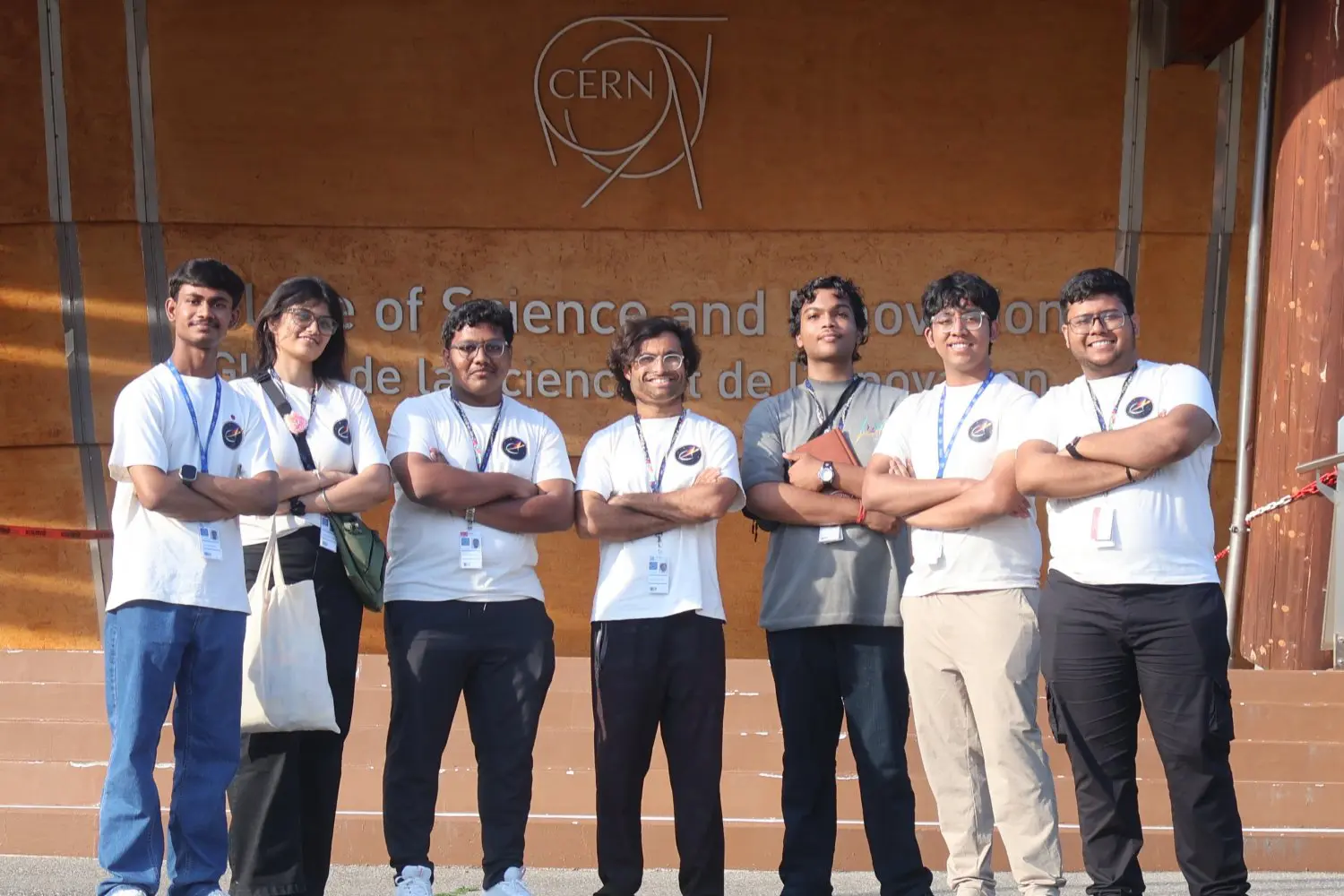
Six Indian high school students, Ayush Bhardwaj, Misbah Shaikh, Nenavath Abhay Vivek Sidhartha, Aniket Jaiswal, Aarush Mandala, and Aritra Sadhukhan, developed a classroom idea into a working experiment at CERN this past spring, with mentorship from MIT graduate student Manu Srivastava.
Srivastava, a PhD student studying quantum gravity with Professor Hong Liu, accepted the mentorship request despite often declining similar proposals facilitated by companies; he noted the students’ direct and earnest approach, saying, “But this email seemed very genuine.” Over two weeks in Geneva, Team attoPION measured pion charge exchange, an experiment that could contribute to the international Deep Underground Neutrino Experiment, or DUNE, and potentially yield a publishable result.
Team attoPION Measures Pion Charge Exchange at CERN
Team attoPION’s experiment centers on observing how positively charged pions interact with neutrons, producing neutral pions and protons; the team aims to characterize the frequency of this reaction. This measurement is relevant to the Deep Underground Neutrino Experiment, or DUNE, because understanding pion interactions helps refine the accuracy of neutrino measurements.
Dave Newbold, a DUNE co-spokesperson, emphasized the sophistication of the students’ proposal, stating, “The proposal is real experimental particle physics!” and noting it surpassed the level of work he undertook in high school. If successful, the team’s data could contribute to a publishable result and improve understanding of pion interactions, similar to how other “test beam” experiments informed the design of DUNE’s detectors.
During a two-week period at CERN, the students gained hands-on experience with detectors and data-acquisition systems, analyzing collected data and attending scientific talks. Berare Göktürk, a support scientist for Beamline for Schools, prepared the team for the challenges of detecting a rare charge-exchange process, acknowledging the ambitious nature of aiming for a result useful to a large-scale experiment. Göktürk prioritized ensuring the students “understand the journey of a scientist,” navigating technical problems collaboratively.
Srivastava, whose expertise lies in quantum gravity, found the mentorship personally rewarding, recalling that he himself lacked awareness of CERN during his own high school years. He said, adding, “But these students, they are just that good.”
This [proposal] stands out because of the work the students have put into motivating their measurement, and demonstrating that the experiment is feasible.
Dave Newbold, a co-spokesperson for DUNE
Srivastava’s Mentorship Connects MIT to Indian Students & DUNE
Manu Srivastava’s decision to mentor a team of high school students from India differed from his usual practice; he typically declines mentorship requests solicited through companies offering access to MIT scientists. Srivastava explained that the students’ request felt authentic. This connection ultimately led to the students’ participation in the Beamline for Schools competition at CERN, a feat achieved among a record 712 teams from 89 countries and more than 4,500 students.
The six students, meeting through science competitions and shared interests, formed Team attoPION and proposed an experiment focused on measuring pion charge exchange, a process where a positively charged pion interacts with a neutron. They deserve all the credit for their work.
We prepare in the best way possible, but we also stay humble and we are aware of the limitations we have.


See today’s quantum computing news on Quantum Zeitgeist for the latest breakthroughs in qubits, hardware, algorithms, and industry deals.