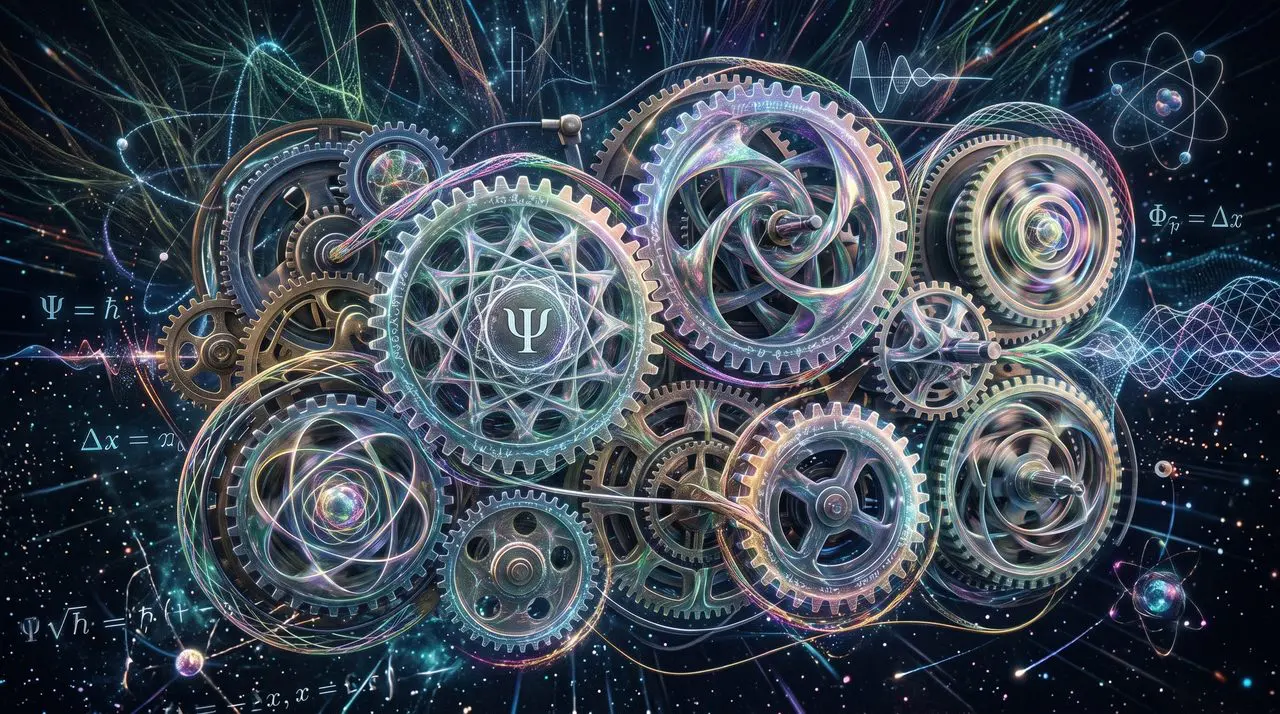
A structural link between Bayesian inversion and the Petz recovery map has established itself by extending existing results to infinite-dimensional systems using von Neumann algebras. A ‘retrodiction functor’, a mathematical construct capturing the process of inferring causes from effects, exists for such complex systems where similar findings were previously limited to finite dimensions. Inferring causes from effects, known as retrodiction, and structures within complex systems connect through the use of mathematical tools called von Neumann algebras.
This work expands upon previous understandings by moving beyond simplified scenarios to encompass more realistic infinite-dimensional systems which is key for modelling genuinely complex phenomena. Bayesian inference links understanding cause and effect; much like detective work where investigators use clues, or effects, to deduce past events, continually refining their conclusions as new evidence appears. This connection strengthens by utilising von Neumann algebras, providing a way of mathematically describing all possible states of an incredibly intricate system, imagine meticulously cataloguing every switch setting within a complex machine.
The findings extend previous results beyond simplified scenarios to encompass infinite-dimensional systems, essential for modelling genuinely complicated phenomena; the Petz recovery map acts as a specialised filter clarifying blurry images to reveal original sources. An open question now formalised asks whether these underlying principles uniquely define the method used to reconstruct likely causes from observed effects, or if other possibilities are viable.
Reconstructing system origins via infinite dimensional Petz recovery maps
The technique establishes correspondences between algebraic structures, specifically utilising ‘von Neumann algebras’, mathematical frameworks capable of describing every possible state within complex systems, akin to carefully cataloguing every switch setting in an intricate machine. By accommodating infinite-dimensional scenarios, this approach moves beyond the constraints of simplified models and becomes vital for representing genuinely complicated phenomena. At its heart lies construction of the ‘Petz recovery map’, which acts as a specialised filter clarifying blurry images and revealing original sources; it reconstructs likely causes from observed effects using information encoded within these von Neumann algebras.
These previous findings extended to encompass infinite-dimensional scenarios without simplifying assumptions. The focus remained theoretical and categorical, establishing a foundation for retrodiction rather than detailing specific qubit counts or temperatures through experimentation with defined parameters. This method bypasses limitations inherent in finite-dimensional models often used in quantum Bayesian inference, allowing accommodation of genuinely complicated phenomena.
Retrodictive Inference Formalised for Systems of Infinite Dimensionality
A key principle of inferential statistics has expanded to encompass infinitely complex scenarios governed by von Neumann algebras; this represents an expansion from finite dimensions to unbounded complexity previously unattainable. Consequently, the existence of a ‘retrodiction functor’ establishes itself, a mathematical tool capturing how causes are inferred from effects within these infinite-dimensional systems and formalising that such inference remains possible even when dealing with genuinely complicated phenomena lacking simplified representations. Rigorous review confirmed the behaviour of the Petz recovery map, a method for estimating initial states from observed outcomes, aligns with established principles even at infinite dimensions and remains uniquely defined.
Von Neumann algebra foundations underpin causal reconstruction from observational data
Establishing a strong method for inferring causes from effects is central to numerous scientific disciplines; accurately reconstructing past events from present observations underpins everything from medical diagnosis to cosmological modelling. Definitive proof linking this mathematical framework to unique retrodiction identification currently remains an open challenge, though acknowledging its absence does not diminish the significance of this work. Understanding ‘retrodiction’, inferring causes from effects, has refined itself and rigorously demonstrated within infinite-dimensional systems described by von Neumann algebras, structures representing all possible states of complex physical realities and extending previous finite dimensional limitations, key for accurately modelling genuinely complicated phenomena like those encountered in quantum mechanics; it formalises that cause inference is mathematically viable even without simplified representations.
The research successfully extended a principle of statistical inference, inferring causes from effects, to infinitely complex systems governed by von Neumann algebras. This expansion beyond limited dimensions allows mathematical tools to capture how causes are identified from effects in these more intricate scenarios. The study confirmed the Petz recovery map functions consistently at this increased complexity, uniquely defining state estimation. Authors note definitively identifying retrodiction within this framework remains an open question, but their work demonstrates its mathematical viability within infinite-dimensional systems.
👉 More information
🗞 Bayesian inference and retrodiction for faithful states on von Neumann algebras
✍️ Pradyut Karmakar and Arthur J. Parzygnat
🧠 ArXiv: https://arxiv.org/abs/2608.20001



See today’s quantum computing news on Quantum Zeitgeist for the latest breakthroughs in qubits, hardware, algorithms, and industry deals.