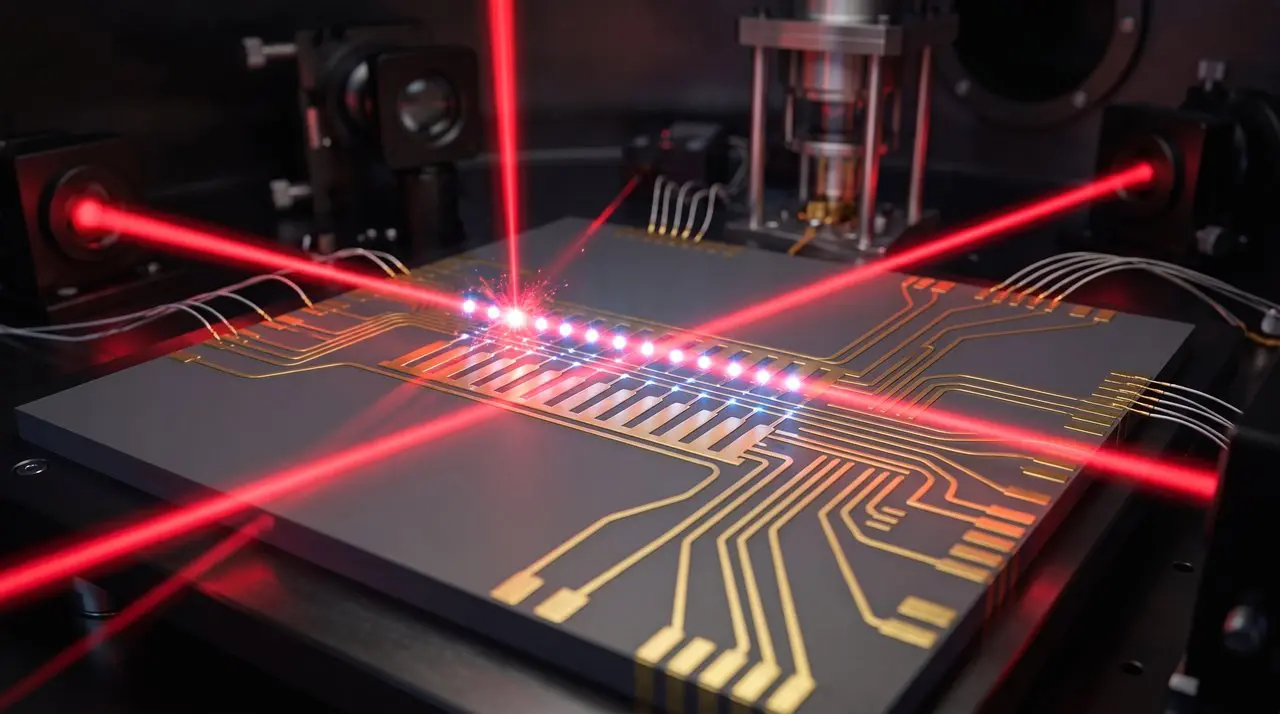
Jai Moondra of Carnegie Mellon University, Phillip C. Lotshaw of Oak Ridge National Laboratory, Greg Mohler of Georgia Tech Research Institute, and Swati Gupta of Massachusetts Institute of Technology have established the first provable guarantees for improving quantum noise resilience and reducing circuit complexity through graph sparsification and decomposition. Their work focuses on compilation schemes for the Quantum Approximate Optimization Algorithm (QAOA), specifically when solving the Max-Cut problem with trapped-ion simulators utilizing Pauli-X operations.
The researchers demonstrate that graph sparsification directly reduces circuit complexity for edge-by-edge QAOA compilations, achieving an asymptotic improvement from O(n^2) to O(n log(n/ε)) for the number of Ising pulses. They anticipate these techniques will be useful tools in future quantum computing experiments.
QAOA Compilation with Graph Sparsification for Reduced Complexity
This advancement directly addresses a critical challenge in near-term quantum computing: longer circuits accumulate more noise, hindering the potential for solving complex optimization problems. The work, detailed in a publication released on 2026-08-07, volume 10, page 2185, focuses on compilation schemes tailored for trapped-ion simulators, though the principles extend to other quantum hardware platforms. Specifically, the team demonstrated improvements when solving the Max-Cut problem, a benchmark used to evaluate optimization algorithms, by leveraging Pauli-X operations and all-to-all Ising Hamiltonian evolution generated by Molmer-Sorensen or optical dipole force interactions.
For trapped-ion quantum simulators, the new compilations reduce the worst-case number of Ising pulses from O(n^2) to O(n log(n/ε)) for n-node graphs, achieving an asymptotic improvement for any constant ε greater than zero. Simultaneously, the worst-case number of Pauli-X bit flips decreases from O(n^2) to O(n log(n/ε)/ε^2). This reduction in required operations translates directly into lower error rates and more reliable results.
The core of this improvement lies in the application of two classical pre-processing techniques. Sparsification reduces the number of edges in a graph while preserving its essential cut structure, effectively simplifying the problem without significantly impacting the solution quality. Decomposition breaks down a weighted graph into multiple unweighted graphs, further streamlining the computational process. The researchers report that these techniques yield dramatically shorter quantum circuits on trapped-ion hardware with only a small, controllable loss in solution quality.
These techniques are not merely heuristic approaches; the team has established theoretical foundations guaranteeing their performance. Beyond trapped-ion systems, the benefits of graph sparsification extend to digital computing schemes utilizing one- and two-qubit gates, relevant to superconducting qubits and certain neutral atom or trapped ion setups.
The researchers found that sparsification results in an exponentially improved circuit fidelity lower bound, suggesting a broad applicability across diverse hardware architectures. Their analysis reveals that a (1-ε) factor loss in the Max-Cut approximation allows for the described improvements in pulse and bit flip counts. This controlled trade-off between solution accuracy and circuit complexity is a key feature of the new compilation schemes. The work also provides a generic argument demonstrating that sparsification improves circuit fidelity in digital computing schemes, a finding with implications for a wide range of quantum hardware.
Trapped-Ion Hardware Benefits from Ising Pulse Reduction
Recent advances in quantum compilation techniques are yielding substantial benefits for trapped-ion hardware, specifically in reducing the computational demands of the Quantum Approximate Optimization Algorithm (QAOA). The benefits of sparsification extend beyond simply reducing circuit size; simulated trapped-ion experiments with dephasing noise revealed significant improvements in the approximation ratio achieved through decomposition, suggesting a robust approach to mitigating the effects of noise.
This work, released on 2026-08-07, volume 10, page 2185, provides a theoretical foundation for techniques previously used heuristically in hybrid quantum algorithms. The research underscores the importance of integrating classical optimization strategies with quantum algorithms to overcome the limitations of noisy intermediate-scale quantum devices.
Decomposition Improves Max-Cut Approximation with Noise
The core of their approach lies in pre-processing graphs before they are processed by a quantum computer. These methods have been employed heuristically in the past, but this study establishes a theoretical foundation for their effectiveness. For quantum simulators utilizing trapped ions, the benefits are particularly pronounced. Simulated experiments with trapped-ion systems incorporating dephasing noise showed significant gains in approximation ratios when using decomposition. The team’s findings are not limited to theoretical improvements; they have practical implications for the design of more robust and efficient quantum algorithms.
Provable Guarantees for Quantum Noise Resilience via Pre-processing
Graph decomposition and sparsification techniques, previously employed as heuristics, now possess formally proven benefits for enhancing the resilience of quantum algorithms against noise. This work marks the first instance, to the researchers’ knowledge, of provable improvements to quantum noise resilience achieved through classical pre-processing of computational problems. The implications extend beyond theoretical advancement, offering a pathway to more reliable quantum computations with near-term hardware.
This reduction in circuit complexity isn’t merely a theoretical exercise; it directly addresses a critical limitation of current quantum devices, as longer quantum circuits accumulate more noise, leading to higher error rates. By classically simplifying the problem before it reaches the quantum processor, the team effectively minimizes the impact of this noise. Simulated experiments, conducted using trapped-ion systems and incorporating dephasing noise, confirmed the gains predicted by the theoretical analysis.
👉 More information
🗞 Promise of Graph Sparsification and Decomposition for Noise Reduction in QAOA: Analysis for Trapped-Ion Compilations
✍️ Jai Moondra, Phillip C. Lotshaw, Greg Mohler and Swati Gupta
🧠 DOI: https://quantum-journal.org/papers/q-2026-08-07-2185/



See today’s quantum computing news on Quantum Zeitgeist for the latest breakthroughs in qubits, hardware, algorithms, and industry deals.