

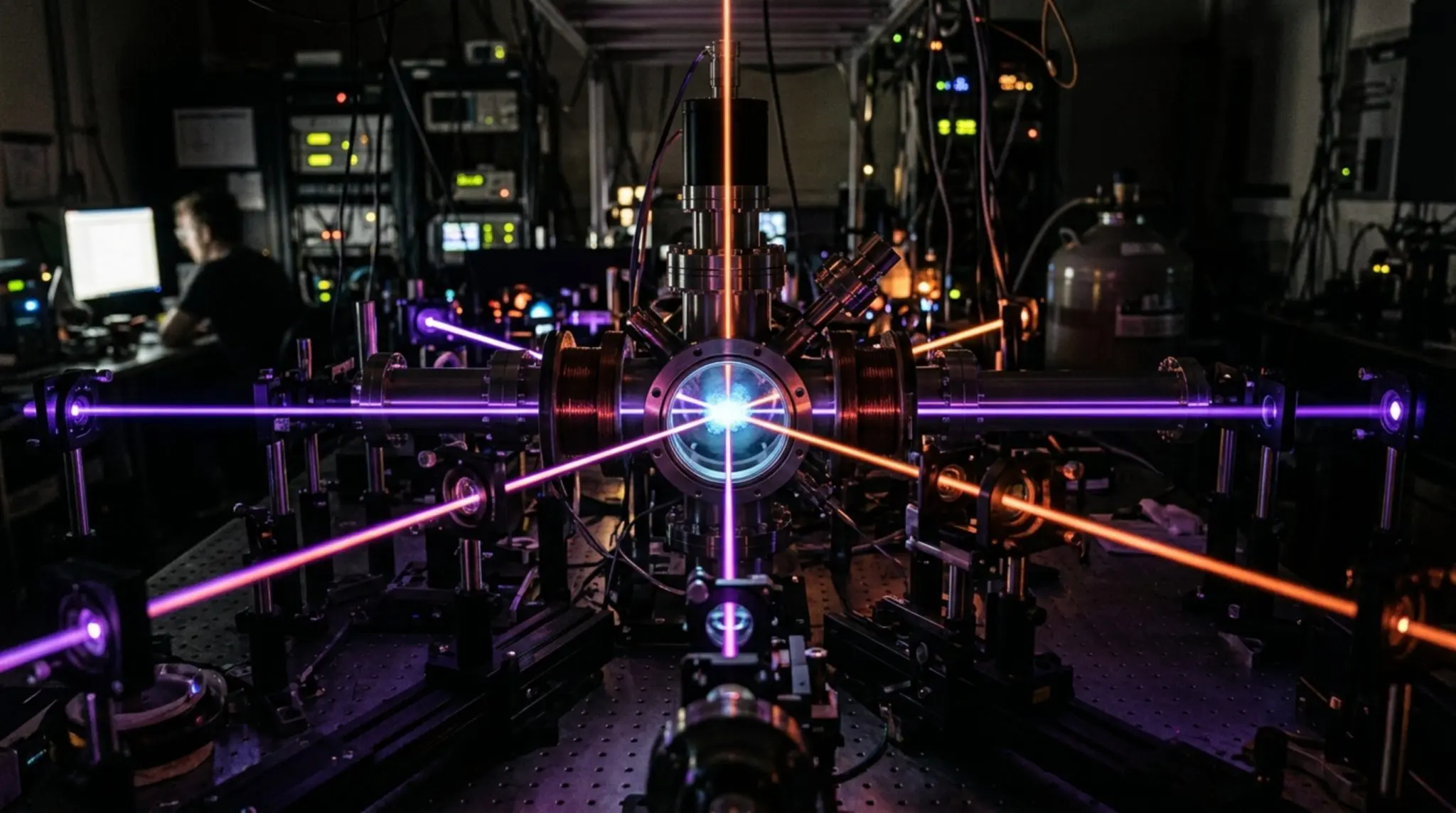
The absolute frequency of the $4s ^2’S1/2leftrightarrow 3d ^2’D5/2 clock transition in trapped calcium ions has been measured using a Global Navigation Satellite System link to Coordinated Universal Time. Previous measurements dating back to 2009 contained inconsistencies, but a precise frequency of 411 042 129 776 401.2 Hertz with an uncertainty of one and half parts per ten quintillion is now established. Researchers refined understanding of time measurement utilising a calcium ion clock, achieving exceptional precision equivalent to losing less than one second every three million years.
A highly accurate frequency for this type of atomic clock is now available; it improves upon existing models by accounting for subtle magnetic field effects that previously introduced inconsistencies in measurements. The team achieved a new level of precision in timekeeping by measuring the frequency of a specific ‘tick’ within an atomic clock, the 4s ^2’S1/2leftrightarrow 3d ^2’D5/2 transition in trapped calcium ions, with extraordinary accuracy.
This measurement relied on linking laboratory clocks to those maintained at the Physikalisch-Technische Bundesanstalt using signals from Global Navigation Satellite Systems; Precise Point Positioning functions much like triangulating your location via mobile phone masts but operates with far greater refinement. The team established a precise frequency of 411 042 129 776 401.2 Hertz, accurate to within one and half parts per ten quintillion, equivalent to losing less than one second every three million years.
Record fractional uncertainty in calcium-40 clock transition surpasses previous limitations using satellite
At Institut für Quantenoptik und Quanteninformation, collaborating with Alpine Quantum Technologies GmbH and Universität Innsbruck, researchers achieved a fractional uncertainty of just 1.5 × 10⁻¹⁵ when measuring the absolute frequency of the important calcium-40 clock transition. This exceeds earlier measurements from before 2013 which showed inconsistencies due to unaddressed systematic shifts. Previously, such accuracy required utilising GNSS technology linked to timekeeping standards at PTB. The team strengthened confidence in their attained precision by comparing calcium ion clocks’ stability with two independent experiments sharing the same laser source.
The Precise Point Positioning technique using signals broadcast by Global Navigation Satellite Systems or GNSS enabled linking the laboratory timescale directly to Coordinated Universal Time maintained at Physikalisch-Technische Bundesanstalt in Braunschweig, Germany. Consequently, measurement of the important calcium-40 clock transition frequency reached 411 042 129 776 401.2±0.6Hz and allowed for refined calculations of the Landé g-factor, determined as g5/2= 1.200329 ±0.000001.
While these results represent major advances in timekeeping accuracy, substantial miniaturisation of laboratory infrastructure is still needed for practical deployment within real-world applications; mitigation of environmental sensitivities not fully characterised by current measurements also remains crucial. The pursuit of ever more accurate timekeeping supports advancements across areas ranging from fundamental physics to secure communications. Achieving absolute consistency between different measurement techniques continues to challenge metrologists worldwide.
Discrepancies persist when comparing these new results against data collected between 2009 and 2012 despite earlier inconsistencies noted during that period. Precise Point Positioning allows highly accurate comparisons over long distances, enabling the team to establish a precise connection between their calcium ion clock and international time standards maintained by the Physikalisch-Technische Bundesanstalt via Global Navigation Satellite Systems.
Researchers achieved refinement of understanding systematic errors affecting atomic clocks; specifically, they accounted for subtle magnetic field influences on energy levels within trapped ions to improve measurement accuracy. The Innsbruck group have attained unprecedented accuracy with fractional uncertainty of just 1.5 parts per ten trillion, a level vital for applications like testing fundamental physics theories and enhancing Global Navigation Satellite System accuracy. This exceptional precision demonstrates significant progress in metrology and opens new avenues for scientific exploration. Further research will focus on reducing remaining uncertainties and exploring novel techniques for even more precise timekeeping capabilities.
Researchers measured the frequency of an atomic clock transition in calcium-40$ ions with high precision, 411 042 129 776 401.2 Hertz with an uncertainty of 1.5x 10⁻¹⁵. This work improves our ability to measure time accurately, which is important for fundamental tests of physics and supports technologies such as satellite navigation systems. The team also refined understanding of magnetic field effects within ion traps, resulting in a revised value for a key constant governing energy levels. They intend to continue reducing uncertainties in these measurements through further investigation into systematic errors.
👉 More information
🗞 Absolute frequency measurement of the $^{40}Ca^{+}$ clock transition using a GNSS link to the SI second
✍️ M. Guevara-Bertsch, M. K. Joshi, M. I Hussain, R. Blatt and C. F. Roos
🧠 ArXiv: https://arxiv.org/abs/2609.15844




See today’s quantum computing news on Quantum Zeitgeist for the latest breakthroughs in qubits, hardware, algorithms, and industry deals.



