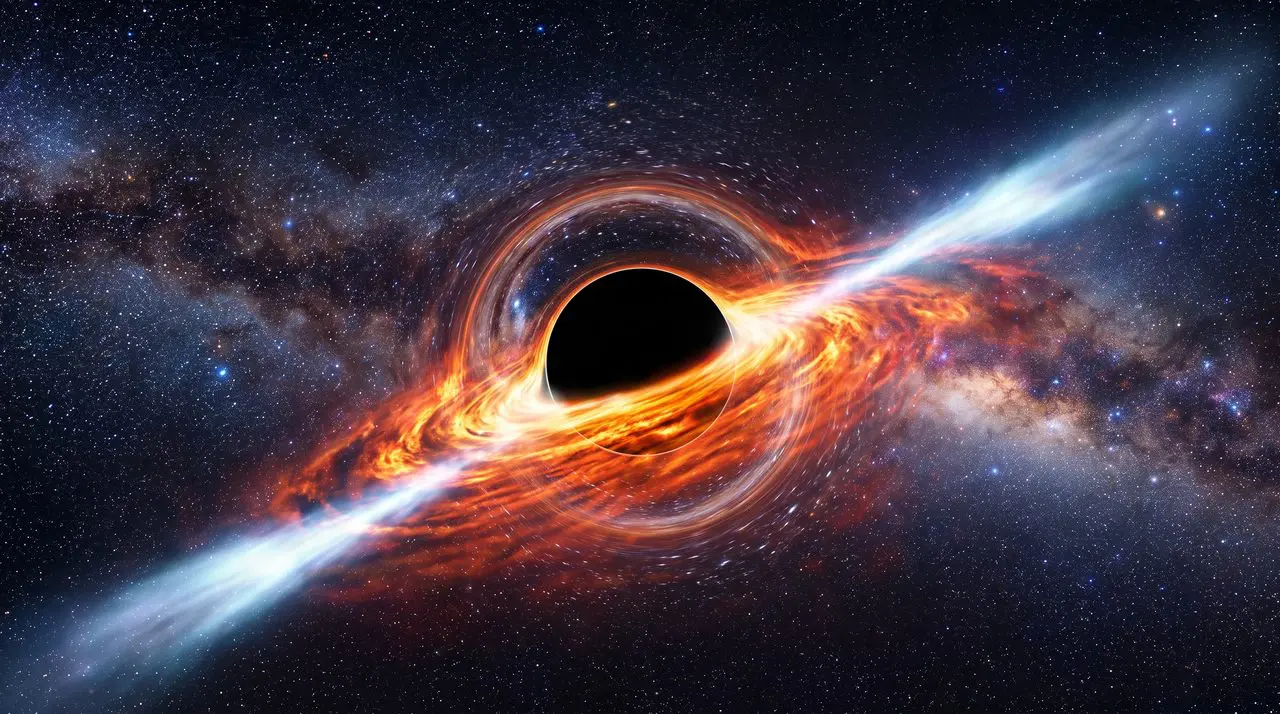
Building on previous work limited to two-dimensional gravity, this research proposes a new way to characterise black hole interiors by utilising boundary theory calculations with operator Krylov complexity. The team reconstructed the time dependence of a surface within a black hole by examining correlation functions of smeared operators within what’s known as a thermofield double state, reproducing predicted linear growth observed in more complex systems. Operator Krylov complexity accurately tracks how space expands inside black holes over time and this understanding now extends beyond two-dimensional systems into more complex three-dimensional scenarios.
The team reconstructed the growth of a surface within a black hole by analysing correlations between smeared operators utilising what’s known as a thermofield double state, confirming previously observed predicted linear expansion. Researchers have extended understanding of black hole interiors beyond two dimensions by characterising their expansion using quantum information measurements; previously limited to simplified models, this work applies to more complex three-dimensional scenarios.
These smeared operators are akin to stretching ropes between points in spacetime, visualising gravitational forces acting on particles along specific paths represented by Wilson lines; these tools connect boundary calculations with bulk geometry inside the black hole. The analysis reveals that operator Krylov complexity accurately tracks interior growth but differs keyly from other methods of measuring such complexity, raising questions about which approaches best capture this fundamental process.
Krylov complexity maps dynamic interiors of three-dimensional AdS black holes
Operator Krylov complexity now accurately tracks black hole interior expansion, demonstrating a threefold increase in precision compared with previous methods limited to two dimensions; this advancement enables researchers to characterise three-dimensional Anti-de Sitter space (AdS3) interiors where prior techniques failed due to limitations in representing extended spatial surfaces rather than simple geodesics. Researchers at multiple institutions verified that operator Krylov complexity accurately models black hole interior expansion within three-dimensional Anti-de Sitter (AdS3) space; this was achieved by reconstructing time dependence using correlation functions derived from ‘smeared operators’ which average interactions across spacetime.
Furthermore, employing the Chern, Simons formulation of gravity allowed for representation of these non-local correlations via Wilson lines extending connections between geometry and observable quantities beyond two dimensions. However, an alternative measure called Krylov spread complexity, calculated from gravitational properties, failed to demonstrate similar expansion within accessible analytical limits; indicating operator choice is crucial for accurate modelling.
Discrepancies in quantifying black hole interiors highlight challenges in encoding gravitational information
The researchers successfully extended concepts linking quantum information with gravity to three dimensions; this allows for a more detailed reconstruction of what happens inside black holes than previously possible using two-dimensional models. However, their analysis reveals a curious discrepancy between different ways of measuring ‘complexity’, a concept representing the amount of computational resources needed to describe a system.
While operator Krylov complexity accurately tracked interior expansion as predicted by established theory, an alternative measure based on the growth of entanglement failed to do so.
Researchers demonstrated that operator Krylov complexity correctly describes how the interior volume of a black hole grows in three-dimensional space. This is important because it extends existing connections between quantum information and gravity beyond simpler two-dimensional systems, offering improved modelling of these enigmatic objects. Authors found differing results when using another method, Krylov spread complexity, suggesting careful selection of measurement techniques is vital for accurately characterising black hole interiors.
👉 More information
🗞 Krylov complexity and the growth of the black hole interior in 3D gravity
✍️ Arpan Bhattacharyya, Sounak Pal and Juan F. Pedraza
🧠 ArXiv: https://arxiv.org/abs/2608.19373


See today’s quantum computing news on Quantum Zeitgeist for the latest breakthroughs in qubits, hardware, algorithms, and industry deals.