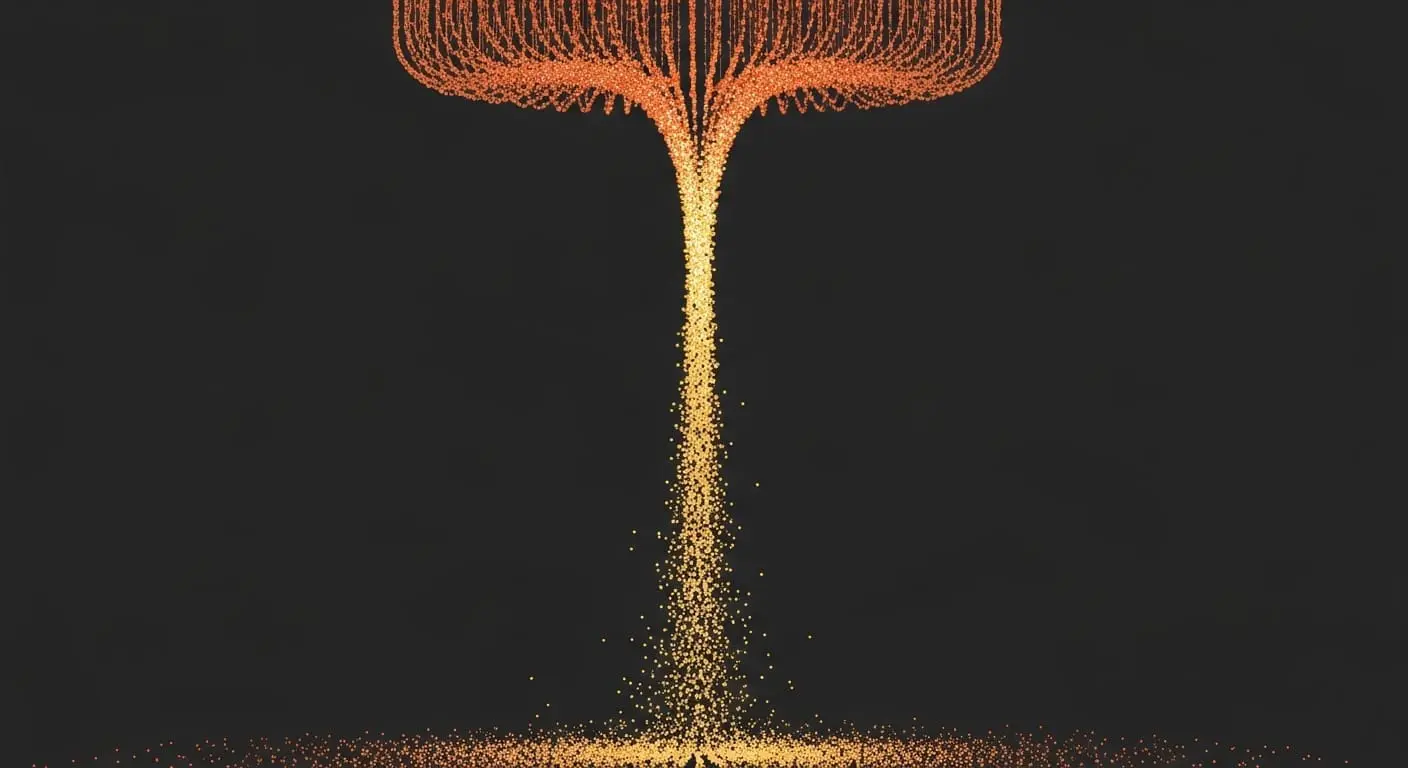
A repulsive Bose-Einstein condensate undergoes implosive dynamics when subjected to a specific topological change, according to work by Marios Kokmotos and colleagues at the University of Birmingham. Numerical simulations reveal that switching the condensate rapidly from a highly charged vortex state to a trivial state initiates a swift inward flow and central density buildup. Topological engineering is a new method for investigating implosive dynamics and symmetry-breaking instabilities within quantum fluids. The initial vortex structure dictates the resulting polygonal shapes formed after the initial implosion and subsequent wavefront evolution.
Stepwise phase imprinting generates giant vortices in a two-dimensional Bose–Einstein condensate
Phase imprinting proved key to initiating these implosive events; it is a technique for creating vortices within a Bose–Einstein condensate, a state of matter where atoms act as a unified “super-atom”. Applying a carefully crafted phase change to the condensate effectively “stamps” a vortex with a specific winding number onto the system.
Rather than directly creating a large vortex, the team applied multiple small imprints, allowing the condensate to adjust between each one. This preserved the coherence of the superfluid and prevented immediate fragmentation. A system utilising 5×1045 \times 10^4 rubidium-87 atoms within an oblate trap was used, defined by parameters λ=15\lambda = 15 and ω⊥=2π×20 Hz\omega_\perp = 2\pi \times 20 \,\text{Hz}. These settings ensured the condensate remained in the Thomas-Fermi regime and effectively two-dimensional.
Simulations employed a 512×512×16512 \times 512 \times 16 grid with a resolution of 0.075×0.075×0.120.075 \times 0.075 \times 0.12, advanced using a split-step Fourier method with timesteps of 1.55×10−41.55 \times 10^{-4}. The team used a stepwise approach to vortex creation, gradually increasing winding numbers to maintain superfluid coherence and avoid fragmentation that occurs when attempting to create large vortices directly.
Initiation of condensate implosion via high-winding-number phase imprinting and symmetry breaking
Phase imprinting achieved a winding number of 25, exceeding previous limits of approximately 10, enabling the creation of giant vortices stable enough for topological quenching. This allows for the creation of giant vortices without relying on attractive interactions or external potentials, a feat previously considered impossible.
Simulations reveal a clear threshold for implosion onset: the condensate remains stable below this winding number, but exceeding it triggers a rapid inward flow and central density buildup.
Following the initial implosion, circular wavefronts emerge and then break azimuthal symmetry, forming polygonal patterns dictated by the initial vortex construction. This symmetry breaking provides a new way to study instabilities in quantum fluids.
A repulsive Bose–Einstein condensate, a state of matter formed by cooling atoms to near absolute zero, can be forced to collapse inward via a precisely controlled change in its internal structure; this process is termed a topological quench. Initially, giant vortices, swirling patterns within the condensate, were created by gradually increasing their winding number through phase imprinting, a technique that manipulates the wave-like properties of atoms.
A subsequent rapid reversal of this process, cancelling the accumulated winding, initiated the implosion, generating a concentrated density peak despite the condensate’s natural tendency to repel itself. After this initial compression, circular waves formed and fractured into polygonal shapes determined by the initial vortex structure. This symmetry breaking offers a new way to study instabilities in quantum fluids.
Engineered condensate modulations trigger polygonal implosions in quantum fluids
Controlling the behaviour of quantum fluids remains a central challenge in condensed matter physics, with implications ranging from superfluidity to turbulence studies. This work offers a new route to induce implosive dynamics, a rapid inward collapse, in these systems, bypassing the need for attractive forces that typically drive such behaviour. However, the current study relies entirely on numerical modelling, and confirming whether these predicted polygonal wave patterns are observable in real experimental setups remains an important challenge.
Even acknowledging that these findings currently exist only in simulations, they significantly expand understanding of how quantum fluids can be manipulated. Bose–Einstein condensates exhibit unusual properties such as superfluidity when cooled to near absolute zero; this is a state of matter with zero viscosity. The study demonstrates a new method of triggering implosion without relying on attractive forces by precisely engineering changes to the condensate’s internal structure.
Scientists have shown that a repulsive Bose–Einstein condensate can be made to collapse inward through a carefully engineered change in its internal structure. This is significant because it achieves implosion, a rapid inward flow, without the need for attractive forces, which usually drive such behaviour in quantum fluids.
The study finds that manipulating the condensate’s initial swirling patterns (giant vortices) leads to polygonal wave formation after implosion. The authors suggest this “topological engineering” approach provides a new tool for investigating implosive dynamics and instabilities in quantum systems.
The researchers demonstrate that a repulsive Bose–Einstein condensate can be made to collapse inward through a precisely engineered topological change. This is significant because it achieves implosion without attractive forces, which are normally required. By manipulating giant vortices within the condensate, the study produces polygonal wave patterns after collapse. The authors propose this as a new method for studying instabilities in quantum fluids.
👉 More information
🗞 Implosive Dynamics from Topological Quenches in Bose-Einstein Condensates
🧠 ArXiv: https://arxiv.org/abs/2604.17932




See today’s quantum computing news on Quantum Zeitgeist for the latest breakthroughs in qubits, hardware, algorithms, and industry deals.