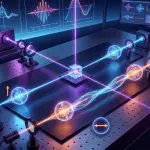
Tereza Zemánková of the Institute of Scientific Instruments of the Czech Academy of Sciences and colleagues investigate how manipulating light can cool tiny, levitated particles without traditional cooling methods. They demonstrate a flexible optomechanical platform using a vacuum-levitated nanoparticle to control its mechanical modes, including non-reciprocal interactions. Their research shows that by tuning the polarisation of the trapping beam, asymmetric energy transfer can be induced between the particle’s modes, leading to the spontaneous cooling of one mode. This clean and strongly controlled system offers a pathway toward exploring non-Hermitian dynamics and realising related phenomena in the quantum regime, potentially advancing quantum technologies.
Asymmetric optical trapping enables spontaneous mechanical cooling without feedback
Spontaneous cooling of a single mechanical mode was achieved, reducing thermal motion by a factor of two, an outcome previously unattainable without external feedback. Manipulating the polarisation of a trapping beam focused on a 987 nm-diameter levitated silica microsphere induced asymmetric energy transfer between its transverse motional modes.
Engineering the spatial ellipticity of the optical trap enabled precise control over inter-axial coupling, the interaction between motions along different axes, and transitioned the system from reciprocal to non-reciprocal dynamics. The principle relies on the gradient force exerted by a highly focused laser beam on a dielectric particle, trapping it in a stable potential minimum. By shaping the polarisation of this beam, the researchers created an anisotropic potential, meaning the particle experiences different forces depending on its direction of motion. This anisotropy is crucial for inducing non-reciprocal interactions.
Both mechanical modes shared identical mass, size, charge, and optical environment, creating a uniquely clean platform for investigating non-Hermitian dynamics and exploring phenomena such as directional energy flow at the level of individual degrees of freedom.
Achieving this cooling represents a major advance over previous techniques, as it was accomplished without any external feedback mechanisms. Traditional cooling methods for micro- and nano-mechanical systems often rely on feedback loops, where motion is monitored and actively damped. This introduces complexity and can limit cooling performance. The absence of feedback in this experiment simplifies the system and allows for a more fundamental investigation of the underlying physics.
The team engineered asymmetric energy transfer between the microsphere’s transverse motions by precisely controlling the ellipticity of the optical trap, transitioning the system from reciprocal to non-reciprocal dynamics. The ellipticity, defined by the ratio of the semi-minor to semi-major axis of the optical trap, directly controls the strength of inter-axial coupling. Higher ellipticity leads to stronger coupling and more pronounced non-reciprocal behaviour.
Further investigation will focus on the limitations of this approach, the potential for extending the duration of the cooling effect, and scaling these effects to more complex systems while maintaining coherence over extended periods. Maintaining coherence is essential for quantum applications, as loss of coherence degrades quantum states and limits device performance.
Levitated nanoparticle experiments show controlled energy behaviour beyond standard quantum regimes
Researchers are increasingly able to manipulate light to control microscopic objects, opening new avenues for sensing technologies and fundamental physics experiments. However, achieving truly quantum behaviour in these systems remains challenging, requiring extremely low temperatures and strong isolation from environmental noise.
The challenges arise because levitated particles are constantly affected by thermal fluctuations from their surroundings, which can obscure subtle quantum effects. Levitation in high vacuum significantly reduces these disturbances, enabling more precise control and observation. The use of a silica microsphere further minimises surface effects and ensures a well-defined optical response.
While this work demonstrates a route toward non-Hermitian dynamics, a framework describing open systems where energy is not conserved in the traditional sense, the study does not specify exact temperatures achieved during cooling. Non-Hermitian dynamics can produce phenomena such as exceptional points, where system behaviour changes dramatically and sensitivity to external perturbations is enhanced.
The absence of precise temperature measurements does not diminish the significance of demonstrating controlled non-Hermitian dynamics in a levitated nanoparticle. The reduction in thermal motion by a factor of two, while not reaching absolute zero, is a substantial achievement and demonstrates the effectiveness of the non-reciprocal cooling mechanism.
This establishes a pathway toward exploring exotic states of light and matter. Controlling energy flow at this scale has implications for advanced sensing technologies and quantum devices, including highly sensitive detectors that exploit enhanced responses near exceptional points.
A silica microsphere with identical properties in all directions provides a uniquely clean environment for studying energy redistribution in minimal systems. This enables isolation of engineered effects from intrinsic asymmetries in the particle itself. The system exhibits genuinely non-reciprocal behaviour, where energy flow is directionally biased rather than symmetric.
Researchers demonstrated spontaneous cooling of one mechanical mode in a vacuum-levitated silica microsphere by engineering non-reciprocal interactions. This was achieved without external feedback, reducing thermal motion by a factor of two. The system’s use of elliptical polarisation enables controlled exploration of non-Hermitian dynamics and asymmetric energy transfer. Combined with existing cooling techniques, this work provides a pathway for investigating fundamental physics and enhancing sensitivity to external perturbations.
👉 More information
🗞 Unidirectional Inter-Axial Coupling and Spontaneous Cooling in a~Non-Hermitian Dynamics of a~Levitated Particle
🧠 ArXiv: https://arxiv.org/abs/2604.17985

See today’s quantum computing news on Quantum Zeitgeist for the latest breakthroughs in qubits, hardware, algorithms, and industry deals.