

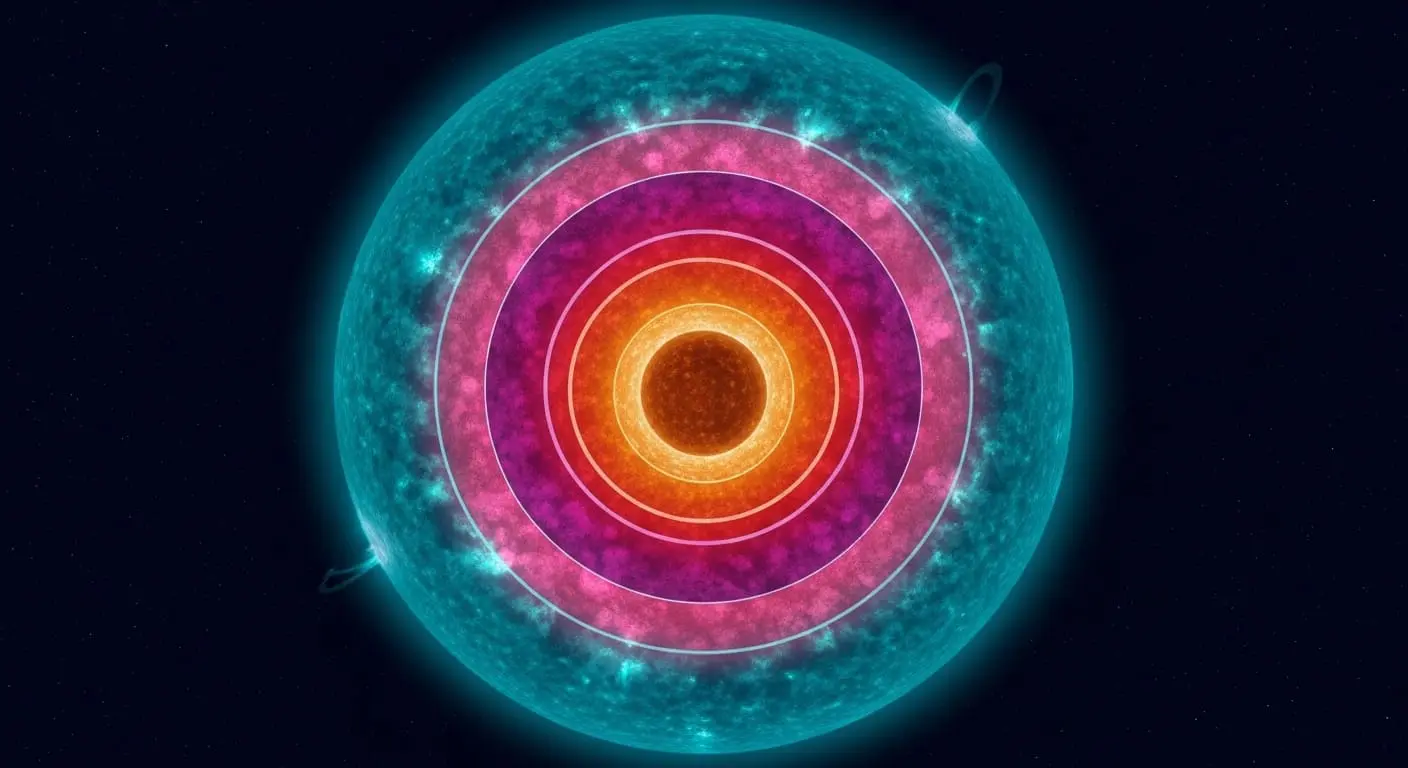
A new laboratory analogue for neutron stars has been created by investigating the complex behaviour of superfluids within aerogels, as described by Samuli Autti and colleagues at Lancaster University and Royal Holloway University of London. The research addresses the longstanding puzzle of “glitches”, sudden spin-ups observed in neutron stars, believed to originate from the dynamics of quantised vortices within their superfluid phases. By employing point-vortex simulations of aerogels mimicking both the crust and core of a neutron star, the team identified distinct regimes of vortex behaviour, including pinning and avalanche-like vortex production. These findings offer a new framework for interpreting neutron star observations and potentially improving our understanding of these enigmatic celestial objects.
Aerogel networks simulate vortex pinning within neutron stars
Utilising aerogels enabled the creation of an analogue system: an extremely lightweight and porous solid where over 90% of its volume is empty space, resembling a delicate foam. These aerogels provided the structural network needed to act as pinning sites for quantised vortices, tiny swirling whirlpools within the superfluid. Replicating these structures was vital because neutron stars are thought to contain similar pinning structures. The team then introduced superfluid helium-3, a liquid helium isotope that flows without resistance like a frictionless fluid, into these aerogels, allowing observation of vortex behaviour in a controlled environment. Experiments contained hundreds to thousands of vortices, offering advantages over simulations by providing access to global vortex physics. The team explored two aerogel types, representing neutron star crust and core environments, to examine differing vortex dynamics.
Enhanced vortex pinning in aerogels simulates neutron star interiors and explains glitch phenomena
The pinning force in superfluid helium-3 within aerogels is up to two orders of magnitude larger than previously observed in bare core displacement effects, representing a substantial leap in replicating extreme astrophysical conditions. Detailed study of vortex dynamics is now possible, something earlier, less sensitive experimental setups could not achieve. Structures exceeding 90% empty space have successfully been used to model the interior of neutron stars, identifying two distinct regimes of vortex behaviour. Aerogels mimicking a neutron star’s crust exhibit depinning, while core-like aerogels exhibit avalanche-like vortex production.
These findings provide a new framework for interpreting observations of “glitches”, sudden spin-ups in neutron stars, and offer an important testbed for refining theoretical models of these complex celestial objects. A point-vortex model, mirroring the aerogel’s geometry, accurately reproduced experimental observations of vortex behaviour in detailed simulations, validating a microscopic understanding of this strong pinning effect. Further analysis of the “crust-like” aerogel demonstrated that pinned vortices are released when a critical rotation speed of 2.6 radians per second is surpassed, indicating a clear depinning threshold. This process is accompanied by a linear increase in counterflow, a measure of the difference in velocity between the superfluid and normal fluid components. Initial measurements revealed a critical flow velocity of 6.7 millimetres per second before vortex creation begins, suggesting a predictable relationship between applied force and vortex liberation.
Superfluid helium aerogels simulate neutron star interiors to study vortex pinning
Laboratory analogues are increasingly relied upon by scientists to unravel the mysteries of neutron stars, incredibly dense remnants of collapsed stars. While previous experiments have informed theoretical models of these objects, a significant gap remained in replicating the complex interaction between superfluidity and pinning forces within a neutron star’s interior. This work, utilising superfluid helium within aerogels, offers a promising new approach to address this challenge.
Acknowledging the immense disparity between laboratory experiments and actual neutron stars is important; perfectly replicating the conditions within these stellar remnants remains beyond current capabilities. However, this work provides a unique and valuable analogue, allowing scientists to observe and analyse superfluid vortex dynamics in a controlled setting unavailable elsewhere. This research could improve analysis of observed stellar glitches, contributing to a new era in understanding these dense, rapidly spinning objects.
Superfluid experiments within aerogels now provide a compelling new way to study neutron stars, incredibly dense stellar remnants. This work establishes a laboratory analogue where the behaviour of tiny swirling whirlpools, known as quantised vortices, within a superfluid can be directly observed and analysed, a significant improvement over previous reliance on theoretical modelling. By utilising lightweight structures over 90% empty space, conditions thought to exist both in the outer crust and the dense core of a neutron star were replicated, revealing differing vortex dynamics in each environment.
The research demonstrated that superfluid helium within aerogels can effectively simulate the interior of neutron stars, allowing for the observation of pinned vortex behaviour. This is important because neutron star glitches, sudden changes in spin, are thought to be caused by the movement of these vortices, but observing them directly within a star is impossible. Experiments revealed differing vortex dynamics depending on the aerogel structure, with vortices being released at a critical flow velocity of 6.7 millimetres per second in one environment and new vortices being created in another. The authors suggest these findings should be applicable to the analysis of neutron star observations, potentially refining current understanding of these complex objects.
👉 More information
🗞 Superfluid $^3$He aerogel experiments as a laboratory neutron star analogue
🧠 ArXiv: https://arxiv.org/abs/2604.18016


See today’s quantum computing news on Quantum Zeitgeist for the latest breakthroughs in qubits, hardware, algorithms, and industry deals.



