

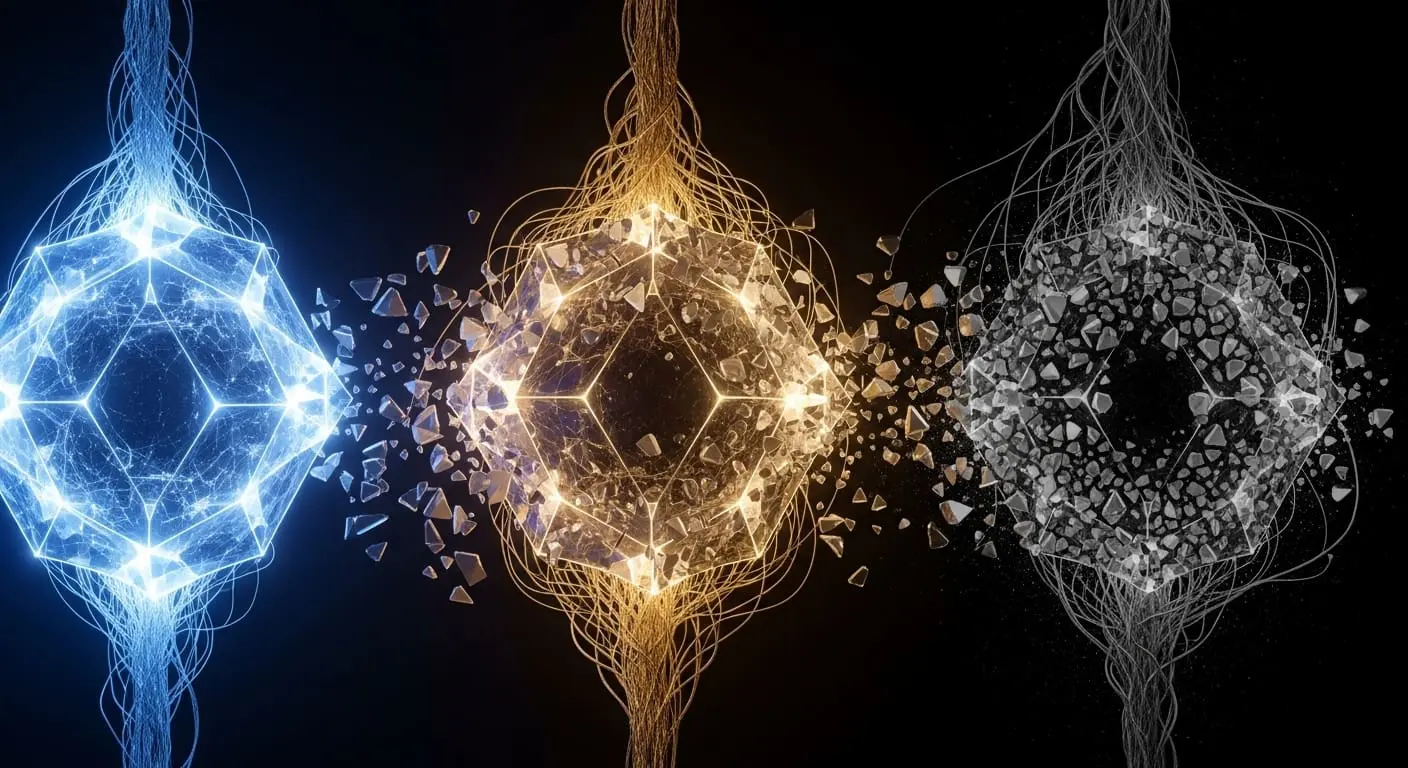
A new computational technique accurately models decoherence’s impact on light–matter interactions within waveguide quantum electrodynamics. Matias Bundgaard-Nielsen and colleagues at the Technical University of Denmark present a matrix product state (MPS) method capable of modelling decoherence processes via density matrices, representing a key advancement over previous approaches. The method utilises collision quantum optics and efficiently incorporates various loss mechanisms, including emitter pure dephasing and off-chip radiative decay, to simulate complex waveguide QED systems such as two-level systems and multi-emitter setups. By modelling these realistic dissipation dynamics, the research offers vital insights into the behaviour of quantum systems and enables improved designs for quantum technologies.
Modelling non-Markovian dynamics extends timescales in waveguide quantum electrodynamics
A six-fold increase in simulated timescales for waveguide quantum electrodynamics has been achieved, surpassing limitations that previously restricted simulations to Markovian dynamics. This advancement results from employing a density matrix-based matrix product state (MPS) method, enabling accurate modelling of non-Markovian effects arising from time delays and memory effects within the system.
Traditionally, waveguide QED simulations have relied on the Markov approximation, which assumes that the system’s memory of past events is negligible. However, in many realistic scenarios, particularly those involving long propagation delays within the waveguide or slow emitter dynamics, this approximation breaks down. The method explicitly accounts for the system’s history, allowing the simulation of phenomena that depend on non-Markovian effects. In particular, it incorporates realistic decoherence mechanisms such as pure dephasing, which perturbs the phase coherence of quantum states, and off-chip radiative decay, where excitation energy is lost to the environment outside the waveguide.
By representing the many-body state as discrete time bins efficiently managed by the MPS chain, the technique circumvents approximations that neglect important temporal dynamics. The MPS representation is particularly well suited for this task because it efficiently captures entanglement between emitters and waveguide modes while keeping computational costs manageable. Each time bin represents a snapshot of the system’s state at a specific point in time, and the MPS chain enables efficient propagation of this state forward in time.
Simulations based on matrix product states reproduced results obtained using a discrete waveguide model and collision quantum optics, accurately modelling light–matter interactions within a waveguide even with finite propagation delays between emitters. Collision quantum optics provides a framework for describing light–matter interactions in terms of collisions between photons and atoms, while the discrete waveguide model discretises spatial degrees of freedom for numerical simulation.
Further analysis revealed that pure dephasing alters the dynamics by suppressing superradiant emission observed when emitters are initially excited. Superradiance is a collective phenomenon in which multiple emitters radiate coherently, resulting in an enhanced emission rate, and its suppression highlights the importance of coherence in quantum systems.
The approach successfully models systems with mixed initial states, demonstrating a reduction in decay rates due to the absence of coherence between emitters, as evidenced by comparisons with purely superradiant states. A mixed initial state represents a statistical ensemble of quantum states, reflecting uncertainty in the emitters’ initial conditions. The reduction in decay rates arises from the loss of collective emission effects when coherence is absent.
Off-chip radiative decay was also demonstrated, exhibiting qualitatively different effects compared to pure dephasing, highlighting the method’s ability to simulate realistic quantum systems where perfect coherence is rarely maintained. Off-chip decay corresponds to energy loss into the external environment, whereas pure dephasing only affects phase coherence. The technique’s strength lies in its detailed representation of system evolution, enabling exploration of the interplay between different decoherence processes and their influence on quantum behaviour.
Matrix product states model light–matter quantum information loss
Accurately modelling decoherence, the loss of quantum information, is vital for building practical quantum devices, but scaling these simulations to realistically complex systems remains a considerable challenge. Quantum information is fragile and susceptible to environmental noise, which can destroy the quantum properties required for computation and communication.
The authors acknowledge current limitations in system size, leaving open questions about how efficiently the method will scale to significantly more emitters or more intricate waveguide geometries. The computational cost of MPS simulations grows rapidly with system complexity, limiting the size of tractable problems. Alternative approaches, such as process tensors, also address non-Markovian dynamics but often require substantial computational resources.
Despite these scaling limitations, this work provides a valuable new technique for modelling how quantum information degrades in light–matter systems. It accurately accounts for energy loss via both pure dephasing and off-chip radiative decay, both essential for realistic simulations of quantum devices. Scientists can now incorporate complex dissipation dynamics into matrix product state frameworks, representing a major improvement over previous approximations.
The approach represents system evolution as discrete time bins efficiently managed by a matrix product state chain, allowing simulation of non-Markovian dynamics where past events influence present behaviour. This makes it a complementary alternative to process tensor methods and is particularly relevant for quantum networks, where waveguide-mediated quantum information transfer is a key component and decoherence plays a central role in limiting performance.
The researchers developed a new computational method using matrix product states to model how quantum systems lose information due to decoherence. This technique accurately represents the degradation of quantum states in waveguide quantum electrodynamics, accounting for both pure dephasing and off-chip radiative decay. By representing the system’s dynamics as discrete time bins, the method offers an efficient way to simulate complex interactions where past events influence the present. The authors demonstrate its application to single and multi-emitter systems in waveguides and suggest it provides a complementary approach to existing techniques.
👉 More information
🗞 Decoherence in Waveguide Quantum Electrodynamics using Matrix Product States
🧠 ArXiv: https://arxiv.org/abs/2604.18036


See today’s quantum computing news on Quantum Zeitgeist for the latest breakthroughs in qubits, hardware, algorithms, and industry deals.



