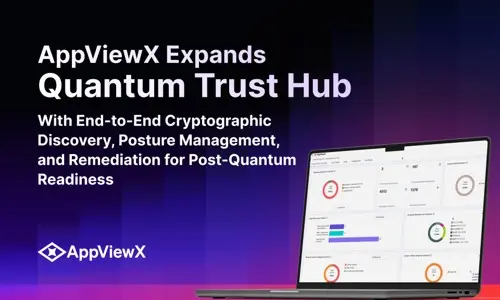
AppViewX has expanded its Quantum Trust Hub with new features designed to help organizations address the looming threat of quantum computing. Recognizing that 2030 is the year NIST plans to begin phasing out RSA and ECC, the platform now offers cryptographic posture management and remediation capabilities as a standalone solution.
Quantum Trust Hub uses an agentless-first approach, using existing security infrastructure to discover cryptographic assets without adding the overhead of new agents or sensors. “The quantum transition is a complex undertaking that enterprises need to start preparing for now,” says Jennifer Glenn, research director at IDC.
Quantum Trust Hub Delivers Agentless Cryptographic Asset Discovery
The Quantum Trust Hub now integrates with Qualys alongside existing Tenable support, allowing organizations to use existing security investments for cryptographic asset discovery without deploying additional agents. This agentless-first approach minimizes implementation costs and complexity while still enabling comprehensive visibility into an organization’s cryptographic footprint. AppViewX designed this feature to address the growing need for continuous monitoring of cryptographic posture as the 2030 deadline for phasing out RSA and ECC approaches, a timeline established by the National Institute of Standards and Technology.
The platform consolidates findings from these existing tools, building a unified inventory of cryptographic assets that extends beyond traditional certificate inventories to include TLS configurations, cipher suites, keys and application code. This expanded visibility is important because cryptographic exposure extends far beyond certificates, making a complete assessment of risk difficult without an integrated view.
The platform classifies assets as either quantum-vulnerable or quantum-resistant, then prioritizes remediation efforts based on business application context and NIST-aligned severity ratings. This risk-based approach allows security teams to focus on the most critical exposures first, accelerating the transition to post-quantum cryptography. Remediation planning and execution are further streamlined through direct integration with ServiceNow, where cryptographic findings are automatically converted into ready-to-work tickets containing affected assets, identified risks, recommended fixes and ownership information. The ability to upload Cryptographic Bills of Materials and Software Bills of Materials from third-party tools further enhances the platform’s capabilities.
By consolidating findings from multiple discovery sources, Quantum Trust Hub provides a single, unified inventory of cryptographic assets, forming the foundation for robust cryptographic posture management. “Certificates are only one part of the equation. Cryptographic risk extends across the identities, keys, protocols, and applications that underpin enterprise trust,” said Archit Lohokare, CEO of AppViewX.
“With Quantum Trust Hub, we’re giving organizations the continuous visibility and risk intelligence needed to identify vulnerable cryptography, focus on their most critical exposures, and take a more proactive approach to quantum readiness.” The platform’s agility extends beyond initial discovery and remediation, enabling organizations to respond quickly to new vulnerabilities, policy changes, and evolving PQC standards. Maintaining a continuously updated inventory of cryptographic assets and their risk status eliminates the need to repeatedly reassess exposure from scratch, saving valuable time and resources.
Jennifer Glenn, research director at IDC, emphasizes the urgency of this proactive approach. “Recent attacks involving compromised cryptographic credentials and signing keys underscore the risks organizations already face today. With federal migration deadlines approaching and quantum computing potentially advancing faster than expected, understanding the full scope of cryptographic exposure will be essential to planning an effective response.” The expansion of Quantum Trust Hub reinforces AppViewX’s broader mission to secure machine and agent identities, credentials, and cryptography as enterprises navigate the transition to post-quantum computing.
The platform works alongside AppViewX’s Certificate Lifecycle Management and SSH Key Lifecycle Management solutions to accelerate remediation of vulnerable certificates or SSH keys identified during a PQC assessment. This integrated approach provides a more comprehensive solution for managing cryptographic risk across diverse environments and ensuring a smooth transition to quantum-resistant cryptography. The company also recently advanced its Agent Identity Security solution to discover, govern, and control the actions of AI agents at runtime, further extending its security portfolio.
The quantum transition is a complex undertaking that enterprises need to start preparing for now.
Jennifer Glenn, research director at IDC




See today’s quantum computing news on Quantum Zeitgeist for the latest breakthroughs in qubits, hardware, algorithms, and industry deals.