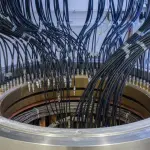
Germany’s largest national quantum computing project to date, QSolid, has achieved its initial goal of developing a 30-qubit quantum chip with low error rates, exceeding expectations since its launch in early 2022, the company says. The €75 million consortium, comprised of 26 research institutions, companies and start-ups coordinated by Forschungszentrum Jülich, is currently testing the chip and has made a 10-qubit system accessible via the cloud.
“The performance of a quantum computer depends on how many computational steps it can carry out while keeping errors to a minimum,” explains Prof. Frank Wilhelm-Mauch of Forschungszentrum Jülich, who coordinates the project. The consortium tested the hardware and software interaction by modelling spin resonance processes used in chemical analysis and MRI.
Developing the quantum technology research landscape 2
Researchers focused on developing processes for superconducting qubit circuits, with current characterisation and statistical analysis underway to validate reproducibility and yield, essential for scaling quantum systems. Integrating these processes into the FLUXONICS Foundry’s service portfolio will ensure long-term availability and practical application of the project’s results, according to project leads. To achieve sustained progress, QSolid encouraged close collaboration between research and industry; over five years, teams (PGI-13) worked alongside consortium partners to transition a quantum control system testing into continuous operation on the QSolid demonstrator, according to the company.
This experience directly informs the development of the next generation control system, designed to address the challenge of creating long-lived logical qubits, a critical step towards fault-tolerant quantum computation. “QSolid shows what close collaboration between research and industry can achieve,” stated a consortium representative.
The project’s impact extends beyond hardware development. QSolid helped advance work on quantum applications, specifically in nuclear magnetic resonance (NMR). This research identified a promising pathway for demonstrating the practical value of quantum computing and led to the creation of a product for analysing materials using NMR, already delivering value to users. “QSolid was a turning point for our work on quantum applications,” the company reports, highlighting the translation of research into concrete industrial impact.
QSolid shows what close collaboration between research and industry can achieve. Over five years, we worked side by side with Forschungszentrum Jülich (PGI-13) and our consortium partners to take our quantum control system from the lab into continuous operation on the QSolid demonstrator. The experience we gained in QSolid now feeds directly into the next generation of our control system, built to master the challenge ahead: long-lived logical qubits.
Dr Gregor Oelsner, Head of the Quantum Circuits Research Group at Leibniz-IPHT, also
Establishing industrial competitiveness through lighthouse projects 4
A 30-qubit system is currently undergoing testing, demonstrating a significant advancement in German-engineered quantum hardware. With a total budget over €75 million, the collaborative project has pooled expertise from across Germany and brought together partners from research and industry. By jointly developing a quantum ecosystem, the consortium has given companies early access to this emerging technology and strengthened their technological capabilities and independence.
With QSolid, we have demonstrated that here in Germany we can design, manufacture and operate functional quantum processors from scratch within a short period of time. This is a crucial prerequisite for the further development of the German quantum ecosystem and a major achievement for the highly skilled students, scientists and engineers who made it possible.
Prof. Rami Barends, Director of the Peter Grünberg Institute for Functional Quantum Systems (PGI-13) at Forschungszentrum Jülich
Shaping international collaboration 6
Researchers achieved a quantum operation on a qubit in just 6.8 nanoseconds with 99.98 percent accuracy, significantly faster than typical superconducting quantum computers which usually require several tens of nanoseconds for similar operations. This speed improvement is not merely an academic exercise. It directly impacts the complexity of computations the system can handle and the reliability of results. Efforts are now focused on refining the control systems and ensuring consistent performance across multiple manufacturing runs.
The project’s results are a foundation for future quantum technologies and a catalyst for further innovation. Contact for further information is available through EURICE GmbH, with communications managed by Marlena Jakobs.
The performance of a quantum computer depends on how many computational steps it can carry out while keeping errors to a minimum. There are two main ways to achieve this: we can either ensure that qubits retain their quantum states for longer or speed up gate operations, allowing more computational steps to be performed in the same amount of time.
Prof. Frank Wilhelm-Mauch of Forschungszentrum Jülich, who coordinates the large-scale project




See today’s quantum computing news on Quantum Zeitgeist for the latest breakthroughs in qubits, hardware, algorithms, and industry deals.