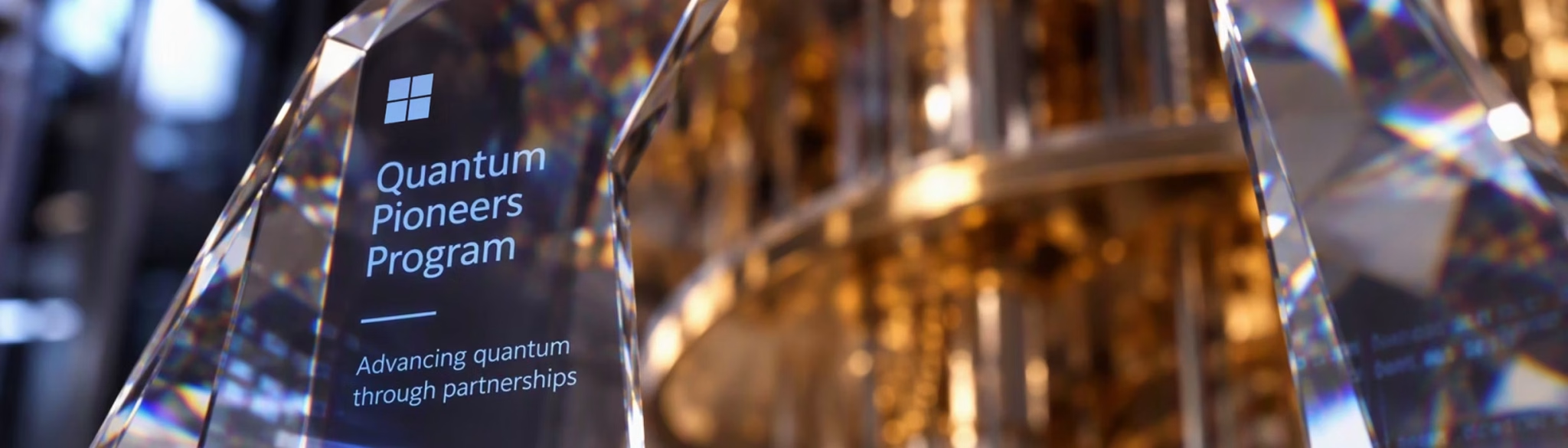
Microsoft has named the winners and finalists of the June 2026 round of its Quantum Pioneers Program, the company’s initiative for partnering with academic research groups on the problems that stand between today’s experimental devices and fault-tolerant quantum computing, meaning machines that can detect and correct their own errors quickly enough to run long and useful calculations reliably. Five teams were selected in the Hardware Track and five more in the Software Track, with a further six Software Track proposals recognised as finalists, drawing on universities across the United States as well as TU Delft in the Netherlands and The Hebrew University of Jerusalem.
Much of the hardware work centres on topological qubits, the approach Microsoft has pursued for years, in which quantum information is stored in exotic states of matter called Majorana zero modes so that it is spread across a device and harder for local noise to disturb, and several teams are focused on reading those qubits out faster and more cleanly. The software proposals lean heavily toward quantum error correction (QEC), which protects fragile information by encoding each logical qubit across many physical qubits and repeatedly checking for faults, although the selected projects also extend into quantum chemistry, materials simulation and drug discovery.
Microsoft presented the new cohort as a reflection of how interdependent progress in the field has become, since new physical devices rely on dependable measurement and control while error-correcting codes and algorithms both need practical implementations that make good use of whatever resources the hardware provides. The company said it plans to work with the selected researchers to test ideas and share findings as it pursues fault-tolerant quantum computing, and it thanked everyone who submitted a proposal ahead of future rounds of the programme.
Hardware Track winners
| Researchers | Institutions | Proposal |
|---|---|---|
| Andrea Young and Michel Devoret | University of California, Santa Barbara | Advanced Readout Techniques for High Magnetic Field Topological Qubits |
| Constantin Schrade and Valla Fatemi | Louisiana State University and Cornell University | Evaluation of Fast, High-SNR Parity Measurements via Inductive and Dot-Free Methods |
| Michael Wimmer and Anton Akhmerov | Delft University of Technology (TU Delft) | Multi-Objective Optimization of Measurement-Based Quantum Computing in Quantum Dot Kitaev Chains (MOOKit) |
| Shyam Shankar | University of Texas at Austin | DC-Powered Super-Semi Amplifier for Scalable Qubit Readout |
| Ali Yazdani and Michael P. Zaletel | Princeton University and University of California, Berkeley | Building a Prototype Topological Qubit |
Software Track winners
| Researchers | Institutions | Proposal |
|---|---|---|
| Edward F. Valeev | Virginia Tech | Realistic Active-Space Hamiltonians for Fault-Tolerant Quantum Computers |
| Ruben Verresen and Henry Yuen | University of Chicago and Columbia University | Adaptive Computation on Measurement-Based Topological Hardware |
| Aleksander Kubica and Alex Retzker | Yale University and The Hebrew University of Jerusalem | Adapting Recent QEC Constructions to Quantum Hardware |
| Isaac L. Chuang | Massachusetts Institute of Technology | Quantum Redundant Residue Arithmetic Coding, Non-CSS Qudit Codes that Make Arithmetic Clifford |
| Jong Yeon Lee | University of Illinois Urbana-Champaign | From Logical Spectroscopy to Hardware-Aware qLDPC Compilation |
Software Track finalists
| Researchers | Institutions | Proposal |
|---|---|---|
| Vojtech Vlcek and Alexander Kemper | University of California, Santa Barbara and North Carolina State University | Adaptive Dynamical Downfolding for Correlated Materials |
| Gushu Li | University of Pennsylvania | Architectural Support for Fault-Tolerant Measurement-Based Topological Quantum Computing |
| Junyu Liu | University of Pittsburgh | End-to-End Quantum Software for Majorana-Native Stabilizer Codes |
| Ning Bao and Eugene Tang | Northeastern University | Locality-Aware Quantum Error Correction for Fault-Tolerant Architectures |
| Yu Tong | Duke University | Open-System Quantum Simulation with Near-Optimal Spacetime Scaling |
| Sabre Kais | North Carolina State University | Quantum Simulation of Chiral Reaction Dynamics for Drug Discovery |
The June 2026 competition identified five winning proposals for the Software Track of the Quantum Pioneers Program, reflecting a selective process designed to encourage focused research efforts. Six finalists also received recognition, indicating a robust and competitive field of applicants exploring quantum software solutions. Microsoft plans to collaborate with these researchers, testing new concepts and exchanging insights to accelerate progress toward practical quantum computing. This collaborative approach aims to bridge the gap between theoretical innovation and tangible implementation, addressing the interconnected challenges inherent in building fault-tolerant quantum systems.
The company intends this group of researchers to contribute to the development of reliable measurement and control techniques, practical error-correcting code implementations, and algorithms that efficiently use available quantum resources, according to Microsoft. Microsoft anticipates future rounds of the Quantum Pioneers Program will continue to attract innovative proposals from the research community, furthering the field’s advancement.


See today’s quantum computing news on Quantum Zeitgeist for the latest breakthroughs in qubits, hardware, algorithms, and industry deals.