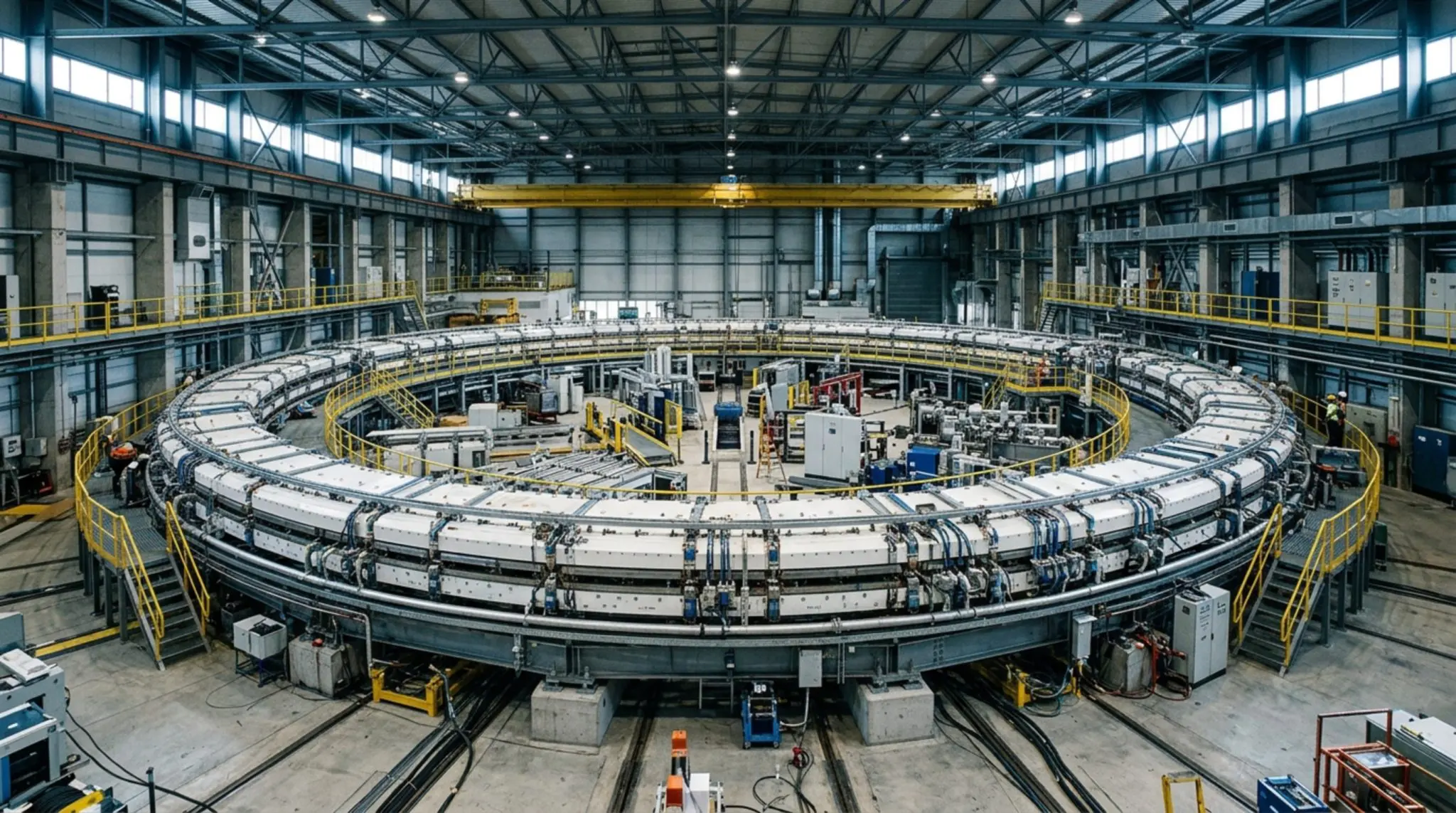
CNPEM will soon host the world’s first Biosafety Level 4 (BSL-4) laboratory directly connected to a synchrotron light source, a unique infrastructure that will accelerate both pathogen research and new drug development. Established 40 years ago to build Brazil’s first synchrotron, CNPEM has evolved into a multidisciplinary research hub spanning health, materials science and bio-renewables.
“The evolution from bench to market is CNPEM’s collective responsibility, not any single person’s,” says Antonio José Roque da Silva, Director-General at CNPEM, adding that this integrated model is what “makes this institution genuinely powerful.” The center’s expanded role is further solidified as the first anchor hub of Brazil’s national health innovation program, Projeto Âncora, providing dedicated infrastructure for pharmaceutical companies and startups.
Sirius Synchrotron Establishes Brazil’s Scientific Infrastructure
This connection, initially proposed as a response to a query from Brazil’s Ministry of Science and Technology, will allow scientists to study infectious diseases with unprecedented detail at the atomic level, according to Antonio José Rodrigues da Silva, Director-General of CNPEM. The integration of these two facilities positions Brazil as a global leader in pathogen research, offering capabilities not currently available elsewhere. This transformation was driven by the success of designing, building, and operating Sirius, a fourth-generation synchrotron light source that demonstrates Brazil’s capacity for large-scale scientific infrastructure.
Sirius enables sophisticated experiments at the atomic, nanometric and molecular levels, impacting fields ranging from health to critical mineral research, areas of increasing geopolitical importance. Beyond the technological advancement of the BSL-4 connection, CNPEM is actively working to broaden access to its infrastructure, particularly for researchers in the north and northeast regions of Brazil.
Historically, the strongest scientific groups have been concentrated in the southeast, creating a disparity in research opportunities, the company says. To address this, CNPEM is implementing a regional ambassador network embedded within federal universities, linking sophisticated infrastructure to locally identified scientific challenges.
This initiative responds to long-standing conversations within the Ministry of Health and aims to ensure equitable access to advanced research tools across the country. Measuring the impact of this broadened access is now a key priority for CNPEM, moving beyond simply opening its 33 open labs, covering areas from biology to electron microscopy, to assessing the tangible outcomes of increased participation.
The institution is also deploying artificial intelligence across its operations, from protein structure analysis and materials design to optimizing the synchrotron itself, though the governance of these AI capabilities remains under discussion, according to the company.
“Simply opening the lab is one thing,” Rodrigues da Silva explained, “But the strategic question we are working through right now is what the impact of that access actually is.” The ability to study how pathogens interact at a cellular and organismal level, facilitated by the combined BSL-4 and synchrotron capabilities, is expected to generate new knowledge with significant implications for public health.
CNPEM believes this infrastructure will not only advance fundamental scientific understanding but also position Brazil to respond effectively to emerging infectious disease threats. The organization’s long-term vision extends to supporting innovation and translating research findings into tangible benefits for society, a process Rodrigues da Silva describes as a collective responsibility. “We believe this will generate new knowledge about how pathogens interact, from single cells all the way to whole organisms, and it will position Brazil with a truly unique infrastructure worldwide.
The evolution from bench to market is CNPEM’s collective responsibility, not any single person’s. That integrated model is, I believe, what makes this institution genuinely powerful.
Orion Project: Connecting BSL-4 Biosafety with Synchrotron Light
CNPEM’s expansion of research capabilities now includes a solution to safely transfer samples from a Biosafety Level 4 (BSL-4) laboratory to a synchrotron beamline, a feat previously unachieved and currently under construction. The Orion project, born from a question posed by the Ministry of Science and Technology during the COVID-19 pandemic, addresses the logistical challenges of maintaining containment while using the high-resolution imaging capabilities of the Sirius fourth-generation synchrotron.
Solutions developed by CNPEM, and already presented internationally, focus on guaranteeing sample containment at the point of transfer and during analysis. The impetus for Orion stemmed from CNPEM’s involvement in the initial response to the SARS-CoV-2 virus, a period that highlighted the institution’s lack of a BSL-3 facility, essential for handling the pathogen, the firm reports. This realization, coupled with the Ministry’s inquiry, prompted exploration of a direct connection between a BSL-4 laboratory and the Sirius synchrotron, a concept considered novel at the time.
Antonio José Roque da Silva, Director-General of CNPEM, explains that the project’s origins lie in a willingness to embrace risk, a core tenet of the institution’s culture established during the construction of the Sirius synchrotron itself. “With Sirius, the most important thing we learned was how to manage very large, complex processes,” da Silva said. Originally conceived as a BSL-4 facility, Orion’s scope has broadened to incorporate BSL-3 and a substantial BSL-2 environment, creating a comprehensive platform for studying pathogens at various containment levels.
This expansion reflects a strategic shift towards integrated research, allowing scientists to investigate biological systems from single cells through to animal models using advanced imaging techniques. The synchrotron’s ability to perform tomographic imaging at extremely high resolution is central to this approach, enabling detailed analysis of pathogen structure and function.
This capability extends beyond basic research, offering potential for accelerating drug discovery and optimizing microorganism prospecting for new enzymes. The project builds on lessons learned from earlier work at Diamond Light Source, which successfully brought BSL-3 samples to a beamline during the COVID-19 pandemic, but surpasses it in ambition by designing a fully integrated facility with three dedicated beamlines. CNPEM’s approach, according to da Silva, emphasizes a collaborative model where the translation of research into practical applications is a collective responsibility.
CNPEM’s Role as National Health Innovation Anchor
CNPEM’s designation as Brazil’s first national health innovation anchor hub formalizes existing collaborations between the research center and the health sector, using a unique organizational structure for increased operational flexibility. As a private non-profit organization contracting with the government under the supervision of the Ministry of Science and Technology, CNPEM’s structure allows for the inclusion of other ministries as intervening partners, a step explored with the Ministry of Health and Fiocruz, the company states.
Beyond the well-known Sirius fourth-generation synchrotron, CNPEM has cultivated strong competencies in biological and health research, a development that positioned the institution as the logical choice for the national health innovation program. This expansion into health research complements existing work in materials science and bio-renewables, demonstrating a multidisciplinary approach to scientific challenges.
CNPEM’s bio-renewables lab, for example, has progressed beyond second-generation ethanol production from sugarcane bagasse to developing hydrocarbons for aviation fuel and long-haul transport, demonstrating a commitment to practical applications of research. The establishment of Projeto Âncora provides dedicated infrastructure and access for pharmaceutical companies and startups, extending CNPEM’s impact beyond fundamental research and into the realm of commercial innovation, by the company’s account. This distributed approach ensures that CNPEM’s resources address regional priorities and encourages collaboration across the country.
“That capability is present across CNPEM, and how we manage it collectively is the open question,” da Silva noted. CNPEM’s influence is also expanding beyond national borders, with the institution increasingly viewed as a hub for addressing health challenges across South America and the broader Global South. The scarcity of comparable infrastructure in these regions positions CNPEM as a critical resource for collaborative research and development.
Da Silva believes this potential stems not only from the physical infrastructure but also from the operational model CNPEM has established. Governance of these AI capabilities remains an active area of discussion, reflecting a commitment to responsible innovation. This strategic deployment of AI highlights CNPEM’s dedication to using cutting-edge technologies to accelerate scientific discovery and address complex challenges, the company claims. “That is the direction we are moving in, and I think it is the right one.”
Regional Ambassador Network Links CNPEM to Local Challenges
CNPEM is actively structuring connections between its resources and regional needs through a network of ambassadors embedded within federal universities across Brazil’s north and northeast. This initiative directly addresses historically low user numbers from those regions, moving beyond simple awareness programs to a more formalized system of identifying and tackling locally relevant scientific challenges. The program challenged these ambassadors to compile a list of seven initial regional problems, prompting a call for proposals that received approximately 60 submissions for six of those challenges.
Researchers from multiple universities are now forming consortia to explore how access to CNPEM’s 33 facilities can contribute to solutions, a process that has recently begun and is generating optimism within the institution. Funding agencies have already taken notice of this approach, with one bank also expressing interest in coupling companies and startups with these regionally focused challenges.
This external engagement directly links to Projeto Âncora, CNPEM’s new infrastructure dedicated to the Ministry of Health’s radical innovation initiative, and is designed to organize access for commercial entities, the company says. The design of the access model for companies and startups is still underway, but the direction is clear: to support a more integrated relationship between research infrastructure and practical application. This strategic alignment extends beyond simply providing access to facilities. CNPEM is actively seeking to connect its capabilities to pre-existing regional needs, rather than waiting for researchers to independently identify potential uses.
This connection, while initially considered naive, presents a unique opportunity to combine advanced containment with powerful analytical tools. The ambassador network and regional challenge design are intended to be scalable, allowing CNPEM to respond to scientific challenges identified in other regions and to encourage simultaneous consideration of both infrastructure and research questions.
CNPEM aims to be more than a passive resource for proposal submissions. It envisions itself as an integral component of a larger system linking public policy, regional needs and scientific capability. The institution’s goal is to actively participate in shaping the research landscape, ensuring that its resources are deployed to address the most pressing issues facing Brazil and beyond.
AI Integration and Capability Development at CNPEM
Artificial intelligence tools are now integral to operations across CNPEM’s laboratories, responding to specific needs in areas ranging from drug development to bio-renewable fuel research. The institution’s approach to AI has evolved organically, initially focused on understanding protein structure and assisting in molecular design, and now extending to the analysis of complex data generated by the Sirius synchrotron. Researchers use AI to screen biodiversity pools, identifying promising drug candidates and then pinpointing the precise binding locations of those molecules to target proteins, enabling optimization of their effectiveness, according to CNPEM.
This widespread capability, however, presents a new challenge: collective management of AI resources. While individual labs have successfully integrated AI into their workflows, CNPEM is now focused on how to best coordinate these efforts to maximize impact.
The institution’s designation as Brazil’s National Health Innovation Hub by the Ministry of Health formalizes existing collaborations and provides a framework for expanding access to its unique capabilities. CNPEM will not conduct clinical trials directly, but instead plans to integrate with other Brazilian institutions possessing complementary expertise to advance projects through the development pipeline. Supporting the increased volume and pace of research demanded by this initiative requires dedicated infrastructure, leading to the creation of Projeto Âncora.
This new infrastructure is not intended for CNPEM’s internal research, but rather to provide access to external companies and research groups who require experimental resources beyond their independent means. The broader strategic emphasis, he added, is on integration, shifting the burden of translating initial science into viable products and companies away from individual researchers. If a region identifies specific scientific challenges requiring CNPEM’s capabilities, the institution can be directly coupled into the problem-solving process, encouraging simultaneous consideration of both infrastructure and research questions.




See today’s quantum computing news on Quantum Zeitgeist for the latest breakthroughs in qubits, hardware, algorithms, and industry deals.