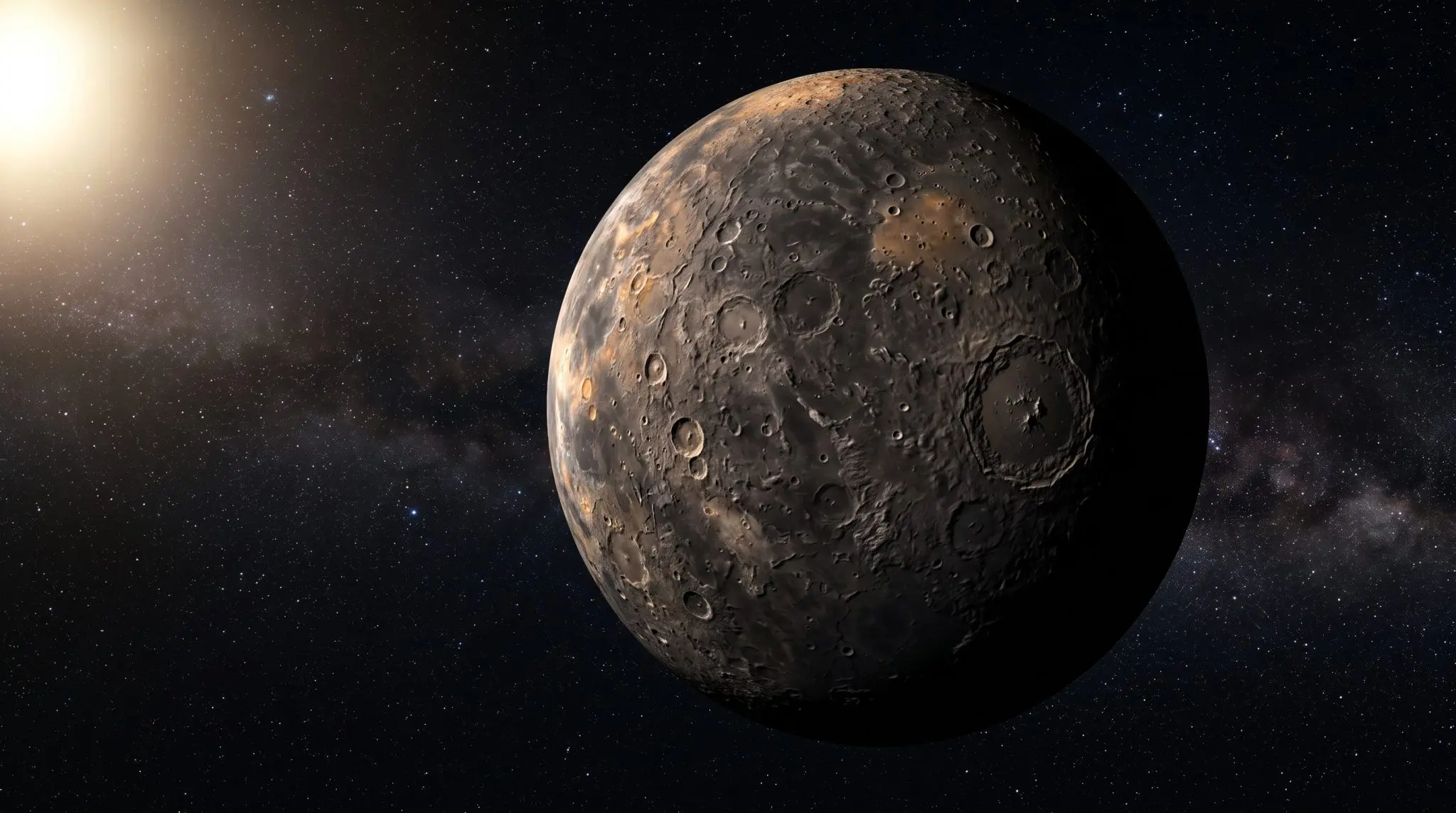
The composition of Earth reveals that ≳75% of its building blocks originated from two protoplanets formed via pebble accretion, supplemented by up to ~25% material from planetesimals similar in composition to the asteroid Vesta. In contrast, the work finds Mars strikingly different, assembling from 27 ± 5% pebble-accreted material and 73 ± 5% Vesta-like planetesimals. Volatile depletion is a chemical fingerprint of hybrid accretion, in which both pebble accretion and collisional assembly contribute to terrestrial planet growth.
Volatile Depletion as a Fingerprint of Hybrid Accretion
This finding aligns with existing silicon isotope constraints on Mars’ accretion, which previously suggested a significant contribution from material similar to Vesta-like planetesimals, as detailed in a 2009 Icarus study. By quantitatively linking formation pathways to volatile budgets, the findings demonstrate how planetary accretion histories can be inferred from elemental signatures, with broad implications for interpreting the chemical diversity of rocky exoplanets.
MVLE Depletion in Earth and Mars Compared to the Protosun
The volatile depletion scales of early planetesimals reveal insights into the formation of Earth and Mars, with models testing varied levels of volatile loss through parameters like inflection point and steepness. Researchers modulated these variables within a logistic model to understand how differing volatile-depleted planetesimal populations contributed to planetary accretion, finding that the composition of Vesta may represent a broader population of early-formed planetesimals that released volatile elements before contributing to the growth of both planets.
This approach allows for testing whether volatile loss stemmed from high disk temperatures or internal magma ocean degassing on bodies like Vesta, offering a new way to constrain the conditions of the early solar system. Using instead a planetesimal volatile-depletion curve that is not observed among known meteorite parent bodies would allow the planetesimal contribution to reach \(-14^{+15}\) %.
For Mars, adopting a pre-depleted pebble model increases the potential contribution of these materials by approximately 10%, but also results in a poorer overall fit to observed Martian volatile depletion patterns as shown in supplementary figures. The team’s work builds on prior research establishing the volatility trend of elemental abundances in both the protosolar nebula and terrestrial planets, incorporating data from studies detailing the compositional diversity of extrasolar terrestrial planets and the stochastic accretion of Earth.
1-9. 1 weight percent to convert to bulk sulfur content in Mars. This detailed analysis of volatile depletion patterns offers a refined understanding of the complex processes shaping the composition of terrestrial planets.
This indicates that terrestrial planet growth is not uniformly driven by a single mechanism, but rather a hybrid process combining pebble accretion with the collisional assembly of planetesimals.
Vesta-like Planetesimals Contribute to Terrestrial Planet Formation
Mars’ building blocks differed markedly from Earth’s, assembling from approximately 73 ± 5% material originating from planetesimals akin to Vesta and only 27 ± 5% from pebble accretion, a finding that underscores the diverse origins of terrestrial planets within a single system. The differing accretion pathways suggests that planet formation is not a uniform process, but rather a complex interplay of mechanisms yielding varied planetary compositions.
This can occur through several processes, including incomplete condensation in the early solar system, heating and evaporation of planetesimals, or vaporization during giant impacts, potentially representing a universal feature of rocky planet formation. Simulations confirm that for Mars, the contribution from early-formed planetesimals consistently exceeds 65%, with pebble accretion never falling below 10% within statistical uncertainty, reinforcing the hybrid nature of its growth.
Freeing the assumption of a strictly Vesta-like composition for the planetesimals accreted to Earth further strengthens the evidence for hybrid accretion, demonstrating that the total fraction of this mixed origin is 79 ± 11%, with pebble accretion contributing the remaining 21 ± 11%.
Bayesian Inference Quantifies Protoplanet Contributions to Earth
Bayesian inference, employing nested sampling via the dynesty Python package, enabled quantification of compositional contributions from planetary building blocks, allowing for efficient exploration of complex posterior distributions and estimation of Bayesian evidence. This computational method revealed that increasing the assumed initial depletion of accreted pebbles results in a poorer fit to observed volatile depletion on Earth, even if such pre-depletion cannot be definitively ruled out based on Bayesian evidence, with absolute differences in log Bayesian evidence remaining below 1.
The team utilized a global 3D radiation hydrodynamic simulation of proto-Jupiter’s convective envelope to model pebble transport and growth within a protoplanet’s gas envelope. Alternative modeling explored a planetesimal composition with a higher initial temperature, providing a comparative dataset alongside compositional data presented as mean values with standard deviations. Sossi for providing Earth and Mars compositions, and Y. Tian for expertise in Bayesian inference principles.
The analysis corrected for potential partitioning of elements like chromium, manganese, and zinc into planetary cores, excluding heavy halogens, chlorine, bromine, and iodine, from the inference process to refine the results. Performing computations of reduced chi-squared in logarithmic space confirmed agreement with those derived from linear space, bolstering the robustness of the findings.
Planetesimal Volatile Loss from Radiogenic Heating & Collisions
Planetesimals experiencing thermal processing through radiogenic heating or collisions may account for volatile loss, with the decay of short-lived radionuclides like aluminum-26 and iron-60 playing a key role alongside energetic impacts. Differentiated asteroid Vesta, often considered a surviving planetary embryo, exhibits significant depletion of elements that sublimate below approximately 1,200 Kelvin, providing a benchmark for understanding these processes. This depletion suggests a mechanism where early-formed planetesimals lost volatile compounds through heating and evaporation, a process distinct from the sublimation driven by pebble accretion in larger protoplanets.
The maximum volatile loss occurs in bodies around Moon mass; larger protoplanets reach a mass-dependent volatile loss envelope driven by pebble sublimation. Collisional devolatilization during the disk phase remains poorly understood, however, as the surrounding gas could facilitate the escape of vaporized elements.
Researchers adopted a baseline for volatile-depleted planetesimals modeled on Vesta’s composition, adjusting parameters to explore the effects of these bodies on the accretion of both Earth and Mars. This approach allows for examination of how varying the initial temperature and spread of volatile depletion impacts planetary formation. Beyond radiogenic heating and collisions, the study acknowledges the importance of understanding the interplay between these processes and the surrounding disk environment.
Linking Planetary Accretion to Volatile Element Budgets
This substantial contribution from Vesta-like bodies suggests a fundamentally distinct formation pathway for the red planet, diverging significantly from Earth’s accretionary processes. A one-dimensional model of protoplanetary gas envelopes calculates how volatile elements are lost as pebbles descend and heat up, revealing that the cumulative sublimation fraction of both refractory and volatile elements changes during planetary growth. When the sublimation temperature of a volatile element falls below the temperature at the base of the envelope, that element is assumed to vaporize and escape into the surrounding disk via convection.
This process provides a mechanism for understanding how planetary composition reflects the conditions within the protoplanetary disk. The study builds on earlier work examining the volatility of elements in both the early solar system and modern terrestrial planets, including investigations into the elemental abundances of Earth-like exoplanets and the composition of Mars.
Braukmüller et al.’s research in Icarus demonstrated that Earth’s volatile depletion pattern likely originated from a source similar to carbonaceous chondrites, while Lodders, Fegley, and Mezger previously detailed the condensation and volatility trends of elements in the early solar system. Further research explored the role of radiogenic heating from isotopes like 60Fe and 26Al in devolatilizing planetesimals, and Saurety and Caracas investigated impact-induced vaporization during planetary accretion. Evidence suggests that post-nebula volatilization also plays a role in shaping the composition of exoplanetary bodies.
Cool Disk Conditions Support Early Planetesimal Formation
The widespread presence of moderately volatile siderophile elements in iron meteorite parent bodies indicates that even the earliest planetesimal generations formed under relatively cool conditions, challenging previous assumptions about intense heat in the early solar system. This finding supports a model where protoplanetary disks weren’t uniformly hot, but rather exhibited temperature gradients allowing for the condensation of these elements even during initial formation stages.
Further bolstering this idea, samples returned from the asteroids Ryugu and Bennu demonstrate that dust similar to CI chondrites, material pristine and representative of the early solar system except for the most volatile components, was common throughout the system. Bayesian analysis of formation model parameters reveals this contribution, linking volatile budgets to planetary accretion histories.
Lithophile Element Compositions Reveal Volatility Trends
Spectroscopic measurements of white dwarf atmospheres and stars ingesting planetary material reveal compositional patterns extending beyond our solar system, supporting a universal process of volatile loss during planet formation. Analysis of lithophile elements, those with an affinity for oxygen, in rocky bodies demonstrates a clear relationship between elemental volatility and abundance, with less stable elements depleted relative to more refractory ones. These observations provide crucial context for evaluating the diversity and potential habitability of exoplanets, as volatile content significantly influences a planet’s atmosphere and potential for liquid water.
Model parameter estimation utilized a reduced χ² minimization approach to compare observed lithophile element abundances with predictions from a model grid incorporating both pebble-accreting bodies and Vesta-like planetesimals. Researchers selected major rock-forming elements including magnesium, silicon, aluminum, calcium, and titanium, alongside less abundant but thermally relevant lithophiles like lithium, fluorine, indium, chlorine, bromine, and iodine, to cover a broad range of volatility.
This detailed compositional analysis of Earth and Mars, alongside data from asteroids Ryugu and Bennu, reveals that the degree of volatile depletion acts as an indicator of a planet’s accretion history. Further support comes from Braukmüller et al.’s 2019 research in Icarus, demonstrating a carbonaceous chondrite-like source for Earth’s volatile element depletion.



See today’s quantum computing news on Quantum Zeitgeist for the latest breakthroughs in qubits, hardware, algorithms, and industry deals.