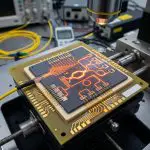
Infleqtion has experimentally confirmed a signal over 1000 times stronger than underlying noise while entangling 30 logical qubits on its Sqale quantum computer, a first for a neutral-atom system. This achievement, enabled by an AI-assisted discovery that halved the number of gates needed for a key operation, validates the core architecture of Infleqtion’s hardware and Superstaq software, the company says.
“Getting 30 logical qubits to work together is hard, and our team has done it,” said CEO Matt Kinsella, as the company builds toward its goal of 100 logical qubits by 2028 and develops early applications with customers like the Wellcome Leap Quantum for Bio program. Infleqtion reported Q1 2026 revenue of $9.5 million, a company record, and subsequently revised its Q2 2026 revenue to $13.5 million, also a company record.
The company has raised over $550 million in funding, including a $3 million DOE grant received on July 23, 2026, and a $1 million Navy contract on April 28, 2026. Infleqtion published a demonstration of a materials science application in partnership with NVIDIA. Reports were made on September 13 and 18 regarding a partnership with Cisco.
T-SQUARED is constructing a new Quantum Innovation Centre in Oxford, while Infleqtion is expanding its presence there. The $100 million contingent funding from the U.S. Department of Commerce CHIPS R&D Office positions Infleqtion as a key player, but is not a final award and is not counted as capital raised.
Sqale Achieves 30 Entangled Logical Qubits on Commercial System
Infleqtion has experimentally validated the architecture of its Sqale hardware and Superstaq software by entangling 30 logical qubits within a single quantum state, a key milestone on its roadmap to deliver 100 logical qubits by 2028. This achievement marks the first time a neutral-atom quantum computing company has reached this level of logical qubit entanglement on a commercial system, demonstrating a significant advance in computational stability and accuracy.
Unlike physical qubits, which are prone to rapid decay from environmental noise, logical qubits utilize software protocols to group multiple physical qubits, ensuring more reliable calculations. “We’re moving quickly toward our target of 100 logical qubits in 2028, and we’re already developing applications with customers.” Maintaining entanglement across a coherent circuit is equally vital for unlocking computational power.
Infleqtion is already collaborating with three customers utilizing logical qubit circuits on the Sqale platform, including the Wellcome Leap Quantum for Bio (Q4Bio) program, according to the company. This collaboration has pioneered a quantum neural network approach, initially demonstrated with 12 logical qubits, for biomarker discovery, with training performed on GPUs and inference executed on the quantum processing unit.
The extension of that work underscores the platform’s progress beyond theoretical research and into practical application. Infleqtion’s commitment to scaling extends to a goal of 1,000 logical qubits by 2030, supported by its utilization of individual qubit addressing and reconfigurable atom arrays to minimize error and atom loss. Systems built by the company are currently deployed with the U.S. Department of Defense, NASA, the U.K. government, and in collaborations with NVIDIA. With operations spanning the U.S., Europe, and Asia, Infleqtion serves government and commercial clients across diverse sectors including space, defense, energy, finance, and telecommunications.
The company, founded in 2007 and now publicly listed as INFQ on the NYSE, currently employs approximately 250 people, the firm reports. Infleqtion’s Sqale platform, based on caesium neutral-atom qubits, currently holds 1,600 physical qubits, while its Sqorpius system is focused on developing fault-tolerant quantum computing capabilities. The goal, according to the company, is to provide customers with a quantum computer capable of solving problems currently beyond their reach. Infleqtion reported revised second-quarter 2026 revenue of $13.5 million on August 18, 2026, a company record.
Getting 30 logical qubits to work together is hard, and our team has done it.
Matt Kinsella, CEO of Infleqtion
AI-Assisted Gate Reduction Halves Physical Operations for Logical Qubits
This reduction in gate count, achieved using GPT 5.6 Sol, directly translates to fewer physical operations needed to maintain the stability of logical qubits, a critical step toward scalable quantum computation. The company executed approximately 1,000 physical operations, termed 1 KiloQuOp, marking a transition from academic experiments to commercially viable systems. This focus on operational efficiency underscores Infleqtion’s strategy for achieving fault tolerance using neutral-atom technology, the company states.
This achievement isn’t simply about increasing qubit count; it’s about maintaining coherence long enough to perform meaningful calculations. Infleqtion’s co-design approach, integrating hardware and software development, was instrumental in achieving this result with only 80 physical qubits, a comparatively low number for a system boasting 30 logical qubits. Infleqtion’s success is further bolstered by its dynamic reconfigurable architecture, allowing for faster progress toward quantum utility. This approach is central to Infleqtion’s roadmap, which targets 100 logical qubits by 2028 and 1,000 by 2030.
A detailed technical analysis of the circuit, the AI-discovered gate identity, and the loss correction results is publicly available on the Infleqtion blog, providing transparency into the methodology behind this advancement. “We’re using the dynamic reconfigurability of Sqale’s neutral-atom architecture to move faster toward quantum utility,” the company stated. The implications of this progress extend beyond the laboratory, with Infleqtion’s systems already deployed with the U.S. Department of Defense, NASA, and the U.K. government. T-SQUARED is constructing a new Quantum Innovation Centre in Oxford and Infleqtion is expanding into Colorado and the UK.
We’re using the dynamic reconfigurability of Sqale’s neutral-atom architecture to move faster toward quantum utility.
Pranav Gokhale, Chief Technology Officer and General Manager of Computing at Infleqtion
Quantum Neural Networks Validate Biomarker Discovery on Sqale Platform
This achievement positions Infleqtion as the first neutral-atom quantum computing company to demonstrate 30 logical qubits on a commercially available system, a milestone enabled by a hardware-software co-design approach and an AI-assisted reduction in gate count. This work uses GPU-based training and quantum processing unit (QPU) inference, showcasing the potential for hybrid classical-quantum algorithms to accelerate scientific research. A recent strategic partnership with Cisco was reported on September 13 and 18, 2026, and is focused on advancing networked quantum technology by integrating Infleqtion’s quantum computers with Cisco’s networking infrastructure.

See today’s quantum computing news on Quantum Zeitgeist for the latest breakthroughs in qubits, hardware, algorithms, and industry deals.