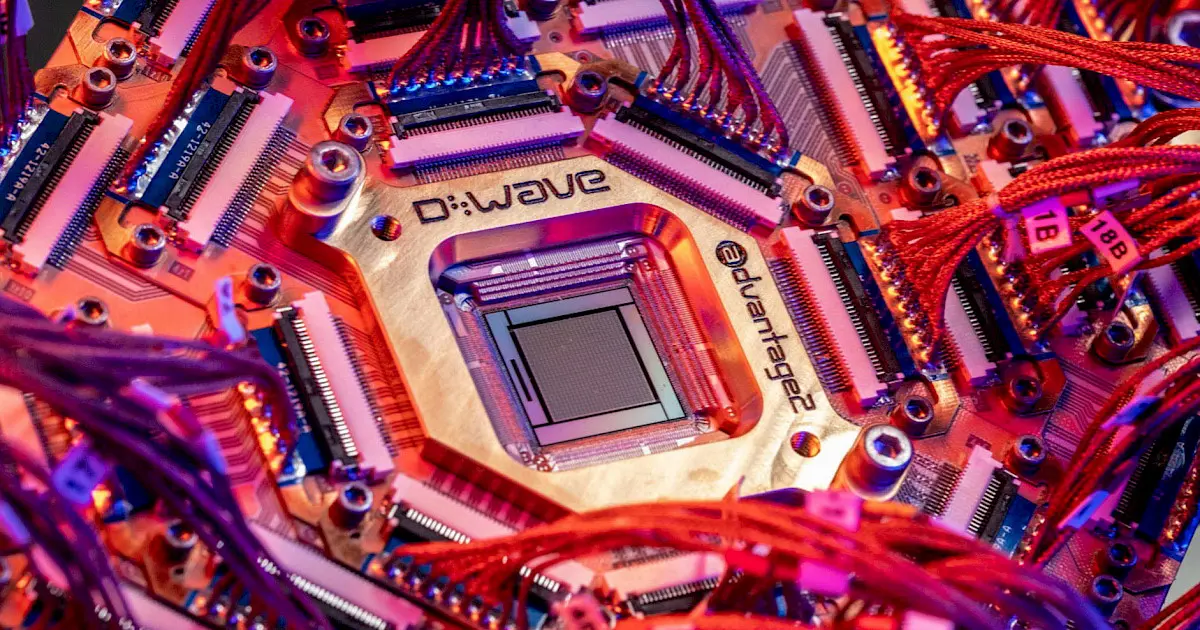
North Wales Police is deploying quantum computing to halve emergency response times in a region where up to half a million residents face inadequate cover under previous strategies. Led by Advanced Analytics and AI Lead Alistair Hughes, the force turned to quantum annealing to overcome limitations of conventional policing methods, aiming to reduce response times from ten to five minutes. D-Wave’s quantum technology offers a new approach to balancing rapid response with comprehensive geographical coverage across the challenging rural landscape.
North Wales Police Targets Halved Emergency Response Times
North Wales Police now utilizes a standalone application to determine optimal officer deployment, a system previously requiring two analysts over three months to calculate manually. The application, central to the force’s quantum-enhanced strategy, provides real-time insights into vehicle placement, incident density within a defined radius, and average response times, according to Alistair Hughes, Advanced Analytics and AI Lead. This shift from manual analysis to automated quantum-assisted calculation represents a fundamental change in how the force approaches resource allocation across its challenging terrain, D-Wave says.
The implementation of quantum annealing addressed a critical equity concern: ensuring consistent emergency coverage for the approximately half a million residents of North Wales, many residing in isolated rural communities. Prior policing strategies, focused on high-density crime areas, risked leaving these populations vulnerable, a scenario the force actively sought to avoid.
Hughes explained that the initial ten-minute response target was ambitious; measuring time from call receipt, rather than dispatch, effectively halved it to five minutes, demanding a complete overhaul of deployment methods. “The problem we faced was even bigger than we expected as we were also going to measure the time from when the call came in rather than when the car was dispatched, which effectively knocked another five minutes off.
So, a 20-minute target, became suddenly a ten-minute target,” he stated. D-Wave’s technology, a hybrid quantum-classical system, navigated this complexity. The system processes both quantum optimisation and data preparation simultaneously, using the strengths of both classical and quantum computing.
As Hughes described, “D-Wave’s hybrid-quantum technology enables you to do all of the processing for the quantum optimisation and data preparation in one hit by using both the classical and the quantum computer which talk to each other. The classical computer handles data preparation, while the annealing quantum computer finds the optimal solution.” This integrated approach allows for rapid analysis of vast datasets, identifying patterns and predicting optimal deployment locations with a speed and accuracy previously unattainable.
The selection of quantum annealing, a specialized form of quantum computing, stems from its suitability for optimisation problems, according to D-Wave. D-Wave, founded in 1999 and now publicly listed as QBTS on Nasdaq, designs and manufactures quantum annealing computers, offering a distinct approach to complex calculations.
The company, currently led by chief executive Alan Baratz and employing about 220 people, has secured a total raised of $1.3B, including a $1.5M NSF grant secured on 2026-06-30 to advance fault-tolerant quantum computing. This funding reflects a growing recognition of the potential of quantum annealing to address real-world challenges, as demonstrated by partnerships with companies like AT&T and Shionogi, and research collaborations with Nasdaq Verafin.
Beyond the immediate benefits to North Wales Police, the project’s success has broader implications. Hughes envisions applications extending beyond law enforcement, encompassing all emergency services and national agencies involved in resource deployment. The scalability of the technology suggests it could be adapted to optimise logistics, manage complex supply chains, or even improve disaster response efforts.
This versatility is underscored by recent deployments of D-Wave technology by NTT DOCOMO to improve network efficiency, and a partnership with Florida Atlantic University to train over 300 quantum ambassadors. Hughes emphasized the immediate availability of quantum solutions for optimisation problems. “Quantum computing as a solution is actually already here, if you’ve got an optimisation problem, the solution is already here,” he asserted. The North Wales Police project, therefore, is a practical demonstration of how quantum technology can be deployed to address pressing public safety concerns.
“Quantum optimisation of forward deployment basically is using quantum algorithms running on a hybrid quantum annealer to speed up and improve the accuracy of our forward deployment locations. Enabling us to minimise the response time but at the same time maximise the geographical coverage,” Hughes concluded, highlighting the core benefit of this innovative approach to policing.
Quantum computing as a solution is actually already here, if you’ve got an optimisation problem, the solution is already here.
Alistair, the project’s success paves the way for a future where advanced technology and human value
Quantum Annealing Optimizes Police Deployment Locations
The North Wales Police deployment application, operational since earlier in the year, currently processes data for approximately 220 vehicles, a scale previously untested for quantum-assisted policing. The system’s initial focus on vehicle placement represents a departure from traditional grid-based policing strategies, shifting towards a dynamically optimized network informed by real-time incident data, the company says. The development of this application stemmed from a 2024 Hackathon, a collaborative effort between North Wales Police and D-Wave specialists, where the feasibility of quantum annealing for police deployment was rigorously tested.
This event was not simply an exploratory exercise; it directly resulted in a functional prototype capable of addressing the complex interplay between minimizing response times and maximizing geographical coverage. Hughes’ team used D-Wave’s hybrid-quantum technology, a system where classical computers handle data preparation while the quantum annealer focuses on finding optimal solutions, streamlining the entire process.
This approach allowed for a comprehensive assessment of deployment strategies, considering factors beyond simple proximity to incidents. D-Wave’s position as a publicly listed company, trading on Nasdaq as QBTS, reflects a growing investor confidence in quantum annealing as a viable solution for complex optimization problems, the company states. Founded in 1999, the Canadian firm has secured $1.3 billion in funding. This financial backing underscores the broader trend of investment in quantum computing, particularly in areas with demonstrable real-world applications.
The company completed the acquisition of Quantum Circuits Inc. in January 2026, adding gate-model quantum computing capability, expanding its technological portfolio beyond solely annealing-based solutions. In August 2026, NTT DOCOMO deployed a second D-Wave application, achieving a 65.3% reduction in location registration signals and improving network efficiency, demonstrating the versatility of the technology across different sectors.
Similarly, AT&T signed an agreement to utilize D-Wave’s quantum computing for complex network optimization, while Shionogi is exploring its potential in pharmaceutical drug discovery, achieving results in minutes that would take approximately one million classical supercomputer years. These partnerships highlight the growing recognition of quantum annealing’s potential to address optimization challenges across diverse industries. Hughes anticipates that the current standalone application will evolve through the integration of machine learning algorithms, enabling predictive capabilities that further refine deployment strategies.
This next phase aims to anticipate demand fluctuations, allowing the quantum system to proactively optimize resource allocation. “At the moment it’s a standalone app, it lets people know exactly where the cars should be deployed, how many should be deployed at each location, how many incidents have occurred in that location’s sphere of access, and also gives average response times,” Hughes explained, outlining the application’s current functionality.
The team is also exploring the potential for expanding the system’s scope beyond vehicle deployment, potentially encompassing personnel allocation and resource management across all emergency services, the company’s account states. The project’s long-term impact extends beyond improved response times; it establishes a framework for responsible innovation in public service. Hughes, drawing on his eight-year tenure at North Wales Police and prior experience in technology start-ups, emphasizes the importance of ethical considerations alongside technological advancement. This perspective underscores the potential for quantum technology to deliver tangible benefits to communities, provided it is implemented thoughtfully and ethically.
We had previously tried to optimise forward deployment using Excel to analyse data, and heat maps, which is very time consuming, and would take two analysts over three months to calculate.
Alistair, the project’s success paves the way for a future where advanced technology and human value
D-Wave System Reduces Processing Time from Months to Minutes
The transition from months to minutes in emergency response calculations materialized when North Wales Police used D-Wave’s quantum annealing technology, reducing a previously laborious process for optimizing vehicle deployment. Previously requiring over three months of work from two analysts using conventional methods like Excel and heat maps, the force now completes the same analysis in a matter of minutes, a shift validated by measuring time from initial call receipt to optimized dispatch, a refinement that tightened the target response time from twenty to ten minutes.
This acceleration wasn’t simply about speed; it demanded a complete re-evaluation of existing analytical frameworks. D-Wave’s approach centers on quantum annealing, a computational technique that exploits quantum mechanics to identify optimal solutions within complex problem spaces, a departure from the binary logic of classical computers.
Instead of bits representing 0 or 1, quantum computers utilize qubits, capable of representing 0, 1, or both simultaneously through superposition, alongside the quantum phenomena of entanglement and tunneling. This allows the system to explore a vast landscape of possibilities more efficiently, akin to a metallurgical annealing process where controlled cooling yields a stable, low-energy configuration, but at a dramatically accelerated pace, D-Wave claims. D-Wave has constructed systems exceeding 4,400 physical qubits, exponentially increasing the potential states the computer can evaluate.
The ‘cooling’ process involves reducing quantum fluctuations, guiding the system toward the optimal solution for a given problem. The initial demonstration of this capability revealed a potential reduction in processing time from four months to just four minutes, a result that propelled the project forward. Beyond the sheer speed gain, the team prioritized ethical considerations and officer wellbeing, recognizing that a purely time-focused optimization could create unsustainable deployment scenarios.
A key concern was preventing officers from being dispatched so far from their home bases that their commutes became excessively long and detrimental to their personal lives. To address this, the team implemented a phased approach, initially focusing optimization efforts on a single Local Policing Area (LPA) to ensure officers remained connected to their communities, D-Wave says. This commitment extended to factoring in team cohesion, the health risks of prolonged vehicle use, and the need for officers to return to station for administrative tasks and social interaction.
The team achieved this nuanced optimization by the system, allowing for real-time adjustments based on daily officer and vehicle availability. This adaptability enabled the model to be rerun and re-optimized as conditions changed, ensuring operational efficiency didn’t compromise officer wellbeing or ethical policing standards.
The ability to dynamically adjust parameters proved important, as a static solution would quickly become obsolete in the face of fluctuating demands. According to Hughes, this flexibility is a hallmark of a successful implementation, allowing the quantum system to adapt to diverse and evolving circumstances. The company also received up to $300,000 Canadian dollars from the National Research Council of Canada to further develop annealing software for commercial applications, and a $1, according to D-Wave.
D-Wave’s roadmap includes a 100,000-qubit annealing system by 2030, and the company is also developing dual-rail gate-model hardware, with the first machine slated to ship later in 2026 from a new research center in New Haven, Connecticut. The company, with about 220 people, has established itself as the longest-running commercial entity in quantum computing, and its partnerships with organizations like Shionogi and AT&T demonstrate the broadening applicability of its technology.
The problem we faced was even bigger than we expected as we were also going to measure the time from when the call came in rather than when the car was dispatched, which effectively knocked another five minutes off. So, a 20-minute target, became suddenly a ten-minute target.
Alistair, the project’s success paves the way for a future where advanced technology and human value



See today’s quantum computing news on Quantum Zeitgeist for the latest breakthroughs in qubits, hardware, algorithms, and industry deals.