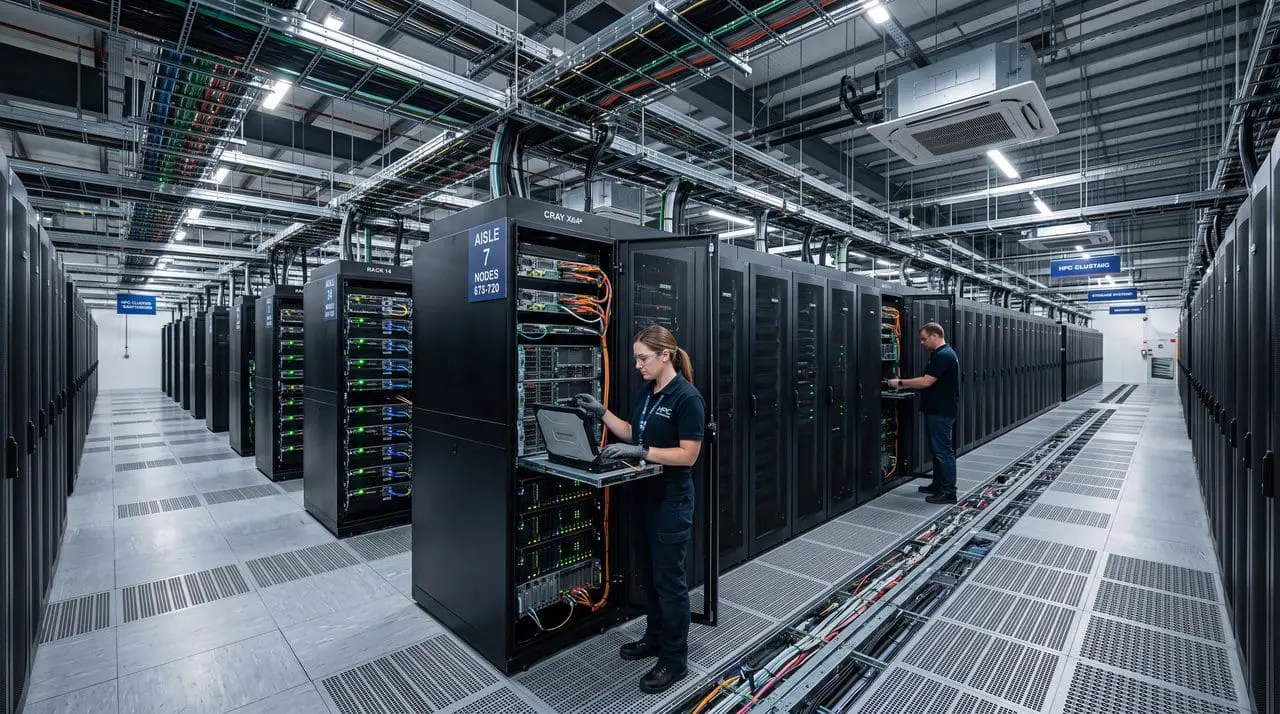
A $5 million National Science Foundation grant is funding the creation of TangleLab, a new supercomputing testbed at the Pittsburgh Supercomputing Center. Rigetti Computing will deliver a 9-qubit Novera quantum computing system to be integrated with a classical high-performance computing system, forming the core of this hybrid environment. This collaboration with Hewlett Packard Enterprise aims to advance workflows for research institutions and enterprises exploring high-performance computing. “We are excited to have a Novera at the core of TangleLab,” said Dr. Subodh Kulkarni, Rigetti CEO, “which will provide researchers and educators access to a hybrid quantum-classical computer to push the boundaries of quantum computing innovation and discovery.” The system will benefit from a critical metric for high-performance hybrid quantum computing environments.
Rigetti, HPE, and PSC Launch TangleLab with $5 Million NSF Grant
Rigetti Computing, Hewlett Packard Enterprise, and the Pittsburgh Supercomputing Center are establishing TangleLab, a supercomputing testbed funded by a $5 million grant from the National Science Foundation. This investment demonstrates a commitment to bridging the gap between emerging quantum technologies and established high-performance computing resources, with the goal of accelerating practical applications beyond theoretical exploration. The project builds on Rigetti and HPE’s existing commercial partnership focused on quantum-enabled high-performance computing systems, expanding the scope to include dedicated research access. The TangleLab testbed is designed to facilitate advancements in workflows for research institutions, public sector organizations, and enterprises investigating the future of high-performance computing. Rigetti’s contribution centers on the Novera system, and Dr. Subodh Kulkarni, Rigetti CEO, emphasized the importance of its performance characteristics. Kulkarni further highlighted that the system’s performance is a critical metric for achieving high performance in these hybrid environments, crucial for complex calculations and simulations.
HPE’s role focuses on unifying quantum processing with existing high-performance computing, artificial intelligence, and networking technologies. Masoud Mohseni, Senior Distinguished Technologist and Director of HPE Quantum at HPE Labs, explained that realizing the potential of quantum computing will depend on how effectively quantum processors integrate with high-performance computing, AI, and advanced networking. PSC will manage access to the TangleLab system through a competitive proposal process, offering dedicated time for individual researchers and real-time access for educational purposes. The center plans to provide onboarding activities, training, and research consulting to support users with varying levels of experience. Construction is slated to begin September 1, 2026, at PSC’s new data center, with full operational capacity anticipated in 2027, and the project directly supports national priorities for quantum information science and artificial intelligence outlined in memorandum M-25-34/NSTM-2 from the Office of Science and Technology Policy.
This system will benefit from the fast gate speeds that are intrinsic to superconducting quantum systems, a critical metric for high-performance hybrid quantum computing environments.
Dr. Subodh Kulkarni, CEO at Rigetti
See today’s quantum computing news on Quantum Zeitgeist for the latest breakthroughs in qubits, hardware, algorithms, and industry deals.