The computer scientist who once shepherded Java into the Fortune 1000, now steering the oldest name in commercial quantum computing.
Who Alan Baratz is
Alan Baratz runs the company that turned quantum annealing from a physics curiosity into a commercial product companies can buy time on today. He became president and chief executive of D-Wave Quantum at the start of 2020, but only after years inside the business building its software, its applications, and its research pipeline. That order matters, because the person now selling D-Wave’s machines is the same one who helped design what they do.
By training Alan Baratz is a computer scientist rather than a physicist, and that background colors how he talks about the field. He frames quantum computing less as a distant scientific marvel and more as an engineering problem with customers, deadlines, and budgets attached. Under his watch, D-Wave has leaned hard into the argument that quantum machines can deliver useful results today, not only in some far-off corrected-error era.
Baratz holds a doctorate in computer science from the Massachusetts Institute of Technology and an undergraduate degree in mathematics and computer science from the University of California, Los Angeles. Those credentials anchor a career that has bounced between deep technology and the commercial side of running it. He is, in short, an operator who knows the science well enough to defend it in public.
That combination is rarer than it sounds. Most quantum leaders are either academic founders or career financiers, while Baratz can talk through the physics of an annealing processor and then turn to the economics of selling time on it. The dual fluency is exactly why D-Wave put him in charge as the company shifted from research milestones toward revenue.
From JavaSoft to the C-suite
Long before quantum computing, Alan Baratz built his reputation on a different platform that reshaped enterprise software. He served as the first president of JavaSoft at Sun Microsystems, where he oversaw the growth of the Java platform from its early days into technology that ran mission-critical applications across a large share of the Fortune 1000. Steering an emerging platform into wide corporate adoption is, in many ways, the same job he holds now.
A long executive resume
His career spans a roster of well-known technology companies and startups. Baratz has held executive positions at Symphony, Avaya, Cisco, and IBM, giving him exposure to networking, communications, and large-scale enterprise computing. That breadth means he has seen how new categories of technology get sold into cautious corporate buyers more than once.
He has also sat in the chief executive chair before arriving at D-Wave. Baratz served as CEO and president of Versata, Zaplet, and NeoPath Networks, and he worked as a managing director at the private-equity and venture firm Warburg Pincus. The investing experience is relevant, because running a public quantum company means speaking fluently to markets as well as to engineers.
Taken together, the path that led Alan Baratz to D-Wave reads as a long apprenticeship for exactly this job. He has shipped emerging platforms, run companies, and sat on the investor side of the table. Few people in quantum computing arrive at the top with that particular blend of product, operating, and financial experience.
Arriving at D-Wave
Alan Baratz joined D-Wave in 2017, stepping into the part of the company responsible for software and applications. Within a couple of years he had moved into a broader role leading research and development as chief product officer, taking ownership of how the company’s technology was built and delivered. That ascent gave him a working command of the annealing hardware and the developer tools wrapped around it.
Climbing from product to the top job
His promotion to chief executive took effect on January 1, 2020, when he succeeded the company’s previous CEO. Stepping up from product leadership to the top role is a familiar pattern in technology, and it signaled that D-Wave wanted a leader steeped in what the machines could actually do. The timing also placed Baratz at the helm just as the broader quantum sector began attracting serious investor attention.
Coming up through the product organization shaped how Baratz now runs the company from the outside. He speaks about D-Wave’s systems with the detail of someone who helped ship them, which gives his commercial pitch a credibility that a pure financier might lack. That fluency has become a defining feature of how he represents the business to customers and to the market.
His arrival also coincided with a strategic shift inside D-Wave toward applications and accessibility. The company invested in cloud access and developer tools so that customers could try quantum optimization without owning hardware, lowering the barrier to experimentation. Putting a product-minded leader in charge sent a clear signal that the next chapter would be measured in adoption rather than only in research papers.
The annealing bet
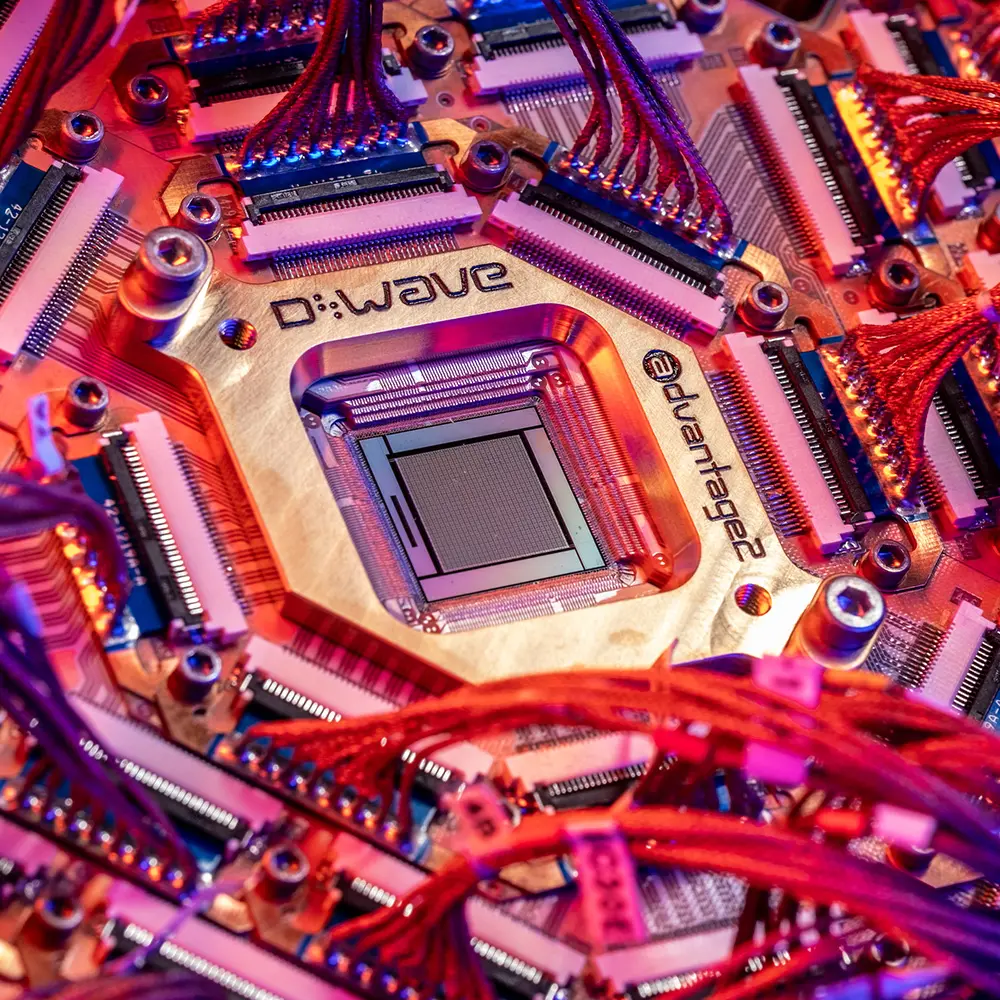
While most of the industry chased the gate-model machine, D-Wave bet on quantum annealing, and Baratz has spent years defending that bet in public. Annealing is built for optimization, the work of finding strong answers among an astronomical number of possible configurations, which is exactly the shape of scheduling, logistics, and resource-allocation problems. His case has stayed consistent, that the narrower road reaches paying customers years before a general-purpose machine will.
Advantage and Advantage2
The hardware behind that argument has gone through several generations. D-Wave’s Advantage line, and then the Advantage2 system, represent the company’s superconducting annealing processors, with Advantage2 reaching general availability in 2025 with more than 4,400 qubits and a denser connectivity topology. Greater connectivity lets larger and more tangled problems map onto the chip without awkward workarounds.
Alan Baratz has also positioned D-Wave as a company that does not have to pick only one path. It has moved into building gate-model systems alongside its annealing machines, aiming to cover both the near-term optimization market and the longer arc toward general-purpose quantum computing. That dual strategy lets the company sell today while still planting a flag in the field’s future.
The reason Baratz keeps returning to optimization is that it shows up everywhere in business. Routing fleets, packing schedules, allocating scarce resources, and balancing competing constraints are all optimization problems, and they are precisely the shape that annealing handles. By aiming the technology at work companies already do, he can frame quantum computing as a tool rather than a curiosity.
Going public on the markets
The biggest financial moment of Baratz’s tenure came in August 2022, when D-Wave merged with a special-purpose acquisition company and began trading on the New York Stock Exchange under the ticker QBTS. The deal valued the business at roughly 1.6 billion dollars and made D-Wave one of the first pure-play quantum computing companies on a major exchange. From that point on, the science came with a stock price attached.
Being a public-company chief executive changes the job in concrete ways. Baratz now answers to shareholders, files quarterly results, and faces the volatility that comes with a young, much-watched sector. The quantum names that trade publicly tend to swing sharply on news, which puts a premium on a leader who can explain technical milestones in plain commercial terms.
That spotlight cuts both ways for a leader in Baratz’s position. Strong demonstrations and customer wins can send the stock sharply higher, while disputed claims or soft quarters invite quick punishment from investors. Managing that scrutiny, while keeping the engineering roadmap on track, has become a core part of how he leads the company.
Selling a quantum story to investors
Public markets reward a clear narrative, and Alan Baratz has worked to give D-Wave one. He repeatedly points to real customers and concrete use cases rather than abstract qubit counts, trying to anchor the stock to commercial traction. That discipline matters in a sector where hype and skepticism can both move share prices far faster than the underlying technology actually changes. By early 2026 that pitch rested on a much stronger balance sheet, with D-Wave reporting around $588 million in cash and rising bookings, which gave Baratz room to fund the new gate-model push.
The feud with Nvidia over quantum’s timeline
Alan Baratz’s combative confidence went public in January 2025, when Nvidia chief executive Jensen Huang told analysts that useful quantum computers were fifteen to thirty years away and quantum stocks promptly fell. Baratz fired back within a day, telling CNBC that Huang had “a misunderstanding of quantum” and that while he might be right about other companies, he was “dead wrong” about D-Wave.
His rebuttal drew a sharp line between approaches. Huang’s timeline might fit gate-model machines, Baratz argued, but it was “100% off base” for annealing, which D-Wave already had in commercial use. The exchange became one of the most-cited moments of his tenure, precisely because it set the best-known name in AI hardware against the oldest name in commercial quantum computing.
The clash also crystallised his wider pitch that quantum has already passed its own ChatGPT moment. Baratz points to named customers, among them Volkswagen, Mastercard, and Lockheed Martin, and to a drug-discovery collaboration with Shionogi that uses quantum methods to help train AI models, as proof that paying organisations are using the technology now rather than waiting for one breakthrough.
The quantum supremacy debate
In March 2025, under Alan Baratz, D-Wave published peer-reviewed research in the journal Science describing a magnetic-materials simulation that, the company argued, its annealing processor solved far faster than a leading classical supercomputer could. Baratz framed the result as the first demonstration of quantum computational supremacy on a useful, real-world problem rather than a contrived benchmark. The claim drew wide attention precisely because it attached the loaded word supremacy to a practical task.
Critics push back
The announcement did not go unchallenged. Researchers at the Flatiron Institute reported that classical tensor-network methods could match or approach the same simulation, and a 2026 follow-up in Science, from the Flatiron Institute and Boston University, pushed those classical results further. The challenges cast doubt on whether the quantum machine had truly outrun every classical alternative. Disputes like this are normal in the field, where each supremacy or advantage claim invites a wave of classical counterattacks.
Baratz responded publicly and stood behind the work. He argued that the disputed classical results did not replicate the full, hardest version of the problem D-Wave had tackled, and he kept making the case that the company’s machine had crossed a meaningful line. Whatever the final verdict, the episode showcased his willingness to defend the company’s science in a contested public arena.
The episode also captures something essential about how Alan Baratz operates as a chief executive. He is comfortable making a bold technical claim, attaching the company’s name to it, and then arguing the point in interviews and conferences. That combative confidence wins attention for D-Wave, even as it invites the scrutiny that any extraordinary quantum claim attracts.
The 2026 gate-model turn
For most of Alan Baratz’s tenure, D-Wave was the company that deliberately did not build gate-model machines, and his public case rested on annealing. That changed decisively in 2026, when in January the company completed its roughly $550 million acquisition of Quantum Circuits Inc, the Yale spin-out co-founded by transmon co-inventor Rob Schoelkopf, bringing in the dual-rail qubit and a working superconducting gate-model team based in New Haven.
On 1 June 2026, at D-Wave’s first Investor Day at the New York Stock Exchange, Baratz laid out a full dual-rail gate-model roadmap for the first time. It runs in steps, from a 17-qubit dual-rail machine in 2026 to a 181-qubit blueprint for fault-tolerant architecture by 2028, then ten logical qubits by 2030 and a 100-logical-qubit system capable of more than a million operations by 2032. The whole plan leans on dual-rail qubits engineered so that their most common errors announce themselves, a design D-Wave argues will need far fewer physical qubits per logical qubit than rival superconducting approaches. The pitch let Baratz reframe D-Wave as what he calls the only dual-platform quantum company, selling annealing today while building toward general-purpose machines.
The move answers a long-standing criticism that annealing alone could never reach the general-purpose, error-corrected computing the rest of the field is chasing. It also raises the stakes of his tenure, since the 2032 roadmap now sits alongside the annealing business as a second yardstick by which investors will judge him.
Leadership style and the road ahead
Ask Baratz about quantum computing and the conversation turns quickly from physics to customers. He has pushed D-Wave’s message toward businesses running real workloads now, and away from speculation about machines that might exist twenty years out. That instinct comes from his product background and from the hard arithmetic of running a public company that has to book revenue, not just headlines.
Betting on both annealing and gate-model
The strategy carries obvious risks alongside its appeal. Critics question how broadly annealing applies, and the gate-model camp argues that the long-term winners will be general-purpose machines with full error correction. Baratz’s answer has been to pursue both annealing and gate-model development while continuing to ship products that paying customers can use right now.
How well that bet pays off will define the back half of his tenure. If annealing keeps finding paying customers and the gate-model effort matures, Baratz will look like the leader who kept D-Wave commercially alive while building toward the future. If general-purpose machines leapfrog the field faster than expected, the same dual strategy will face hard questions about focus.
Why Alan Baratz matters in quantum computing
Alan Baratz matters because he runs the company that proved quantum computers could be sold as commercial products, not just studied in laboratories. D-Wave’s annealing systems have been available to customers and researchers for years, and that commercial track record shapes how the whole industry talks about timelines and value. As its chief executive, Baratz is the public face of the argument that useful quantum computing is a present-day business and not only a future science project.
He also embodies a distinct philosophy about how the technology should reach the world. Where many peers emphasize the long climb toward fault-tolerant, gate-model machines, Baratz keeps insisting that value can be captured along the way. That stance gives the broader debate a clear counterweight, forcing the field to ask whether near-term and long-term approaches are rivals or simply different timelines for the same goal.
His influence also comes from the debates he is willing to enter. By staking public claims about quantum advantage and defending them against sharp criticism, Baratz keeps pushing the field to define what real-world quantum value actually means. Whether D-Wave’s specific claims hold up over time, the questions he forces into the open will shape how the next decade of quantum computing gets judged.
Anyone trying to read where commercial quantum computing is heading should keep a close eye on Baratz. His company sits where laboratory promise meets paying customers, and his calls on annealing, gate-model hardware, and how loudly to claim advantage will be felt across the sector. In a field still arguing over what success even looks like, he is one of the few operators whose answer arrives with a balance sheet behind it.
Frequently asked questions
Who is Alan Baratz?
When did Alan Baratz become CEO of D-Wave?
What did Alan Baratz do before D-Wave?
What is Alan Baratz’s educational background?
What kind of quantum computer does D-Wave build?
What is D-Wave’s gate-model roadmap?
Is D-Wave a public company?
What was D-Wave’s 2025 quantum supremacy claim?
Was the supremacy claim disputed?
What did Alan Baratz say about Nvidia’s Jensen Huang?
Has quantum computing had its ChatGPT moment, according to Baratz?
Which companies use D-Wave’s quantum computers?
How much is Alan Baratz worth?
Why has Alan Baratz sold D-Wave stock?
Why is Alan Baratz important to quantum computing?



See today’s quantum computing news on Quantum Zeitgeist for the latest breakthroughs in qubits, hardware, algorithms, and industry deals.