
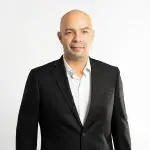
Quantum Cyber has appointed Tzvi Lev as Head of Sales, Middle East, to lead commercial expansion across the Gulf Cooperation Council and Israel. Lev founded and led Israel’s first Economic Division in Dubai and the Northern Emirates following the Abraham Accords, brokering over 17 commercial transactions and facilitating more than $15 million in venture capital for Israeli technology companies during his time as Economic Affairs Officer at the Consulate General of Israel. “Tzvi’s appointment reflects the company’s direction,” said David Lazar, Chief Executive Officer of Quantum Cyber, as the company expands its autonomous defense platform to meet demand from sovereign customers.
Tzvi Lev’s Background Bridges Israeli Diplomacy and Regional Defense Expertise
This experience extends beyond strategic planning, demonstrating an ability to finalize agreements and foster economic ties in a key geopolitical area. During his tenure at the Consulate, Lev designed Israel’s framework for economic engagement across the Gulf Cooperation Council, a role initiated following the Abraham Accords to build lasting commercial relationships. He also secured significant investment into Israeli technology firms, channeling over $15 million in venture capital by connecting investors with innovative companies and bolstering Israel’s tech sector.
Prior to this posting, Lev’s involvement with the Abraham Accords extended to his role within Israel’s Ministry of Foreign Affairs, where he was a member of the dedicated task force and assisted with the transition of Foreign Minister Gabi Ashkenazi. This deep immersion in the diplomatic framework underpinning regional shifts provides a unique understanding of the political and economic landscape.
Lev’s background is not solely diplomatic or economic; he has concurrently served in the Israeli Defense Forces since 2013, currently functioning as an Arabic-speaking intelligence analyst in the Reserves. His military service includes a key foreign liaison position at the Civil-Military Coordination Center, where he directly collaborated with U.S. Joint Special Operations Command personnel and officers from the United Kingdom, Egypt, and NATO. This experience, alongside commanding troops during Operation Protective Edge and leading counterterrorism operations, provides a nuanced perspective on regional security challenges.
“Quantum Cyber addresses the specific threats the region is defending against—battlefield-proven autonomous systems, quantum-accelerated command-and-control, counter-UAS, and EMP-hardened platforms—delivered by a U.S.-listed, U.S.-manufacturing company with Israeli technological expertise,” said Tzvi Lev, Head of Sales, Middle East of Quantum Cyber. His concurrent role as Director of Strategy and Investment at Clavium, an Abu Dhabi-based defense venture capital fund, further demonstrates his established network and understanding of investment priorities within the region.
Quantum Cyber sits at exactly the intersection the region is procuring against – battlefield-proven autonomous systems, quantum-accelerated command-and-control, counter-UAS, and EMP-hardened platforms – delivered by a U.S.-listed, U.S.-manufacturing company with Israeli technological DNA.

See today’s quantum computing news on Quantum Zeitgeist for the latest breakthroughs in qubits, hardware, algorithms, and industry deals.