Yingwen Zhang and colleagues from the University of Ottawa and the National Research Council of Canada have measured time delays as short as 20 attoseconds, demonstrating quantum behavior occurring beyond the traditional limits of photon coherence. The research team utilized a novel application of Hong-Ou-Mandel interferometry, adapting the technique to achieve spectrally resolved measurements at these extremely short timescales. By extracting delay information from the spectral interference fringes of entangled photon pairs, they surpassed the conventional dynamic range limited by photon coherence by over two orders of magnitude. This advance enables single-measurement path-delay sensing at the measurement Cramér, Rao bound with no calibration scanning required, and the work represents a significant step towards deploying quantum-limited measurements in real-world sensing applications.
Spectrally Resolved Hong-Ou-Mandel Interferometry for Delay Sensing
Measurements reaching 20 attosecond precision, extremely short time intervals, have been achieved using a refined quantum technique, extending the boundaries of timing resolution beyond what conventional photon coherence allows. Researchers at the University of Ottawa, the National Research Council of Canada, University of Portsmouth, and Chapman University have adapted Hong-Ou-Mandel (HOM) interferometry, a method typically used to demonstrate photon indistinguishability, to measure path-delay differences with unprecedented accuracy. The team’s innovation lies in analyzing the spectral interference fringes created by entangled photon pairs, rather than relying on traditional coincidence counting methods. This approach circumvents a key limitation of standard HOM interferometry, which restricts precise measurements to time delays within the coherence time of the photons. The authors write that because the estimator relies on fringe periodicity rather than absolute coincidence rates, the method is intrinsically robust to photon losses and variations in interference visibility, eliminating the need for recalibration.
Using one million detected photon pairs, they achieved a time-delay precision of 20 attoseconds (6 nm), while real-time operation at 1 Hz yielded 330 attosecond (100 nm) precision. As a practical demonstration of this enhanced sensitivity, the team measured the thickness of a 300 μm transmissive target with nanometer-scale precision. This advancement promises to unlock new possibilities for quantum-limited measurements in real-world sensing applications, moving beyond the constraints of classical interferometry and offering a pathway to more precise and stable metrology. These results mark a significant step towards deploying quantum technologies for practical sensing tasks and represent a substantial improvement in the operational range of HOM interferometry.
Conventional Hong-Ou-Mandel (HOM) interferometry, a mainstay for studying photon indistinguishability, faces inherent limitations when applied to precise delay measurement. While capable of attosecond-scale timing, traditional methods struggle with path differences extending beyond the coherence time of the photons themselves. These fringes, unlike the rapidly decaying HOM dip, persist over a significantly wider range, enabling measurements far exceeding the photon coherence length.
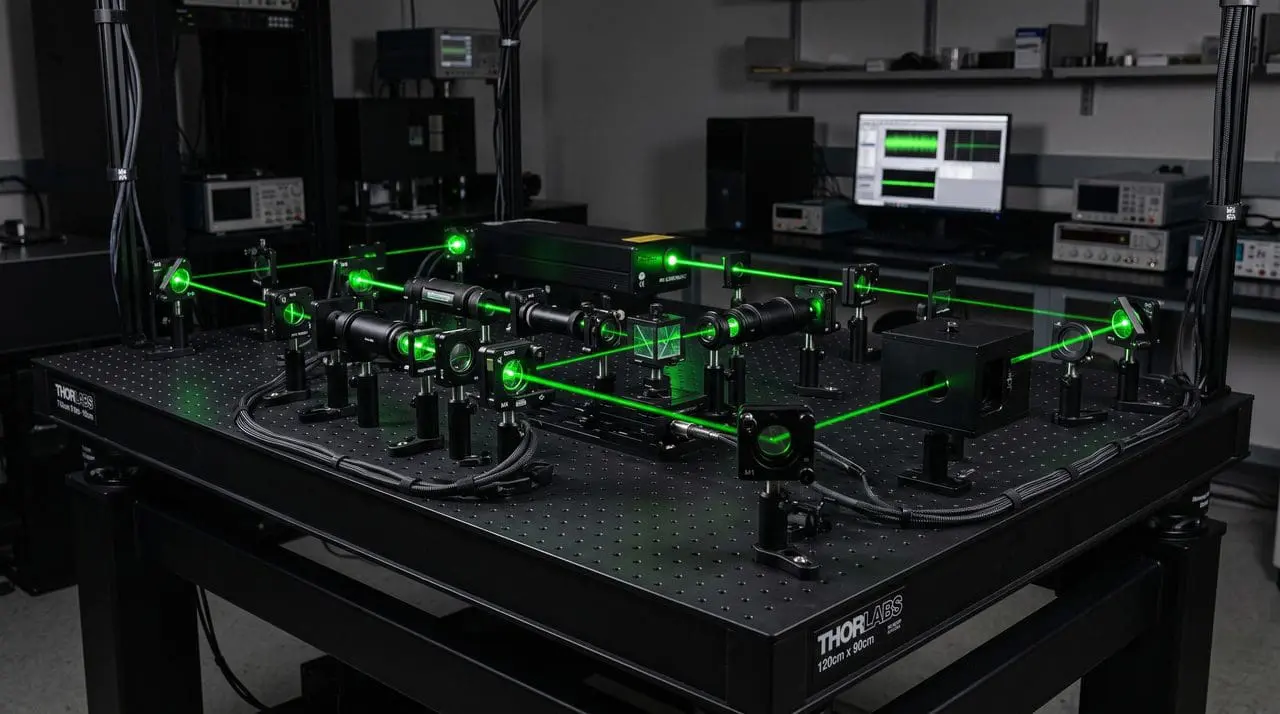
The team constructed a custom two-photon spectrometer utilizing time-tagging event cameras to analyze the spectral characteristics of entangled photon pairs. Unlike traditional HOM interferometry, which measures delays within the photons’ coherence time, this approach extracts delay information from the consistent spacing of the spectral fringes. This robustness is critical for real-world applications where maintaining precise calibration can be challenging.
A precision leap in quantum measurement has allowed researchers to discern time differences as short as 20 attoseconds. Using approximately one million detected photon pairs, the precision reached 20 attoseconds, equivalent to measuring a 6-nm displacement. Even while operating in real-time, at 1 Hz, the precision remained at a remarkable 330 attoseconds (100 nm). Crucially, the method proved robust to signal loss and variations in interference, eliminating the need for constant recalibration.
Conventional quantum metrology often demands meticulous calibration to counteract environmental factors and signal degradation, but the team, led by Yingwen Zhang and colleagues, has demonstrated a method remarkably free from these constraints. Their approach to spectrally resolved Hong-Ou-Mandel (HOM) interferometry achieves precision without the need for constant recalibration, a significant advantage for real-world deployment. This independence stems from how delay information is extracted, not from the absolute number of coincident photon detections, but from the periodicity of spectral interference fringes. This robustness is critical because photon loss is unavoidable in practical sensing scenarios, and maintaining precise calibration across varying conditions can be exceptionally difficult. The team’s system maintains near-optimal sensitivity over an operational range exceeding the photon coherence time by over two orders of magnitude. This method’s resilience extends to real-time operation, achieving 330 attoseconds precision even with a data acquisition rate of one measurement per second. This combination of precision and operational ease positions spectrally resolved HOM interferometry as a viable technology for quantum-limited measurements outside of controlled laboratory settings, opening possibilities for deployment in diverse sensing applications.
Researchers at the University of Ottawa, led by Yingwen Zhang, have demonstrated a significant advance in precision measurement, achieving nanometer-scale thickness determination using a novel application of quantum entanglement. The team bypassed longstanding limitations of conventional interferometry by employing spectrally resolved Hong-Ou-Mandel (HOM) interferometry, a technique traditionally used to examine photon indistinguishability. This approach allowed for path-delay sensing beyond the constraints imposed by the coherence time of photons, a hurdle previously restricting the operational range of such measurements. Even in real-time operation at 1 Hz, the system maintained a precision of 330 attoseconds, or 100 nm. Importantly, the system proved remarkably robust to signal loss, a common challenge in optical sensing.
Source: https://arxiv.org/abs/2607.16849
See today’s quantum computing news on Quantum Zeitgeist for the latest breakthroughs in qubits, hardware, algorithms, and industry deals.