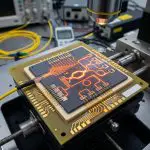
Researchers have, for the first time, demonstrated log-law scaling of subsystem entanglement entropies at criticality on a digital quantum computer. The work, performed using a fully-connected trapped-ion quantum computer, combines the multiscale entanglement renormalization ansatz (MERA) with a holographic scheme for subsystem tomography. This methodological pairing allows for accurate representation of infinite systems and long-range correlations with a limited number of qubits. The team observed a quantum phase transition exhibiting spontaneous symmetry breaking, revealing the evolution of entanglement properties across the critical point; this achievement highlights the potential of MERA for investigating strongly-correlated many-body systems on quantum computers. Thomas Barthel, Marko Cetina, Qiang Miao, Tianyi Wang, and Kenneth R. Brown of Duke Quantum Center, Duke University, Durham, North Carolina, USA led the research.
The team’s approach accurately represents infinite systems and long-range correlations using a relatively small number of qubits, addressing the finite-size effects that typically plague studies of quantum phase transitions. The researchers were able to demonstrate this observation, which confirms a key theoretical prediction regarding the behavior of entanglement near a quantum critical point and validates the efficacy of their combined MERA and tomography scheme. Support for this work came from the U.S. Department of Energy, Office of Science, National Quantum Information Science Research Centers, and Quantum Systems Accelerator, highlighting the national investment in advancing quantum simulation capabilities.
Researchers are now leveraging a fully-connected trapped-ion quantum computer to overcome longstanding challenges in simulating complex quantum systems; most quantum computers do not feature full connectivity, making this setup particularly noteworthy for its precision and control. This work addresses the difficulty of investigating strongly-correlated quantum matter, a field hampered by the curse of dimensionality and intricate entanglement. This methodological pairing enabled the efficient extraction of observables and entanglement properties, even at criticality, a feat previously limited by finite-size effects and diverging correlation lengths. The ability to accurately map entanglement properties at a quantum critical point represents a significant step toward understanding complex quantum materials and opens new avenues for quantum simulation.
This architecture, notable for its all-to-all qubit connectivity, allowed the team to bypass limitations common in other quantum computing platforms and accurately model infinite systems. The ability to map entanglement properties with this level of precision represents a step forward in understanding the behavior of matter at its most fundamental level, potentially informing the design of new materials and quantum technologies. Support for this research came from the U.S.




See today’s quantum computing news on Quantum Zeitgeist for the latest breakthroughs in qubits, hardware, algorithms, and industry deals.