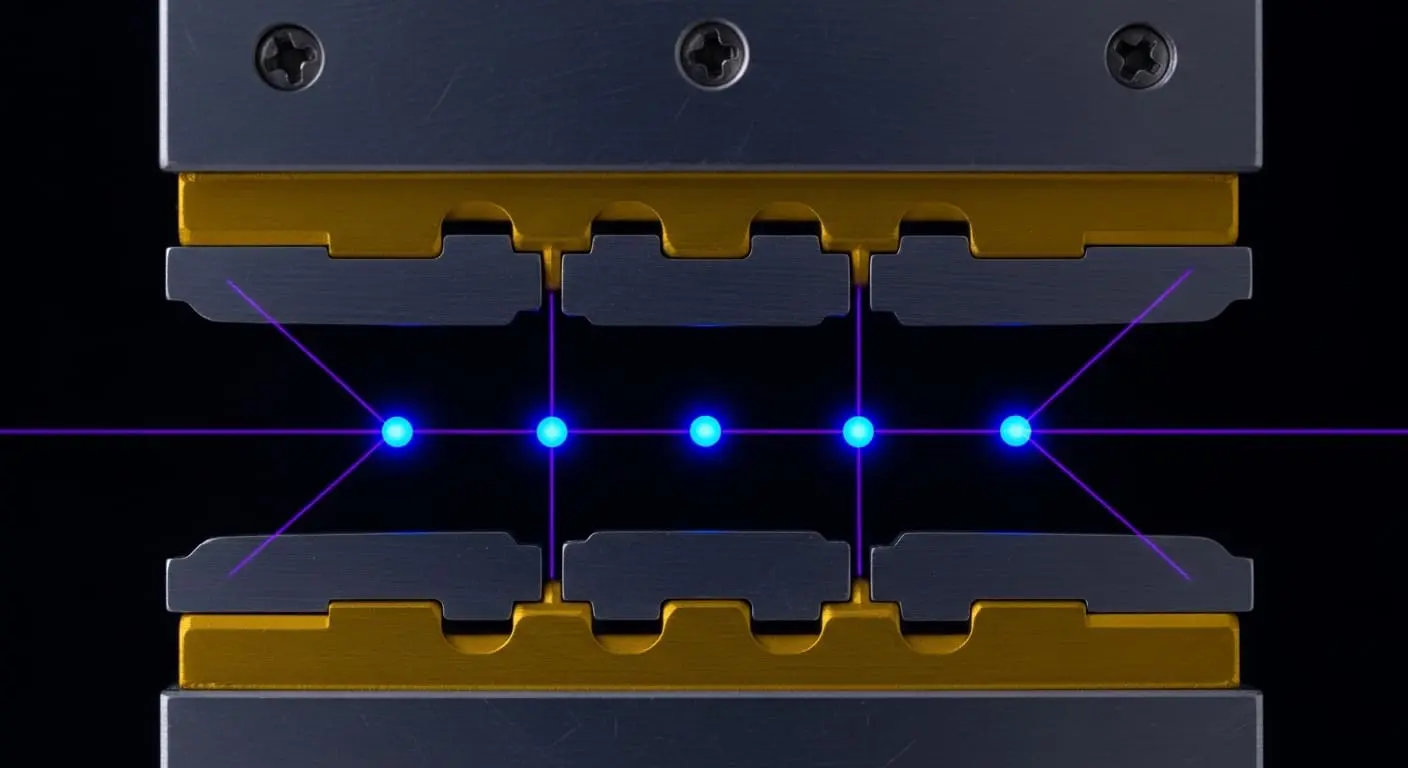
For the first time, researchers at Lawrence Berkeley National Laboratory and the University of California, Berkeley have experimentally observed synchronization between two quantum van der Pol oscillators, a phenomenon theorized for a decade but previously elusive in a quantum system. The team, co-first authors Jiarui Liu and Qiming Wu, achieved this synchronization using a trapped-ion quantum simulator, carefully engineering dissipation to force the oscillators into a coordinated state. Unlike classical synchronization, where individual oscillator phases reveal the effect, this quantum synchronization is revealed primarily through joint readout of both oscillators, according to the researchers. This distinction highlights a fundamental difference in how quantum and classical systems exhibit collective behavior and opens avenues for exploring complex quantum dynamics and potential applications in sensing.
Quantum van der Pol Oscillators in Trapped-Ion Systems
This achievement moves beyond the well-understood realm of classical synchronization and ventures into the complexities of quantum systems, opening new avenues for exploring collective quantum behaviors. The team, co-first authors Jiarui Liu and Qiming Wu and their colleagues at the University of California, Berkeley and collaborating institutions, utilized a meticulously engineered system to observe this delicate quantum phenomenon. The experiment hinged on a trapped-ion quantum simulator, a platform allowing precise control over quantum dynamics through engineered dissipation. Researchers induced synchronization by carefully manipulating the interactions between the two oscillators, effectively forcing them into a coordinated state. Unlike classical oscillators where synchronization manifests as a predictable phase relationship observable through individual measurements, the quantum synchronized state presented a unique challenge. This synchronized state is revealed primarily through joint readout of both oscillators, underscoring the distinctly quantum nature of the observed synchronization.
The significance of this finding extends beyond simply demonstrating quantum synchronization; it lies in the method of observation and the implications for future quantum technologies. The researchers report that they further show the relative phase can be precisely controlled and that the chain of two oscillators can synchronize to an external field, suggesting applications in sensing. This precise control over the relative phase between the oscillators, coupled with their ability to synchronize to an external field, hints at potential applications in quantum metrology and sensing, where enhanced precision is paramount. The team’s approach builds upon previous work in the field, including studies that explored the dynamics of trapped ions and the potential for quantum reservoir engineering.
The researchers acknowledge the challenges of scaling up these experiments to more complex systems, noting that understanding whether quantum features persist becomes increasingly challenging with each added oscillator. They state that their results provide a promising pathway for studying more complex synchronized quantum dynamics beyond two oscillators, where a theoretical treatment becomes increasingly challenging, and it remains to be understood whether genuinely quantum features persist in such cases. The ability to observe and control synchronization in even a simple two-oscillator system represents a crucial step toward unraveling the mysteries of collective quantum behavior and harnessing its potential for future technologies. The team’s work, published in Physics Open Access, establishes a versatile platform for investigating more intricate quantum networks and stimulating the development of advanced applications.
Dissipative Engineering for Quantum Limit-Cycle Dynamics
Beyond simply demonstrating quantum synchronization, this experimental realization opens avenues for exploring the control and manipulation of quantum systems through engineered dissipation. Previous attempts at achieving quantum synchronization often relied on direct coupling between oscillators, a method proving difficult to scale and control with the precision required for observing limit-cycle dynamics. This work differs by utilizing a trapped-ion quantum simulator to introduce dissipation, effectively sculpting the quantum state towards synchronization. The synchronized state is encoded in a fixed relative phase between the oscillators that is inaccessible to individual measurements and revealed primarily through joint readout of both oscillators, in stark contrast to the system in the classical limit where synchronization can be observed via individual phase measurements. This reliance on correlated measurements presents a significant challenge for experimental verification, requiring precise and simultaneous observation of both oscillators to confirm synchronization.
Synchronized Relative Phase and Joint Readout Methods
This accomplishment addresses a challenge that has lingered in theoretical investigations for a decade; while synchronization is commonplace in classical systems, such as metronomes clicking in unison, demonstrating it within the quantum realm has proven remarkably difficult. Crucially, the synchronized state is revealed primarily through joint readout of both oscillators, in stark contrast to the classical limit where synchronization can be observed via individual measurements. The researchers engineered dissipation, effectively introducing controlled energy loss, within the trapped-ion system to force the oscillators into this synchronized state, a technique that differs significantly from previous attempts. The synchronized state is encoded in a fixed relative phase between the oscillators that is inaccessible to individual measurements. Understanding whether genuinely quantum features persist in larger, more complex networks remains an open question, and this platform offers a means to explore these uncharted territories.
Applications in Quantum Sensing and Complex Networks
Beyond demonstrating a fundamental quantum phenomenon, the ability to synchronize these van der Pol oscillators opens avenues for advancements in quantum sensing technologies. Unlike classical sensors relying on individual oscillator measurements, this quantum approach leverages the correlated nature of the synchronized system, potentially surpassing classical limits in precision. The method of revealing synchronization, primarily through joint readout of both oscillators, is not merely a detection challenge, but a feature that could be exploited for novel sensing schemes. This reliance on correlated measurements suggests the possibility of designing sensors that are inherently resistant to certain types of noise, as the signal is encoded in the relationship between the oscillators rather than their individual states. The platform used, a trapped-ion quantum simulator, provides a highly controllable environment for tailoring the oscillators’ properties, allowing for optimization of sensor performance for specific applications.
The implications extend beyond single-sensor applications, hinting at the possibility of constructing complex quantum networks for distributed sensing. However, scaling up these experiments presents significant hurdles, as understanding whether genuinely quantum features persist becomes increasingly challenging with larger networks. Therefore, the team’s work represents not only a demonstration of a quantum phenomenon but also a crucial step towards realizing the potential of synchronized quantum networks for advanced sensing and information processing.